

Venture capital investors are increasingly turning to pre-IPO deals, which allow them to recover their investments more quickly, amid concerns that startups have been overvalued from the earliest stages of funding.
Investment recovery has become more difficult, with shares of 47 of the 50 companies that went public this year trading below their IPO prices. Investment banking industry officials warned that it could take a long time for the bubble to deflate, raising concerns about a slowdown in corporate growth.
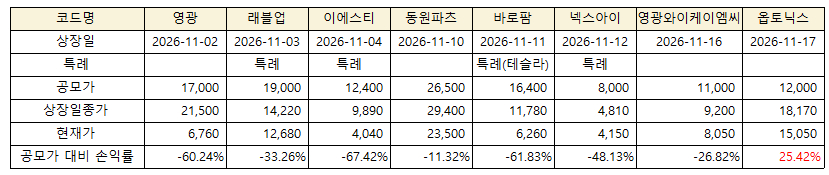
According to Korea Exchange on Wednesday, only three out of the 50th companies listed this year were trading above their IPO prices based on the closing price that day: Injeonia Therapeutics (Reg.S) (93.33% return compared to IPO price), T&N Korea (10.13%), and Optonics (25.42%). Among these, Optonics, which listed on the 17th, showed a brief surge before falling by over 17% that day, approaching its IPO price.
Twenty-six companies, more than half of the total, saw their closing prices drop by more than 50% below their IPO prices. The maximum decline exceeded 80%. Peace Peace Studio (-84.09%), StradVision (-82.54%), and Hanpass (-81.95%) recorded the largest drops in that order.
Companies listed under the technology exemption are no exception. Four companies entered the KOSDAQ through technology exemption listings this month, all of which are trading below their IPO prices. Ravelup, which listed on the 3rd, fell by 33.26% from its IPO price of 19,000 won. YST (-67.42%), which listed on the 4th, Baro Farm (-61.83%), which listed on the 11th, and Nexi (-48.13%), which listed on the 12th, also fell significantly from their IPO prices.
The financial investment industry views this as a result of some investors quickly exiting (recovering funds) after listing. On the other hand, unrealized losses are accumulating in the accounts of institutional investors who pledged not to recover their funds for a long period and retail shareholders.
Some in the industry believe that high corporate valuations from the early investment stage have caused IPO prices to exceed actual value. Criticism also arises that investment firms focus solely on recovering funds after an initial public offering (IPO) to generate profits, rather than acting as partners supporting corporate growth. This trend of capital recovery is expected to continue for the time being.
In fact, early-stage investment units have grown larger than in previous years. Sumbit AI raised 12 billion won through Series A investments from SV Investment, Kiwoom Investment, iM Investment Partners, and Altoros Ventures on the 17th.
Including research and development (R&D) funds from the Ministry of SMEs and Startups's Scale-up TIPS program, it secured a total of 15 billion won. In early this month, Mubin, an AI (artificial intelligence) company specializing in three-dimensional motion data based on LiDAR, also received 10 billion won in Series A investment from IMM Investment, Voyager Ventures, and others.
This is a higher level than Krafton's initial investments, which raised 4.3 trillion won through its IPO to enter the KOSPI. Krafton (then Bluehole) raised 8.5 billion won from Altoros Ventures in its Series A stage in 2009. Krafton's Series B and Series C investment amounts were 18 billion won and 19.1 billion won, respectively.
In the market, voices are emerging that measures are needed as institutional investors become reluctant to invest due to high early-stage corporate valuations driven by AI themes.
An official from the IB industry said, "Recent Series A fundraising units have risen to 10-20 billion won, Series B to 30-50 billion won, and Series C to 70-100 billion won, increasing the burden, but capital recovery is uncertain, making it difficult to find investment targets."
The official added, "More institutional investors are inquiring about pre-IPO deals with quick exits or stop-loss selling their portfolios, but they expect it will take several years for the bubble to burst even if existing investments are pushed out."

 in STOCK
