

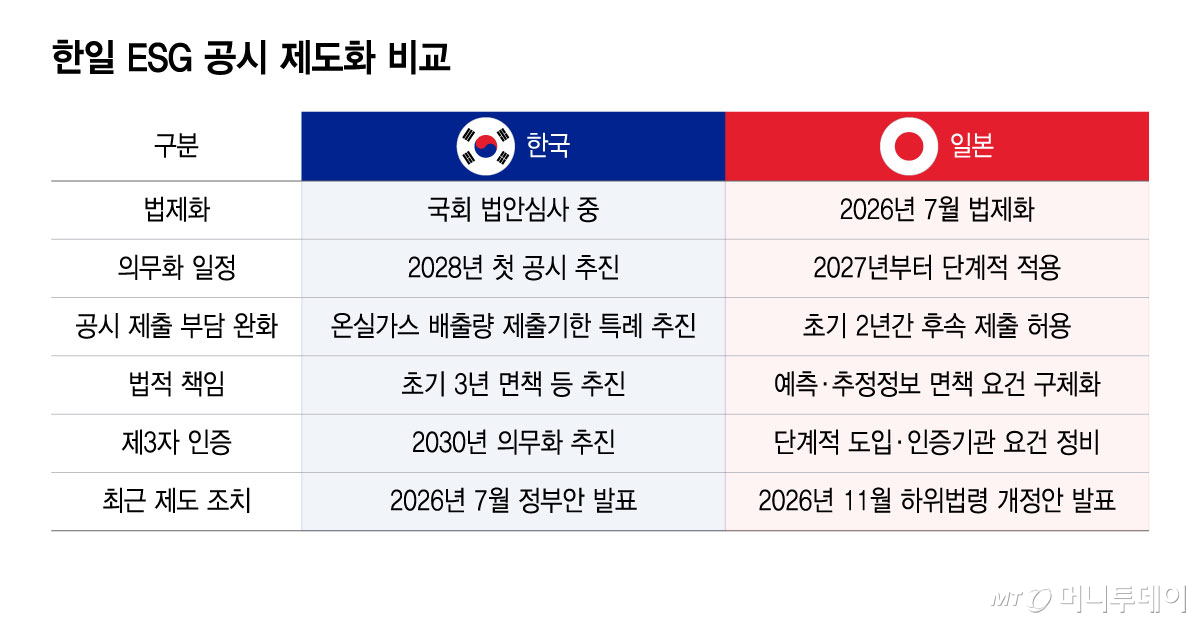
Amid diverging views on mandatory ESG (Environmental, Social, and Governance) disclosure that have clouded South Korea's legislative schedule, Japan is accelerating follow-up measures to reduce corporate burden following its legalization. The approach involves specifying details such as disclosure timing, liability exemption requirements, and certification body qualifications after establishing the principle of mandating disclosure. It is pointed out that South Korea must also move beyond the debate on mandatory implementation to establish both a disclosure method that companies can manage and liability standards for investor protection.
According to the financial investment industry on the 22nd, Japan's Financial Services Agency announced a revised sub-ordinance of the Financial Instruments and Exchange Act regarding sustainability information disclosure and third-party certification on the 13th. This follows the passage of the relevant law by Japan's National Assembly on July 15 and precedes its implementation in April next year. The draft revision, currently undergoing public consultation, includes measures to alleviate corporate disclosure burdens while ensuring information reliability.
First, flexibility was granted regarding disclosure timing. For the initial two years of mandatory implementation, companies are permitted to submit sustainability information later than financial information, and special provisions were established for extending business report submission deadlines. South Korea is also pushing for a special provision on the submission deadline for greenhouse gas emissions, but disagreements continue over disclosure timing and scope.
Legal liability was also differentiated based on the nature of the information. Civil liability for false statements is exempted if certain conditions are met regarding future outlooks, estimates, and information received from third parties other than subsidiaries. In exchange, companies are required to disclose the facts and assumptions used in preparing the information, as well as the reasoning process and internal review procedures. Since the scope of liability exemption is a core issue in South Korea, Japan's approach, which uses preparation grounds and review procedures as criteria rather than blanket liability exemptions, is worth referencing.
Watanabe Koro, Chairman of the Japan ESG Association, recently assessed on social media that "the focus of responsibility is shifting from conclusions to the reasoning process." This means that when companies present future outlooks, it has become more important what grounds they used for their forecasts and how they reviewed them, rather than whether the predictions turned out to be correct. He pointed out that "the purpose of records should lie in updating hypotheses, not just in inspection." The intent is that companies must not limit themselves to formal document creation for liability exemption but must revise and supplement existing outlooks and judgment grounds based on new information.
Japan has also specified the qualifications for certification bodies. Requirements include a minimum capital of 20 million yen (approximately 180 million won), at least three years of work experience for responsible personnel, and conflict-of-interest prevention systems. In South Korea, where there are differences in each bill proposed by lawmakers regarding registration requirements and sanction levels for certification bodies, detailed standards are needed to ensure the reliability of verification.
In this way, Japan has developed its previously presented principles of phased implementation and liability exemption into specific sub-ordinance drafts. In particular, it differentiated liability based on the nature of disclosure information and clarified the internal review procedures companies must establish to receive liability exemptions. In South Korea as well, institutional design is required that simultaneously enhances corporate feasibility and investor protection by proceeding with both the principle of mandatory implementation and detailed burden adjustments.
The European Union (EU) has also narrowed the scope of mandatory disclosure targets to reduce corporate burden. This year, it revised the Corporate Sustainability Reporting Directive (CSRD), limiting its application to companies with more than 1,000 employees and annual revenue exceeding 450 million euros (approximately 780 billion won). While Japan placed emphasis on phased implementation and liability adjustment, the EU chose a method of reducing the number of mandatory targets.
A financial investment industry official stated, "The purpose of ESG disclosure is to secure reliable information that allows investors to judge a company's risks and value," adding, "While maintaining the principle of mandatory disclosure, we must balance corporate compliance burden and investor protection by subdividing submission timing, verification levels, and legal liability according to the characteristics of the information."

 in STOCK
