

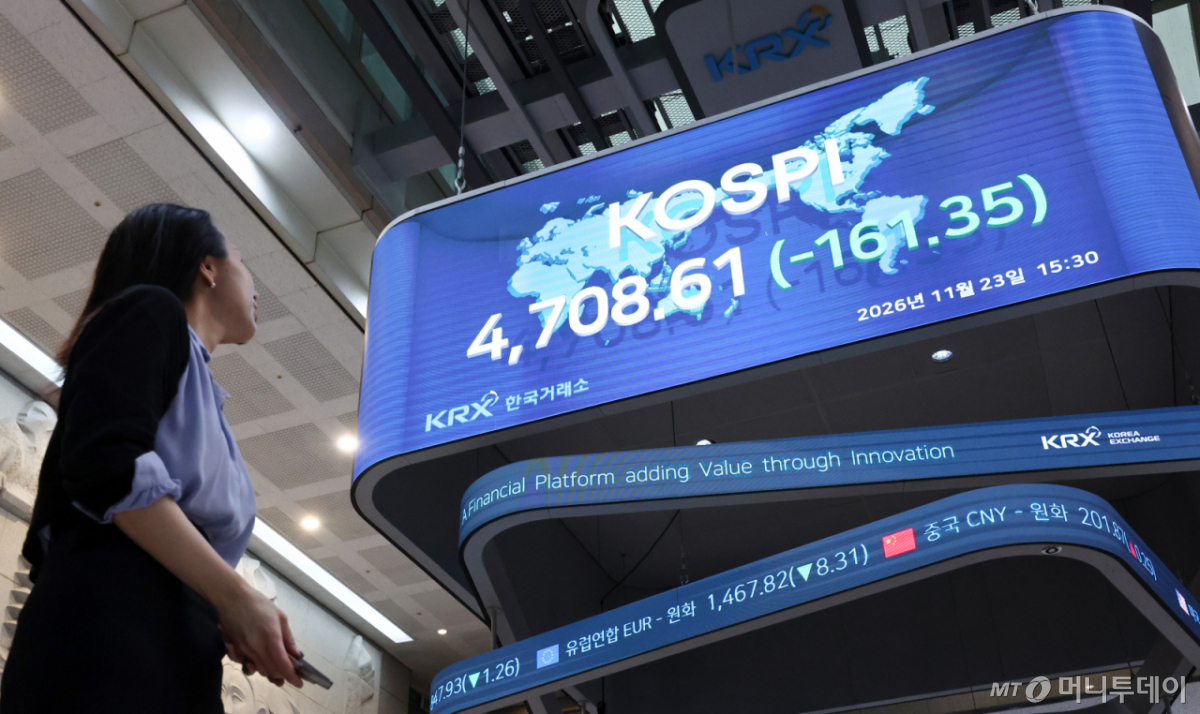
With the KOSPI having nearly halved from its peak, securities analysts are recommending a wait-and-see approach to navigating the downturn.
They advise investors to refrain from making new purchases in hopes of a rebound until the market has clearly bottomed out, while also avoiding panic selling to lock in losses after such a steep decline.
The prevailing view is that the government's securities market stabilization fund may slow the pace of the decline but is unlikely to trigger a sustained rebound.
The KOSPI, which closed at 4,708.54 on the 23rd, has fallen more than 48% from its year-to-date high (9,114.55 on June 22). This is attributed to concerns over AI profitability, combined with the possibility of U.S. interest rate hikes and supply-demand gaps.
Researcher Roh Doong-gil at Shinhan Investment Corp stated, "There is not sufficient reason to rush into expanding new positions at current levels; conversely, aggressive further reduction in exposure, given that valuations have already dropped significantly, could cause investors to miss the subsequent normalization phase."
Researcher Kim Dae-jun at Korea Investment & Securities also noted, "The recent stock price decline is an irrational plunge reflecting excessive fear sentiment rather than damage to fundamentals," adding, "Even if the index fluctuates temporarily, a strategy of holding existing positions is more advantageous than selling at lows, as authorities' stabilization measures are becoming visible." Advice also emerged that investors should secure cash reserves until clear buying entities and a market bottom are confirmed.
While the government is preparing to activate the Stabilization Fund, it has decided to relax the limits on companies' share buybacks for three months. Analysis suggests this will help stabilize market sentiment, as there have been past instances where the mere announcement of deploying the Stabilization Fund led to a stock market rebound. However, many forecast that it will be difficult to reverse the downward trend until confidence in AI profitability is established.
Researcher Jo Byung-hyun at Daol Investment Securities said, "Confidence in AI growth may form only after minimal confirmation of hyperscalers' free cash flow (FCF) and investment sustainability in the first half of next year," adding, "It is reasonable to view that domestic semiconductor stocks' market capitalization share surpassing previous highs will also occur only after confidence in earnings outlooks is confirmed."
Supply-demand gaps are also hindering a rebound. Retail investors, who had supported the stock market with net purchases exceeding 10 trillion won on the KOSPI this year, saw their buying momentum wane as the index fell below the 5,000 mark and losses expanded. Foreign investors made net sales of domestic stocks worth 24 trillion won from January to October this year, influenced by index rebalancing, supply-demand concentration toward large IPOs such as Anthropic, and a stronger U.S. dollar.
Researcher Kim Jae-seung at Hyundai Motor Securities analyzed, "It is not easy to expect low-price buying or a rebound because no clear buying entity is visible to support the lower bound of the index," adding, "Recovering the investment sentiment of retail investors, who have driven net purchases in the domestic stock market, will take time; conversely, retail selling pressure may emerge during any rebound."
Forecasts also suggest that in the worst case, the KOSPI could fall below the 4,000 mark. Researcher Kim Byung-yeon at NH Investment & Securities stated, "The KOSPI could decline to an average of the low 4,000s or even the high 3,000s," adding, "The bottom will form when stabilization policies are implemented." Shinhan Investment Corp also noted that the possibility of downward revisions to next year's KOSPI earnings should be kept in mind. Yuanta Securities lowered its forecast band for the KOSPI next year from 6,000 to 10,000 to 4,000 to 7,300, while iM Securities set the lower bound at 4,300.
The FOMC (Federal Open Market Committee) meeting next month is cited as a potential turning point for a rebound. Researcher Kim Jae-seung explained, "However, we judge the timing when the FOMC on the 9th of next month and major index inclusion-related rebalancing are completed to be an important turning point for easing foreign selling pressure," adding, "The resumption of large-scale share buybacks by Samsung Electronics in early next year will also be a significant factor changing supply and demand in the domestic stock market."

 in STOCK
