

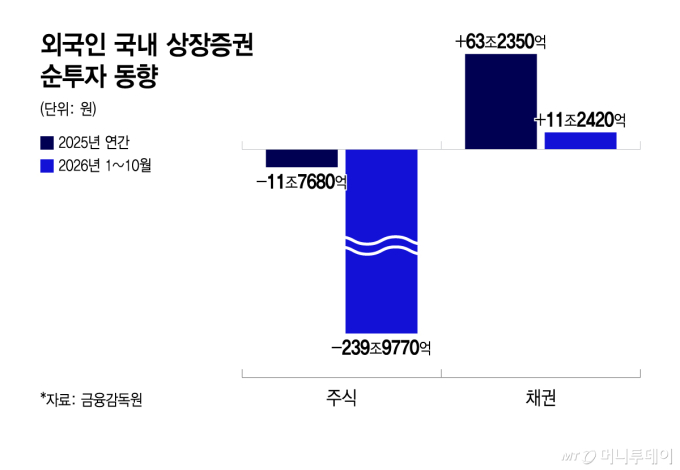
While foreigners have dumped 240 trillion won worth of domestic stocks this year, the cash reserves of retail investors who absorbed those sales are running dry. Although the government has unveiled its securities market stabilization fund (stabilization fund) card, the committed amount is only one-22nd of the foreign selling volume. In a market where buyers have vanished, brokerage firms advise against hasty buying or selling and recommend waiting and watching.
On the 23rd, the KOSPI closed at 4,708.54, falling more than 48% from its year-to-date high (9,114.55 on June 22). According to the Financial Supervisory Service, foreigners made net sales of 239.977 trillion won in domestic listed stocks from January through October this year. August was the only month with net purchases. Selling was concentrated in large semiconductor stocks; among foreign net sales in the KOSPI from the start of the year until the 17th, SK hynix and Samsung Electronics accounted for 85.5%.
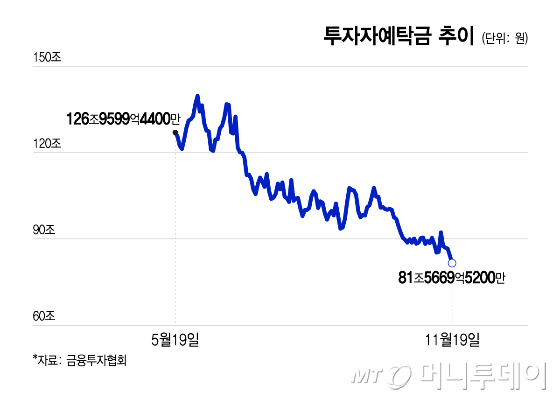
Retail investors were the ones who absorbed the foreign selling. This year, retail investors made net purchases of approximately 100 trillion won in the KOSPI cash market and approximately 77 trillion won in the ETF (Exchange-Traded Fund) market. However, their investment capacity is shrinking rapidly. According to the Korea Financial Investment Association, investor deposits stood at 81.567 trillion won on the 19th, a drop of more than 40% from the all-time high recorded last June (139.6948 trillion won). The outstanding balance of KOSPI margin trading loans also decreased by nearly 10 trillion won to 20.2069 trillion won compared with the end of June. Idle funds are shifting into parking-type ETFs and U.S. stocks. Kim, a retail investor in his 40s, said, “I would like to buy more if the KOSPI rebounds, but I have no money.”
Lee Hyoung-il, Deputy Prime Minister and Minister of the Ministry of Economy and Finance, announced on that day that preparations for activating the stabilization fund had begun, stating, “There are contingency plans already in place (in addition to the stabilization fund).” However, the 10.76 trillion won committed to the stabilization fund is only 0.28% of the KOSPI market capitalization.
It is comparable to the amount foreigners net sold over five days from the 2nd to the 6th of this month. A researcher at a major brokerage firm said, “The absolute volume may not be enough to impact the market, but the announcement of preparations can serve as a psychological defense,” adding, “Ultimately, for foreign investors to return in a meaningful way, doubts regarding AI (artificial intelligence) cyclical financing, which is causing the decline in U.S. tech stocks, must be resolved.”
The securities industry recommends waiting and watching for the time being. Roh Dong-gil, a researcher at Shinhan Investment, said, “There are not sufficient reasons to rush expanding new positions at current levels, and conversely, aggressive further reduction of positions could cause investors to miss the future normalization phase given that valuations have already dropped significantly.”
Kim Dae-jun, a researcher at Korea Investment & Securities, also stated, “Even if the index fluctuates temporarily, as authorities’ stabilization measures are becoming visible, a strategy of holding existing positions is more advantageous than selling at lows.” Forecasts also suggest that in the worst case, the KOSPI could fall below the 4,000 mark. Yuanta Securities lowered its KOSPI forecast band for next year from 6,000 to 10,000 to 4,000 to 7,300.
A burden is also that retail investors may dump stocks aiming to recover their principal even if the market rebounds.
Kim Jae-seung, a researcher at Hyundai Motor Securities, analyzed, “There is no clear buying subject visible to support the lower bound of the index, making low-price buying and rebound expectations difficult,” adding, “It will take time for the investment sentiment of retail investors, who have driven net purchases in the domestic stock market, to recover, and conversely, retail selling may emerge during a rebound.”
He pointed to the timing when the FOMC (Federal Open Market Committee) meeting on December 9 and major index rebalancing are completed, as well as the resumption of Samsung Electronics’ share buyback in early next year, as turning points for supply and demand changes.

 in STOCK

