

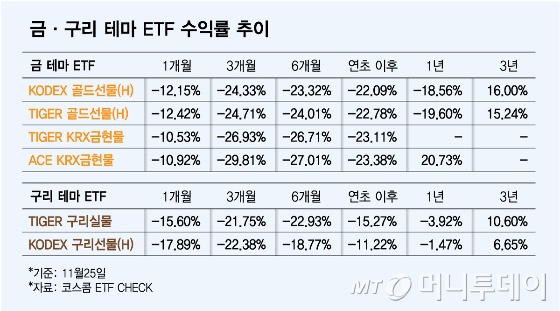
Gold and copper prices have fallen in tandem, dragging down returns on related exchange-traded funds (ETFs). However, investor sentiment toward the two metals has diverged. Gold ETFs are attracting bargain-hunting money, while copper ETFs are seeing funds flow out.
According to Koscom's ETF Check on Nov. 26, the three-month return on ACE KRX Physical Gold, based on reinvested distributions, stood at minus 27.13 percent as of the previous day. Other gold ETFs, including TIGER KRX Physical Gold (minus 26.93 percent), TIGER Gold Futures (H) (minus 24.71 percent) and KODEX Gold Futures (H) (minus 24.33 percent), also posted losses in the 20 percent range.
ETFs investing in copper, another major commodity, fared similarly. As of the previous day, KODEX Copper Futures (H) and TIGER Physical Copper had posted three-month returns of minus 22.38 percent and minus 21.75 percent, respectively.
Expectations of further U.S. interest rate hikes are cited as a key factor behind the recent decline in commodity prices. "Slower growth in liquidity and a stronger dollar have increased selling pressure across commodity markets," said Park Ju-ran, an analyst at Samsung Securities. "Growing doubts about the AI industry, which has led gains in asset markets, have also raised concerns that an economic slowdown could weaken demand for metals."
Despite similarly weak returns, fund flows moved in opposite directions. A total of 74.8 billion won flowed into seven gold-themed ETFs over the past three months, while 21.1 billion won flowed out of two copper-themed ETFs.
Gold is still considered attractive as a medium- to long-term investment, partly because central banks, major buyers of the metal, are increasing their purchases. Investors also appear to be taking advantage of lower prices to buy gold.
According to Samsung Futures, estimates by the World Gold Council (WGC) show that net gold purchases by central banks worldwide rose from 58 tons in the first quarter to 296 tons in the second quarter and 321 tons in the third quarter. The third-quarter figure was the highest since the fourth quarter of 2024.
Copper, meanwhile, has come under pressure from growing doubts about the growth prospects of the AI industry, which had helped drive prices higher. Demand for copper from traditional industries such as construction and manufacturing has remained stagnant over the past three years. However, expectations had been widespread that the expansion of AI data centers would boost demand for power grids and drive up copper prices, as the metal is a key material used in power cables.
The outlook shifted after the Democratic Party won decisively in the U.S. midterm elections on a platform that included tighter regulations on data center construction. LS Securities estimated that if concerns over data center construction delays materialize, copper demand in 2029 could be about 450,000 tons lower than previously forecast.
Securities analysts expect gold prices to remain weak for the time being. Samsung Futures forecast an average gold price of $3,800 per ounce next year, 13.6 percent below its projection for this year.
"Interest rates will continue to cap gold prices until June next year, when the end of rate hikes is expected to become clear," said Ok Ji-hoe, a researcher at Samsung Futures. "Gold prices are expected to bottom out toward the end of the second quarter and rebound in the second half as expectations of rate cuts take shape."
Copper is also unlikely to regain upward momentum until uncertainty surrounding AI investment subsides, analysts say. "As price movements have become more closely correlated with financial markets, a recovery in investor sentiment toward the AI industry and U.S. technology stocks, which have supported the optimistic outlook for medium- to long-term demand, is needed for prices to rebound," Park said.

 in STOCK
