

While market attention was focused on the sharp drop in semiconductor stocks, the shipbuilding, defense and nuclear sectors (Jo-Bang-Won), which had driven the stock market alongside semiconductors in the first half of the year, also fell significantly. Although semiconductors remain up more than 30% from the start of the year despite recent declines, nuclear power has fallen below its early-year level, and shipbuilding returns have been cut in half. Analysts say that rather than seeing the entire sector rise together as it did in the first half, investors must now evaluate additional contract possibilities and profitability on a company-by-company basis.
According to Korea Exchange data on the 26th, the KRX Shipbuilding TOP10 index and the KRX K-AI Defense TOP5+ index have fallen by 51.75% and 28.89%, respectively, since the start of the year.
ETFs investing in domestic shipbuilding, defense and nuclear companies also declined. The KODEX Shipbuilding TOP10 and PLUS K-Defense ETFs fell by 50.59% and 42.07%, respectively, since the start of the year. Nuclear-themed products TIGER Korea Nuclear Power and ACE Nuclear TOP10 dropped by 9.75% and 23.60%, respectively, since the start of the year. Narrowing the focus to the last six months, the decline rates for the two nuclear-related products widen to 57.47% and 60.85%, respectively.
In contrast, the KRX Semiconductor Index, which reflects the returns of domestic semiconductor companies, rose by 33.93%, and the KRX Semiconductor TOP 15 index increased by 38.85%. The HANARO Fn K-Semiconductor ETF, a domestic semiconductor ETF, also rose by 66.86% since the start of the year.
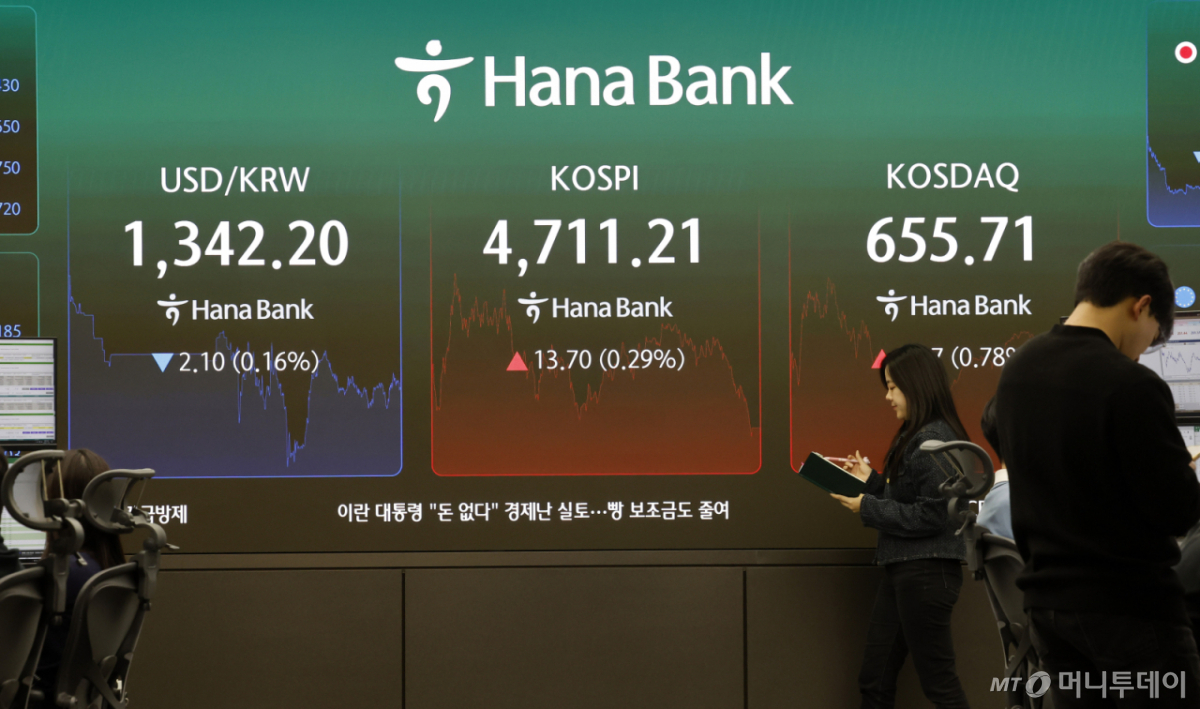
What pushed up shipbuilding, defense and nuclear stock prices in the first half was expectations for overseas orders. However, as large-scale contract signings have slowed in the second half and competition within the sector has intensified, profit forecasts have also been lowered. A strong won is also a burden. The won-dollar exchange rate fell by nearly 100 won from 1,440.10 won at the end of last year to 1,342.7 won on the 25th. Shipbuilding stocks such as HD Hyundai Heavy Industries and HD Hyundai Mipo Dockyard announced in their third-quarter earnings reports that net income decreased due to increased foreign currency-related losses.
JP Morgan advised in a report on Korean industrial materials strategy released on the same day that it is time to selectively invest in individual stocks based on profit forecasts, valuation, and order possibilities, even for promising sectors. JP Morgan named HD Hyundai Heavy Industries as its top overweight pick in the shipbuilding sector, LIG Nex1 and Hanwha Aerospace in the defense sector, and Doosan Enerbility in the nuclear power sector. Conversely, it assigned a neutral investment rating to Hanwha Ocean in shipbuilding, Korea Aerospace Industries (KAI) in defense, and Korea Electric Power Corporation Technology in nuclear power.
HD Hyundai Heavy Industries, recommended in the shipbuilding sector, is estimated to have an average annual operating profit growth rate of around 35% from 2025 to 2028, making it the most distinct growth trajectory among shipbuilders. However, the report pointed out that the allocation and approval of the U.S. Navy budget and merchant vessel orders in the first half of next year are variables.
Hanwha Aerospace and LIG Nex1, recommended in the defense sector, drew attention for their potential to secure additional orders in the Middle East. JP Morgan noted that announcements of defense budgets by Middle Eastern countries serve as clues to gauge new order timing, and that fourth-quarter earnings will allow verification of the profitability of export volumes and adherence to delivery schedules.
Doosan Enerbility, recommended in the nuclear power sector, is evaluated as having expectations for orders in both large-scale nuclear reactors and Small Modular Reactors (SMRs). JP Morgan viewed demand for large-scale nuclear reactors and SMRs as supporting the long-term growth of the nuclear power sector. It cited whether U.S. nuclear operators are pre-ordering equipment that takes a long time to manufacture and deliver as an indicator to gauge project progress.

 in STOCK
