

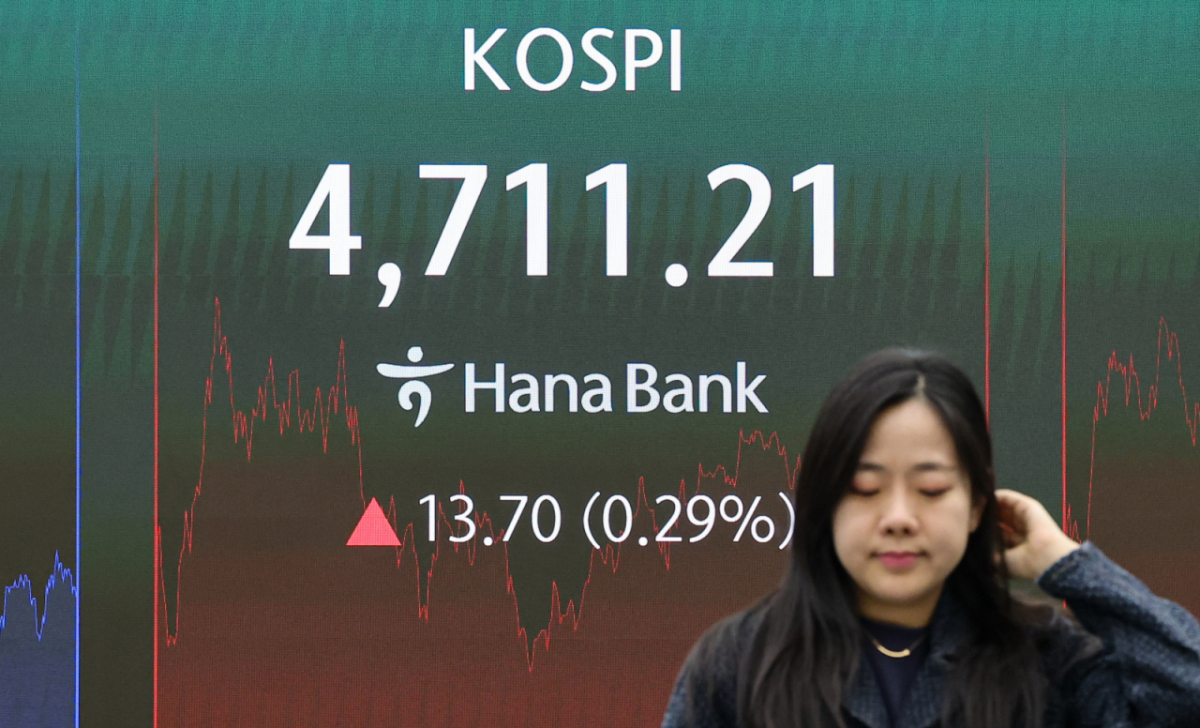
The KOSPI rose more than 2 percent intraday on Nov. 26, when the Bank of Korea raised its benchmark interest rate to 3.25 percent, but gave up most of its gains to close up about 0.3 percent. Bargain hunting following the previous day's sharp decline and smaller losses among U.S. semiconductor stocks fueled the early rebound.
However, the Bank of Korea Monetary Policy Board's higher projection for the upper end of the policy rate range weighed on sentiment. On Nov. 27, Samsung Electronics' large dividend payout and the U.S. Black Friday shopping event, which kicks off the year-end discount season on the day after Thanksgiving, are expected to be key market factors.
The KOSPI index closed at 4,711.21 on this day, up 13.70 points (0.29%) from the previous trading session. The KOSPI opened at 4,745.10, which was 47.59 points (1.01%) higher, and rose to 4,817.77, up 120.26 points (2.56%), during the morning session, but subsequently narrowed its gains. Institutional investors made net purchases of 750.8 billion won, while retail and foreign investors made net sales of 1 trillion 43.8 billion won and 113.7 billion won, respectively.
Samsung Electronics closed at 171,300 won, up 0.35%. SK hynix ended trading at 1,053,000 won, up 2.23%. Among other top market capitalization stocks, Samsung Electro-Mechanics (3.84%), SK Square (2.68%), and Samsung Electronics Preferred Shares (1.63%) showed strength. Conversely, Hyundai Motor (-3.90%), LG Energy Solution (-2.11%), Samsung Biologics Logistics (-1.91%), KB Financial Group (-1.89%), and Celltrion (-0.69%) declined.
U.S. semiconductor stocks recovered a significant portion of their intraday losses overnight, leading to inflows of buying into related domestic stocks in the early trading session. On the 25th (local time), the Philadelphia Semiconductor Index fell by nearly 8% in the early session but narrowed its decline to 57.64 points (0.65%) to close at 8,774.86. However, NVIDIA fell 3.91%, continuing the weakness among major semiconductor stocks.
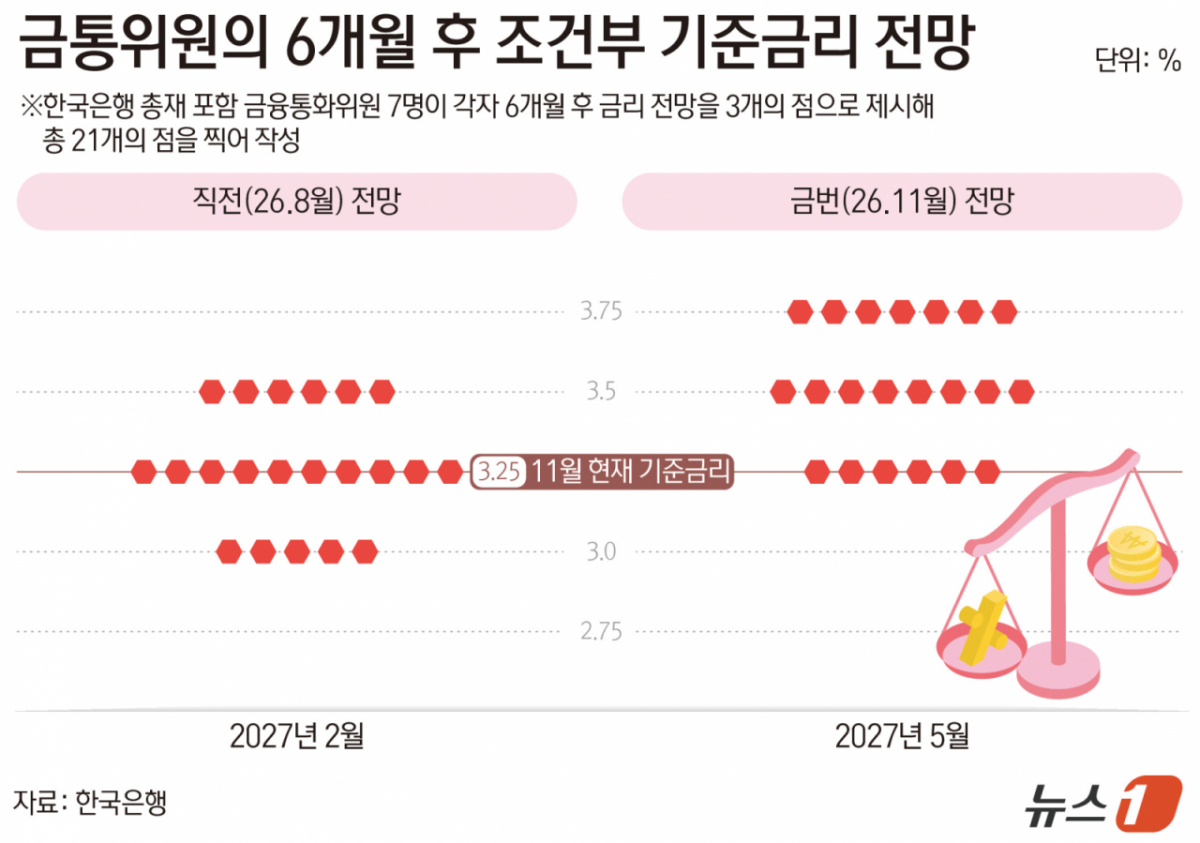
The early-session upward trend did not last long. The Bank of Korea Monetary Policy Board decided on this day to raise the base rate by 25bpercentage points from 3.00% per annum to 3.25%. This was a hike for the first time in three months, following consecutive hikes in July and August and a hold in October. Five of the seven Monetary Policy Board members voted in favor of this hike, while Commissioners Hwang Geon-il and Lee Su-hyang expressed opinions in favor of a hold.
The market is paying attention to the remaining room for rate hikes until the peak base rate. In the Monetary Policy Board members' conditional interest rate forecasts six months later (dot plot), out of 21 total dots, seven were at 3.75%, eight at 3.50%, and six at 3.25%. In August last year, there were six dots at 3.50%, ten at 3.25%, and five at 3.00%. The median value rose from 3.25% to 3.50%.
SK Securities analyzed that this Monetary Policy Board result was generally hawkish (preferring monetary tightening).
It explained that while the two minority opinions for a hold and the removal of the word "speed" from "the timing and speed of additional hikes" in the Monetary Policy Direction resolution are dovish factors (preferring monetary easing), the implications of the hawkish factors are more important.
It was explained that the six dots marked at 3.25% were likely mostly placed by the two commissioners who voted for a hold, and it is judged that the majority within the Monetary Policy Board supports additional hikes.
Researcher Won Yu-seung of SK Securities said, "We forecast an additional hike in February 2027 and a final interest rate of 3.50%," adding, "I think market interest rates will rise further after the Monetary Policy Board meeting."
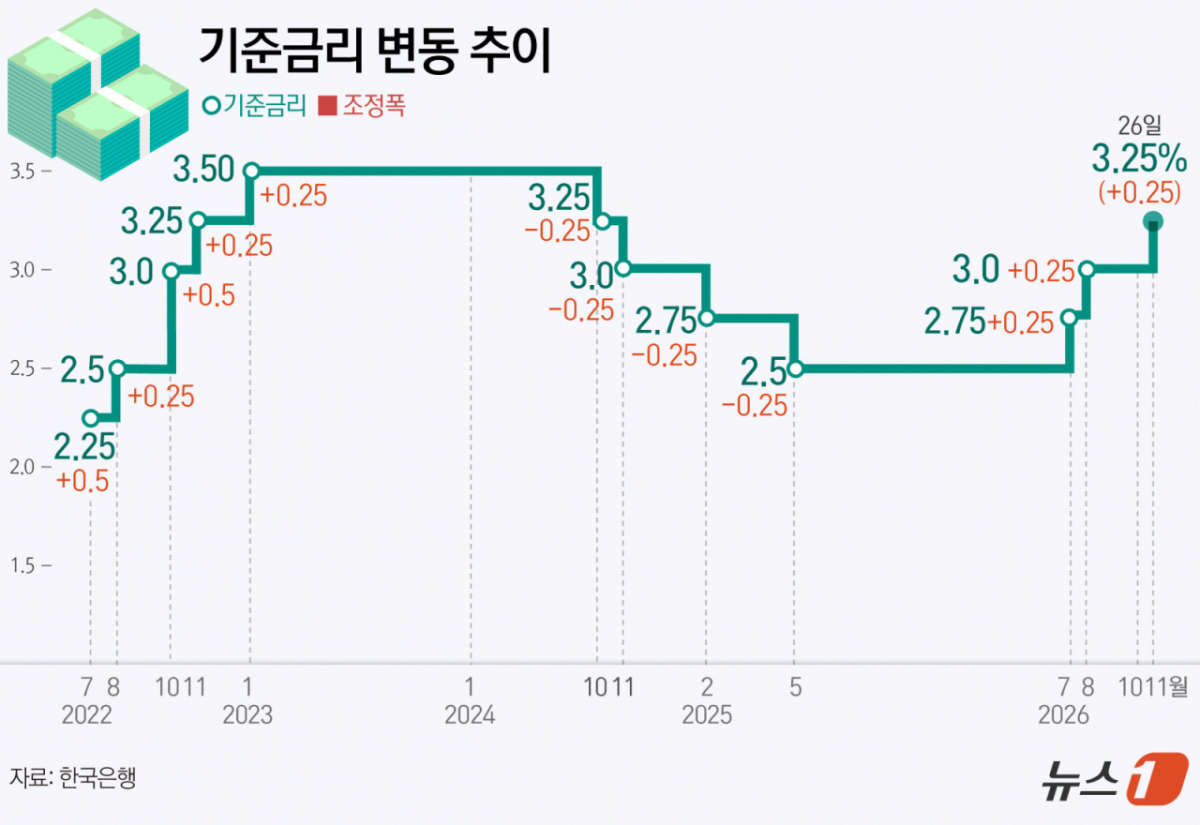
The possibility of hikes exceeding 3.50% is also being discussed. Researcher Kim Myeong-sil of iM Securities said, "Looking at the dot plot, with seven dots at 3.75% and eight at 3.50%, the market seems to interpret it as hawkish," adding, "If next year's growth exceeds 4% and fundamentals are good, I think 3.75% is possible."
On the 27th, Samsung Electronics' quarterly dividend payment of approximately 3 trillion won is scheduled. The market is expected to closely watch whether part of the dividends will lead to domestic stock purchases and whether dollar demand from overseas remittances by foreign shareholders will affect the won-dollar exchange rate.
U.S. Black Friday on Nov. 27 (local time) is also a major variable. Consumer trends during the year-end shopping season provide clues about U.S. household purchasing power and the performance of distribution and consumer goods companies.
Whether consumption remains strong enough to alleviate concerns about an economic slowdown, and whether strong demand heightens caution regarding additional tightening, could influence investor sentiment. The New York stock market was closed on the 26th (local time) for Thanksgiving and will close early at 1 p.m. on the 27th (local time).
Meanwhile, the KOSDAQ closed at 655.71, up 5.07 points (0.78%). Institutional investors made net purchases of 232.6 billion won, while retail and foreign investors made net sales of 135.1 billion won and 106.3 billion won, respectively.
Among top market capitalization stocks, Samchundang Pharm (9.62%), Jusung Engineering (3.39%), HLB (2.65%), Lino Industrial (2.19%), Rainbow Robotics (0.76%), Simmtech (0.69%), and Alteogen (0.41%) rose. Conversely, Ecopro BM (-3.80%), Ecopro (-3.47%), and Robotis (-2.77%) declined.

 in STOCK


