

The government has launched a public-private partnership to build AI (artificial intelligence) data centers with a capacity of 18.4 gigawatts (GW) and foster related industries, aiming to strengthen competitiveness in AI infrastructure. The goal is to develop an AI ecosystem that nurtures upstream and downstream industries—including power, cooling, semiconductors, and cloud—and links them to overseas exports.
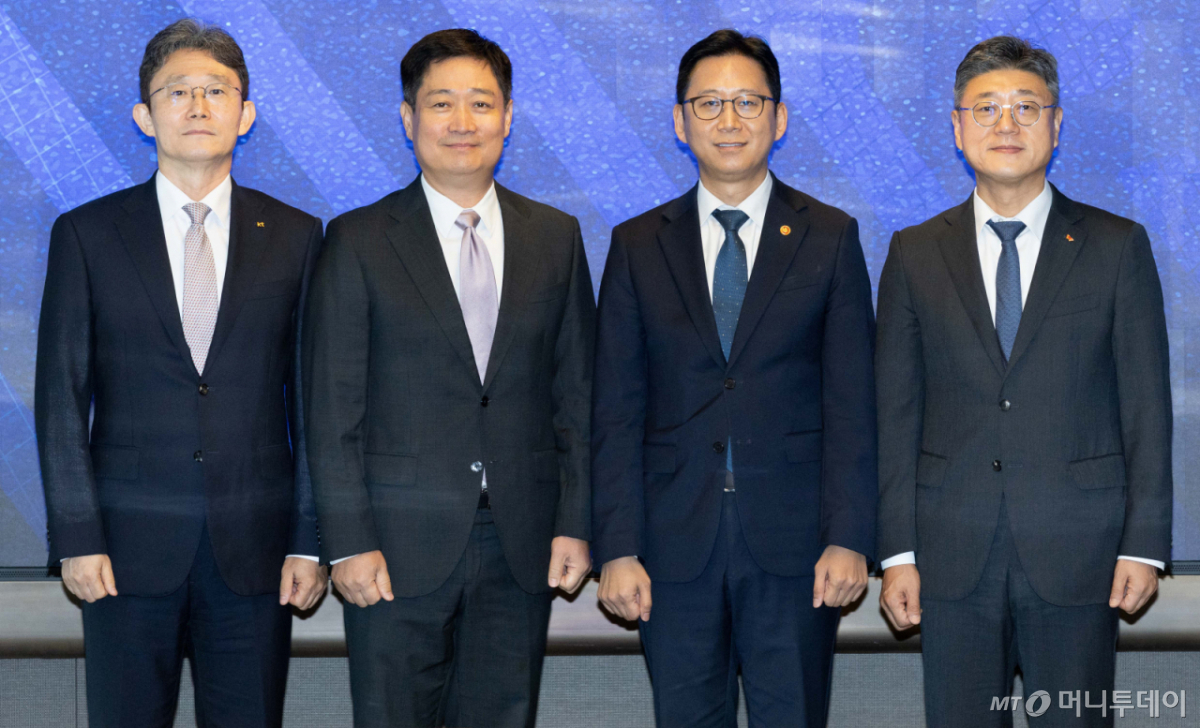
The Ministry of Science and ICT held the launch ceremony for the 'AI Data Center (AIDC) Alliance' on the 29th at Lotte Hotel in Jung-gu, Seoul, with over 400 participants from industry, academia, and research sectors, including representatives from the Ministry of Trade, Industry and Energy, the Financial Services Commission, and the Ministry of Land, Infrastructure and Transport.
The AIDC Alliance is a public-private consultative body established to implement the government's 'National Strategic Industrialization of AI Data Centers' announced last month. It will jointly pursue the construction of 18.4GW-scale AI data centers, foster upstream and downstream industries, and develop AI data center clusters, while discussing regulatory improvements and investment plans.
The alliance will operate under a co-chair system led by the Ministry of Science and ICT and private sector representatives. Jeong Jae-heon, CEO of Korea Information & CommunicationShin Jin-heung-hyeop (Chairman)(SK Telecom), has been appointed as the first private co-chair. Twelve companies from the AI services, cloud, power and facilities, and AI semiconductor sectors will participate: Naver Cloud, Samsung SDS (Samsung 에스디에스), SK Telecom, NHN Cloud, LG Electronics, LG Uplus, KT, Kakao, LS Electric, GS, KTNF, and Furiorsa AI.
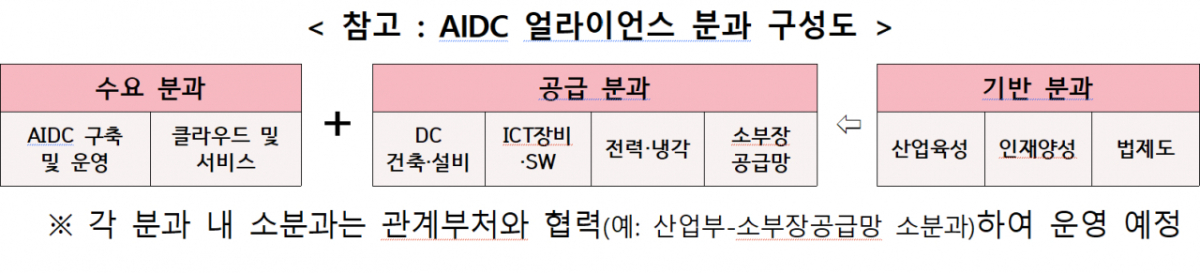
The alliance will operate through three subcommittees—demand, supply, and infrastructure—and an export industrialization task force (TF). The demand subcommittee will promote large-scale demonstrations and secure references based on AI data center construction and operation experience, while fostering collaboration between demand and supply companies. The supply subcommittee will handle localization and standardization of key technologies such as power, cooling, ICT equipment, and software. The infrastructure subcommittee will support legal and regulatory improvements, professional talent development, and ecosystem building.
The government plans to develop strategies for domestic companies to jointly enter the global AI data center market through the export industrialization TF. The initiative aims to identify AI data center package export models that cover design, construction, operation, and cloud services for overseas demand countries such as the UAE.
Co-chair Jeong Jae-heon stated, "The AIDC Alliance marks the beginning of solidarity to lead the global market in the AI era," adding, "It will serve as a cornerstone for South Korea to leap into becoming an indispensable powerhouse in the AI data center industry."
Deputy Prime Minister and Minister of Science and ICT Bae Kyung-hoon said, "The AIDC Alliance will be a key driver for the national strategic industrialization of AI data centers," and pledged, "We will actively support investments in AI data centers to strengthen competitiveness across design, construction, operation, and cloud technologies."
Deputy Commissioner of the Financial Services Commission Kwon Dae-young remarked, "Given that GW-scale AI data center construction requires unprecedented large-scale investment, we will provide active funding support through the National Growth Fund." Industrial Policy Office Director Park Dong-il of the Ministry of Trade, Industry and Energy added, "We will build an AI data center supply chain ecosystem for materials, components, and equipment (소부장) that leads to technological innovation, demonstration projects, and market entry."

 in TECH

