

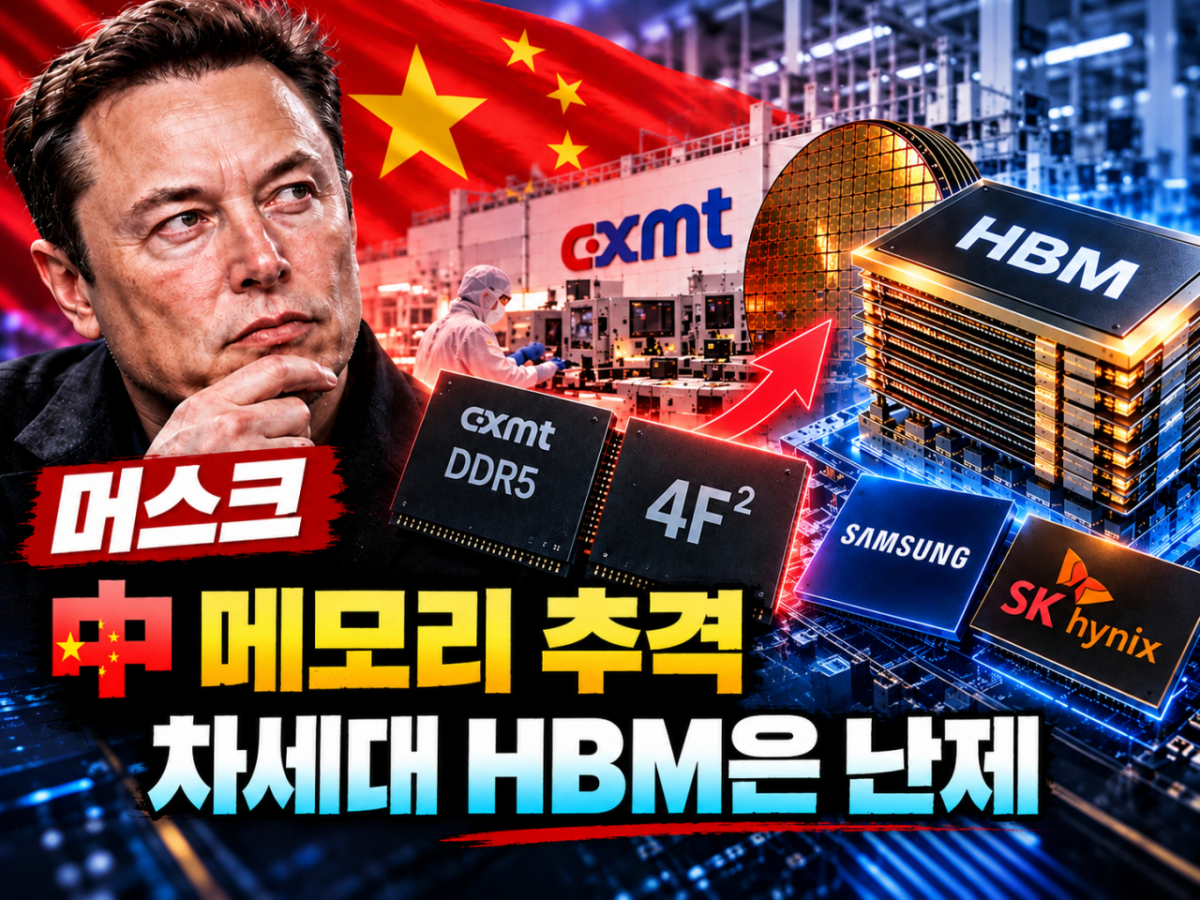
Elon Musk, CEO of Tesla, stated that if China secures memory semiconductor manufacturing technology, it could demonstrate formidable mass production capabilities. However, he assessed that advanced memory fields, such as next-generation high-bandwidth memory (HBM), involve a high degree of technical difficulty.
On the 13th, Musk left a comment to this effect on X (formerly Twitter) in response to a post discussing the technological development and market influence of Chinese memory semiconductor company ChangXin Memory Technologies (CXMT). The post noted that CXMT is developing "4F²" technology, a next-generation DRAM cell structure, and is pushing for entry into the server DDR5 market.
Musk stated, "When China figures out how to manufacture a product, it often has the ability to scale up production better than the rest of the world combined," adding, "We have seen this in the lithium battery and solar power sectors."
While citing SpaceX as a rare case where China's mass production capabilities are not applied, he explained that excluding SpaceX, China accounts for the majority of the weight of payloads transported to orbit.
Regarding the memory semiconductor market, he said, "RAM was still a low-margin commodity product until about three years ago," and added, "Memory may be different, but LP5 and LP6 are designed according to common standards, and it appears China is quickly resolving the related technology." LP5 and LP6 are interpreted as referring to the low-power DRAM specifications LPDDR5 and LPDDR6.
On the other hand, he viewed the next-generation memory field as having high technical barriers. Musk predicted, "It will be more difficult to solve cooling issues while placing SRAM under new HBM architectures and logic semiconductors, or stacking RAM in three dimensions on top of logic."
The 4F² structure that CXMT is pursuing represents the area of a DRAM cell based on the square of the semiconductor's minimum feature size (F). It is drawing attention because it reduces cell area compared to the widely used 6F² structure, thereby increasing integration density. However, technological development and commercialization are separate matters; securing actual competitiveness requires demonstrating yield and production stability.
Musk's remarks are interpreted to mean that while China may rapidly expand its production scale in standardized memory products, technical barriers remain relatively high in next-generation HBM, which requires advanced packaging and thermal management technologies.
From the perspective of domestic memory companies such as Samsung Electronics and SK Hynix, it is necessary to distinguish between China's entry into the commodity memory market and competition in next-generation HBM technology. While China's mass production capabilities could change the competitive landscape, in advanced memory, how quickly technical challenges are resolved is expected to determine competitiveness.

 in TECH
