

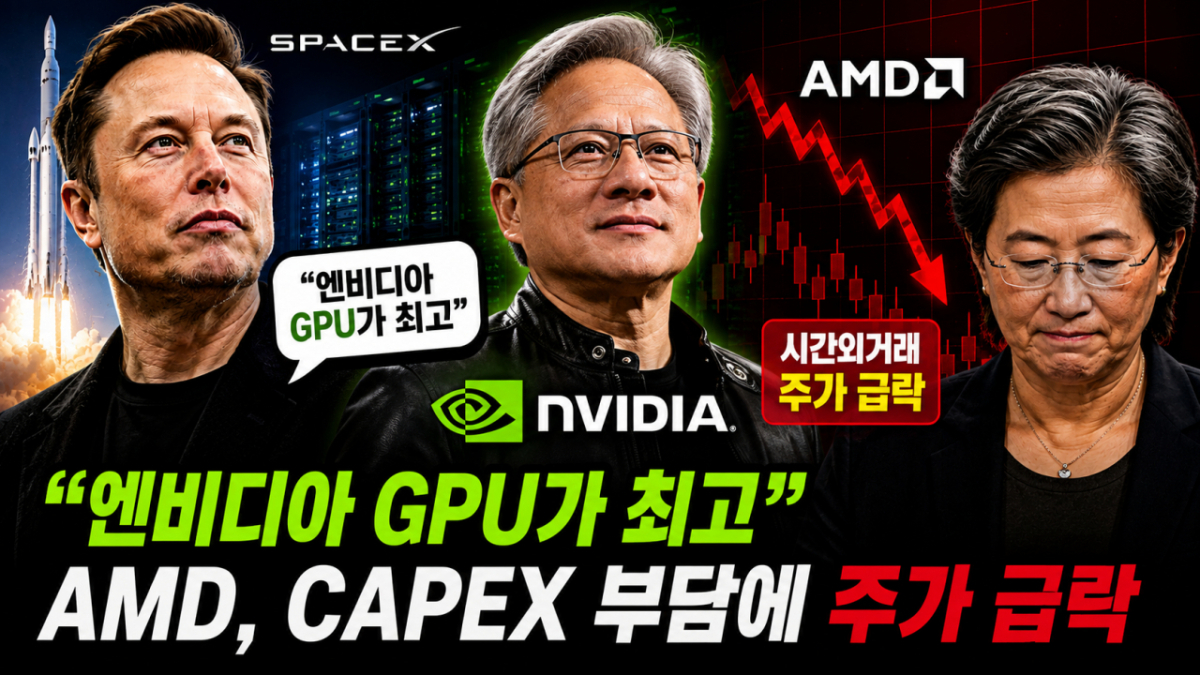
"Nvidia GPUs are the best."
Elon Musk, CEO of Tesla and SpaceX, announced that SpaceX will exclusively use Nvidia GPUs for its AI infrastructure. On the same day, AMD reported second-quarter earnings that exceeded market expectations, but concerns over a larger-than-anticipated CAPEX (capital expenditure) burden caused its stock to fall more than 8% in after-hours trading.
Musk stated on his X platform (formerly Twitter) on the 5th: "SpaceX has decided to use only Nvidia GPUs because Nvidia products are the best." This remark is interpreted as further confirmation of customer trust in Nvidia's performance and CUDA software ecosystem in the AI server market.
On the same day, AMD announced its highest-ever second-quarter earnings.
Second-quarter revenue reached $11.5 billion, a 50% increase year-over-year, surpassing market expectations of $11.28 billion. Driven by growing demand for AI semiconductors, data center segment revenue rose 107% to $6.72 billion, marking the first time it exceeded $6 billion. Adjusted earnings per share (EPS) came in at $1.66, beating market forecasts of $1.62, and third-quarter revenue guidance was set at $13 billion (±$300 million), exceeding the market expectation of $12.5 billion.
Lisa Su, AMD CEO, said, "Data center revenue more than doubled year-over-year, achieving record-breaking sales and profitability," adding, "In the second half of the year, growth in the data center business will accelerate further, driving overall revenue growth and profit expansion."
However, the market focused more on investment scale than earnings results.
AMD's second-quarter CAPEX totaled $808 million, approximately 2.7 times the market expectation of $298 million. While this confirmed AMD's commitment to expanding investments in AI infrastructure and strengthening competitiveness in next-generation AI accelerators, concerns arose that the faster-than-expected investment pace could strain short-term profitability and cash flow, dampening investor sentiment.
As a result, AMD shares fell more than 8% in after-hours trading following the earnings announcement. Despite record-breaking results and positive outlooks, aggressive investment expansion was perceived as a short-term burden.
Musk's public remarks once again highlighted Nvidia's influence in the AI infrastructure market. Meanwhile, although AMD has demonstrated the growth potential of its AI business, how quickly it can convert large-scale investments into revenue has emerged as a key challenge for future corporate valuation and stock performance. As competition in AI semiconductors expands beyond performance to include customer acquisition and investment efficiency, market attention is expected to shift even more toward returns on investment rather than earnings alone.

 in TECH
