

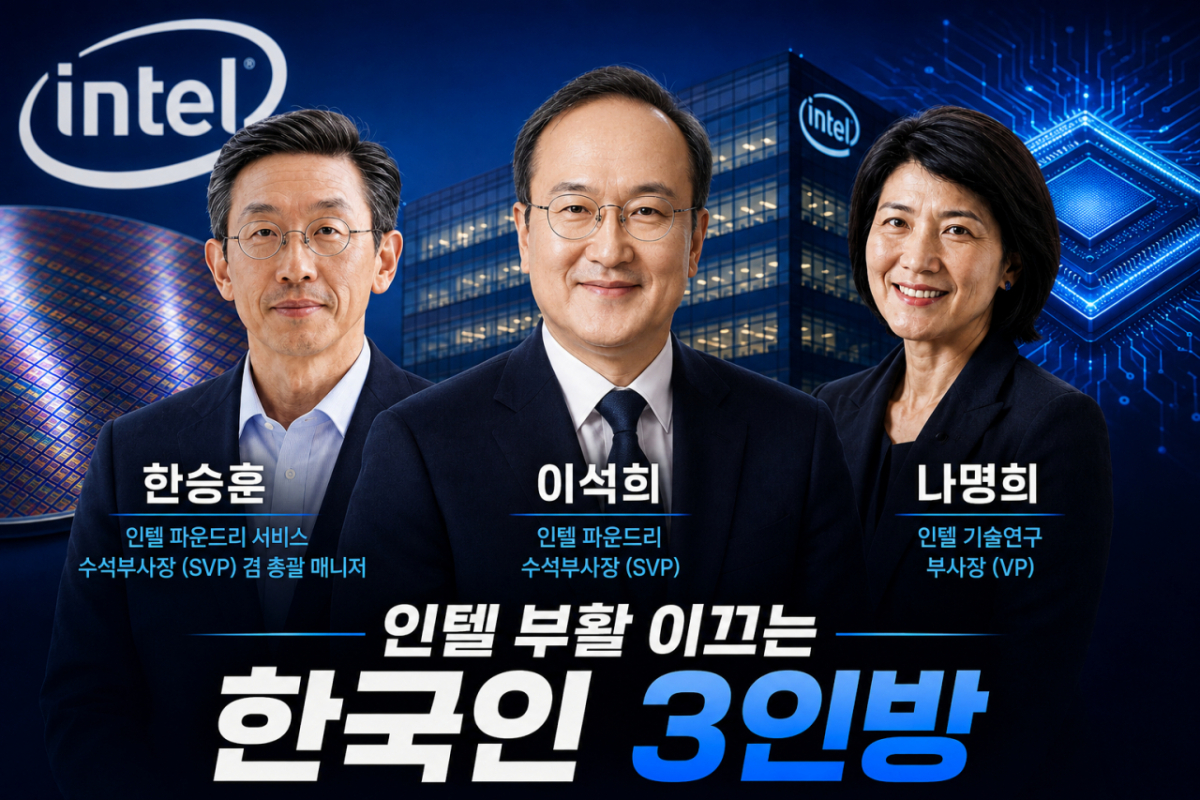
Three Korean semiconductor experts are leading the turnaround of U.S. chipmaker Intel. Having gained experience at Samsung Electronics and SK Hynix, they are now positioned across key areas ranging from next-generation technology R&D to advanced packaging, manufacturing, and foundry (semiconductor contract manufacturing) sales.
According to industry sources on the 10th, the Korean semiconductor experts playing pivotal roles at Intel include Lee Seok-hee, SVP of Foundry; Han Seung-hoon, SVP of Foundry; and Na Myeong-hee, VP of Technology Research.
The most symbolic figure is SVP Lee Seok-hee, who previously served as CEO of SK Hynix. Intel recently brought him on board to oversee advanced packaging, system integration, backend technology development, and manufacturing. He reports directly to Intel CEO Pat Gelsinger. During his tenure as president of SK Hynix, Lee led the acquisition of Intel's NAND business and had also worked as a researcher at Intel for over a decade prior.
The advanced packaging overseen by SVP Lee has emerged as a core technology in the AI semiconductor race. As AI accelerators grow larger, the importance of technologies that connect multiple compute chips and HBM (high-bandwidth memory) into a single package is increasing. Intel holds the 'EMIB' technology, which connects chips by directly inserting silicon bridges onto substrates. Some analysts suggest that compared to TSMC's 'CoWoS-L,' which uses separate interposers, EMIB may offer advantages in cost and scalability for large-scale AI semiconductor packages.
Han Seung-hoon, SVP from Samsung Electronics, is driving the expansion of Intel's foundry customer base. Having worked at Samsung Electronics for nearly 30 years, Han participated in the development of various logic process technologies and recently oversaw Samsung Foundry sales. His role is particularly notable as Intel focuses on securing advanced process technologies and attracting external customers.
Next-generation semiconductor technology research is led by VP Na Myeong-hee. She currently oversees Intel's Technology Research division. Before joining Intel in 2024, she was responsible for future semiconductor technology research at SK Hynix and has also worked as a semiconductor technology expert at imec, the Belgian semiconductor research institution, and IBM.
The three executives are now positioned across Intel's major business areas, from future technology research to manufacturing, advanced packaging, and foundry customer acquisition. As Intel accelerates its foundry business turnaround and strengthens its AI semiconductor competitiveness, talent from Korean semiconductor companies has taken on key roles.
Intel's financial performance is also recovering rapidly. Second-quarter revenue rose 25% year-on-year to $16.1 billion, marking the highest growth rate in 15 years since the third quarter of 2011. Growth was particularly pronounced in data center and AI segments, which saw a 59% increase, while foundry revenues grew by 31%, driven by expanding AI demand.

 in TECH
