

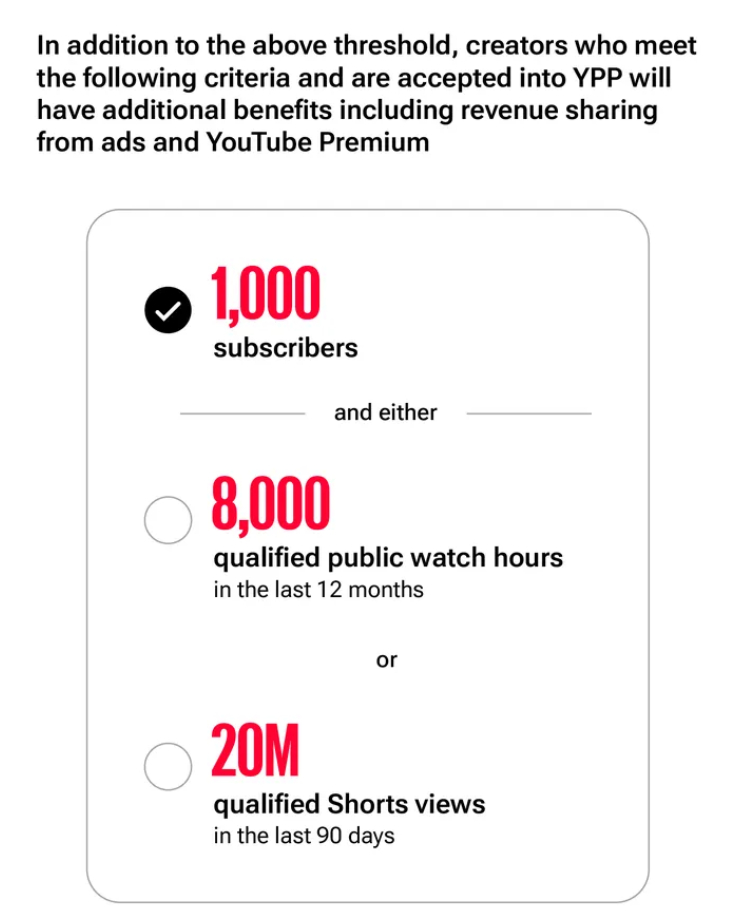
YouTube is doubling the threshold for new creators to generate advertising revenue. It is expected that monetizing early-stage creators with few subscribers and so-called "flash channels" that have a hit video or two in a short period will become more difficult.
According to YouTube's official blog and other sources on the 11th, YouTube will strengthen the eligibility criteria for joining the YouTube Partner Program (YPP) for ad and premium revenue sharing starting February 1, 2027.
Currently, to earn advertising revenue on YouTube, creators must have 1,000 subscribers along with either 4,000 valid public watch hours in the past year or 10 million valid Shorts views in the past 90 days.
Going forward, the watch hour requirement will rise to 8,000 hours and the Shorts view requirement to 20 million views, each doubling. The 1,000-subscriber threshold remains unchanged. This is the first time since 2018 that YouTube has significantly revised its YPP eligibility criteria.
The strengthened criteria will apply only to new channels applying for revenue generation after February next year. Channels already enrolled in YPP and earning advertising revenue will retain their status. The initial YPP enrollment criteria for using fan support and commerce features such as Channel Memberships, Super Chat, and YouTube Shopping will also remain unchanged.
Separate criteria will also be introduced to continue receiving revenue from Shorts. Starting next February, creators must exceed 10 million valid Shorts views in the past 90 days to share in Shorts ads and subscription revenue. Falling short of this threshold will not result in removal from YPP or cessation of revenue for regular videos. If views again exceed 10 million, Shorts revenue sharing will automatically resume.
YouTube explained that this measure is "to provide meaningful rewards to creators who are actively engaged within a rapidly growing creator ecosystem." According to YouTube, more than 3 million creators are currently participating in YPP. Daily average Shorts views have surpassed 20 billion, and daily watch time on YouTube via TV has exceeded 1 billion hours.
Foreign media assessed that this restructuring will place a burden on new and small-scale creators as well as channels centered on Shorts. Until now, even if a single video went viral temporarily, it was possible to meet the monetization threshold; however, going forward, consistent watch time and view counts must be secured. Business Insider explained that YouTube cited the growth of the creator ecosystem and the volatility of Shorts views as the background for this restructuring.
However, YouTube maintains that this is not a measure intended to reduce creators' overall income. It plans to expand the low-cost subscription product "Premium Lite," which has fewer ads, to all countries offering YouTube Premium, and will also introduce new reward programs such as shopping and brand collaborations. The existing ad revenue sharing rates—55% for regular videos and 45% for Shorts—will remain unchanged.
YouTube plans to guide existing YPP members to agree to the revised terms by January 31 next year. The new criteria and revenue-sharing model will take effect starting February 1 next year.

 in TECH
