

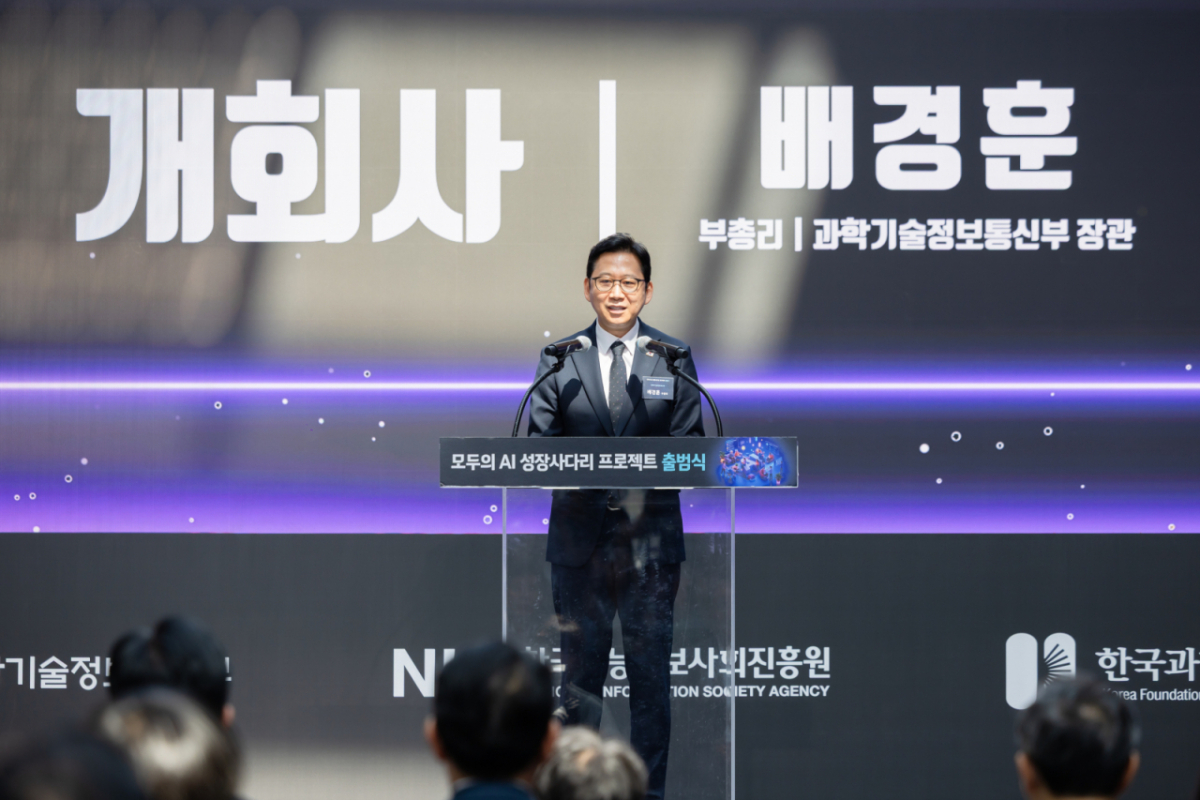
The 'AI for All' project, which aims to develop AI chatbots that anyone can use easily and free of charge, has officially begun. With the goal of launching the core service model by year-end, a consortium of six companies led by domestic mobile carriers, Kakao, and iZsoft has expressed its intention to participate.
On the 18th, the Ministry of Science and ICT and the Korea Information Society Development Institute (nipa) concluded the public recruitment for private enterprises to join the 'Supporting Universal AI Services for All Citizens (AI for All)' project at 5 p.m. today. As a result, a consortium led by SK Telecom, KT, Kakao, iZsoft, Xenon, and MKD participated in the recruitment.
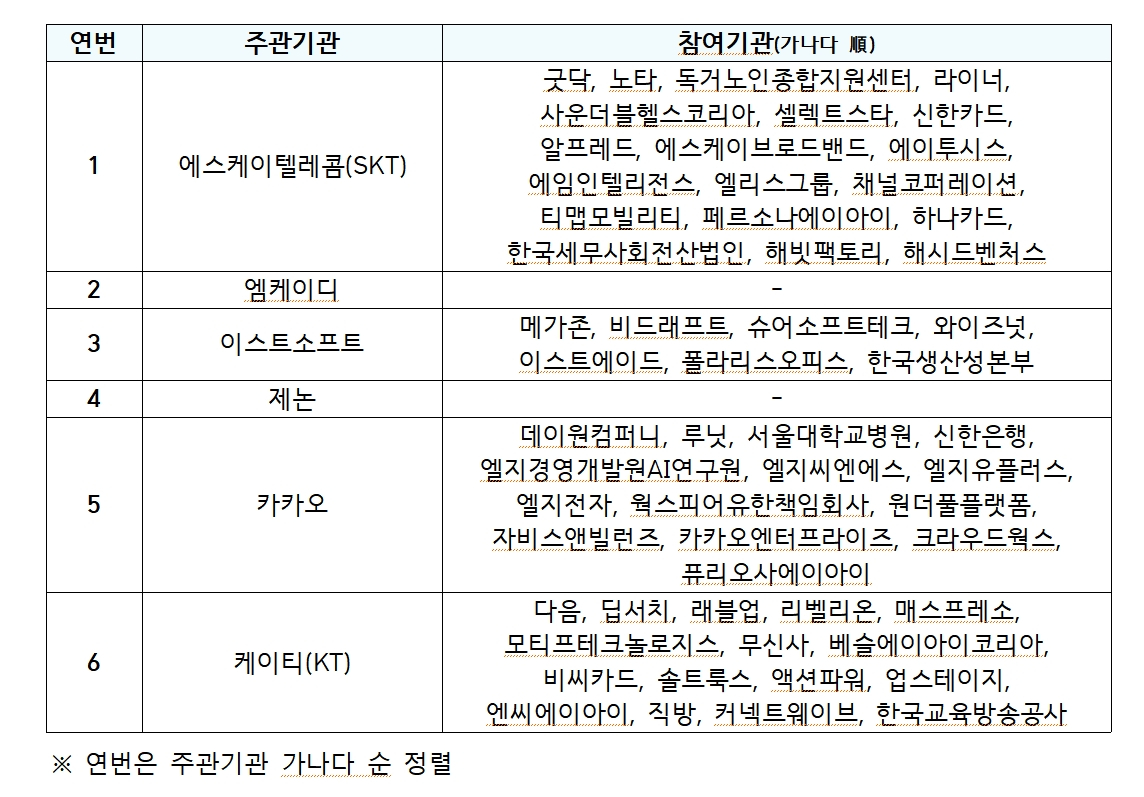
First, SKT formed a consortium with Alice Group, a government GPU data center construction project, and AI agent company Liner.
KT has allied with companies such as Upstage, Daum, Motif Technologies, and NC AI, all of which have experience participating in the first and second rounds of the Dapumo Project, aiming for a turnaround in the AI business.
LG Uplus has partnered with LG AI Research, while Kakao participated as the lead organization. Kakao holds a powerful position as a messenger used by all citizens. Consequently, attention has focused on companies that would partner with Kakao, especially given Naver's absence from the project.
iZsoft formed a consortium with Megazon, WiseNut, Polaris Office, ShureSoftTech, VDraft, Korea Productivity Center, and iZaid.
The 'AI for All' project aims to launch an AI chatbot service within this year. The project's purpose is to enable all citizens to easily and comfortably use generative AI, just like Hangul or arithmetic, so that the digital divide in AI usage does not lead to social and economic inequality. It is also Lee Jae-myung's No. 1 campaign promise.

This year, a universal free AI chatbot for all citizens will be launched and applied to public services. From 2027 onward, the plan is to enhance AI agents and provide one AI agent per person for the entire population.
The Ministry of Science and ICT will select two or three companies in August after conducting written evaluations, presentation assessments, and suitability reviews. Following a beta service launch at the end of September, the main service is scheduled to begin in December.
The government will support a total of 512 B200 GPUs to the selected companies. If two companies are selected, each will receive 256 units; if three companies are selected, the first-ranked company will receive 256 units, while the second and third-ranked companies will each receive 128 units. Participating companies must match the government's support with their own funding.
Project operators must strictly utilize domestic AI models that meet independent foundation model standards for at least 50% of their operations and also use other companies' domestic AI models for at least 30%.
Evaluation criteria are divided into two main categories: written evaluation (100 points: AI competitiveness 40 points, GPU utilization plan 30 points, service development plan 30 points) and presentation evaluation (100 points: user acquisition strategy 50 points, service stability 30 points, ecosystem contribution 20 points).

 in TECH


