

The government has finalized new national AI ethics principles that designate not only companies developing and providing AI but also users of AI as responsible parties for its ethical use. As AI rapidly spreads across industries and daily life, these standards aim to address issues arising during the usage phase—including overreliance, bias, and privacy violations—in addition to safety concerns at the development stage.
On the 24th, the Ministry of Science and ICT and the Korea Institute for Information and Communication Technology Policy (KISDI) announced that they had finalized the "Republic of Korea AI Ethics Principles" following deliberation and approval at the 12th National Science Gi Sul-gwan-gye (Minister) Conference. These principles were established in accordance with Article 27 of the Artificial Intelligence Basic Act and will serve as a foundation for sector-specific AI ethics guidelines and standards in the future.
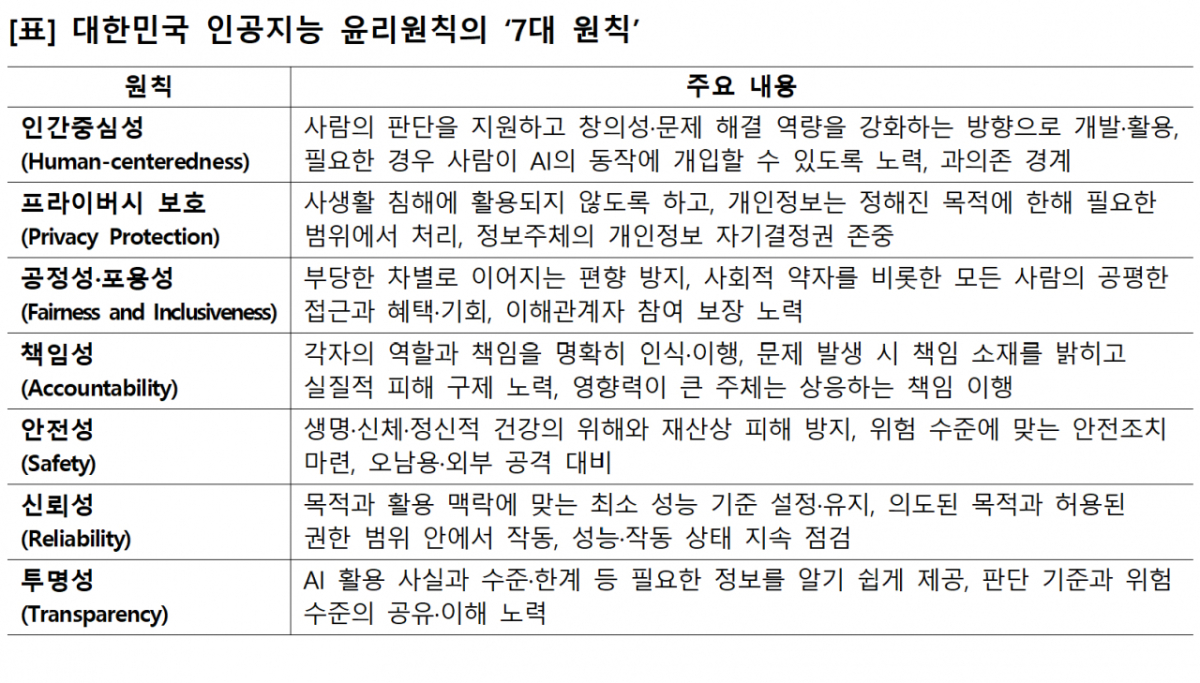
The ethics principles are structured around three core values: human dignity, public good for society, and sustainability for humanity. To realize these values, seven guiding principles have been proposed: human-centricity, privacy protection, fairness and inclusiveness, accountability, safety, reliability, and transparency.
The principle of human-centricity stipulates that AI should be utilized to support human decision-making and allow humans to intervene in AI operations when necessary. It also calls for vigilance against overreliance on AI. The fairness and inclusiveness principle aims to prevent AI bias from leading to unjust discrimination and ensures equal access opportunities for all people, including socially vulnerable groups.
Standards for safety and reliability have also been specified. These include measures to prevent harm to life, physical health, mental well-being, and property caused by AI, as well as preparedness against misuse or external attacks. The principles also require continuous monitoring to ensure AI maintains minimum performance appropriate to its intended purpose and context of use. Additionally, the transparency principle mandates that users be provided with easily understandable information regarding the fact of AI usage, its limitations, decision-making criteria, and risk levels.
Notably, these principles emphasize the responsibility not only of AI providers but also of users. Given that AI is already widely used in daily life and work, users must responsibly avoid accepting outcomes uncritically or becoming overly dependent on technology. The principles also call for countries and companies with greater AI capabilities and resources to bear responsibilities commensurate with their influence, and ensure that the benefits of AI do not become concentrated in specific nations or groups.
The government has revised its AI ethics standards again because the technological landscape has changed significantly since the announcement of the "AI Ethics Standards" in 2020. With the spread of generative AI, new issues have emerged, including labor surveillance, job displacement, copyright and plagiarism concerns, and the use of AI in hiring and evaluation processes. The Ministry of Science and ICT and KISDI began promoting revisions to these principles last December and collected a total of 153 opinions from industry sectors, civil society, academia, and the general public. The Ministry of Science and ICT plans to prepare case-based explanatory guides, sector-specific self-checklists, and ethics education materials tailored to different target groups.
Bae Gyeong-hoon, Deputy Prime Minister and Minister of Science and ICT, stated, "Accelerating AI innovation and creating a safe and trustworthy AI environment are not conflicting tasks." He added, "We will support the ethics principles in becoming a practical standard that facilitates desirable development and utilization while promoting the spread of their benefits."

 in TECH
