

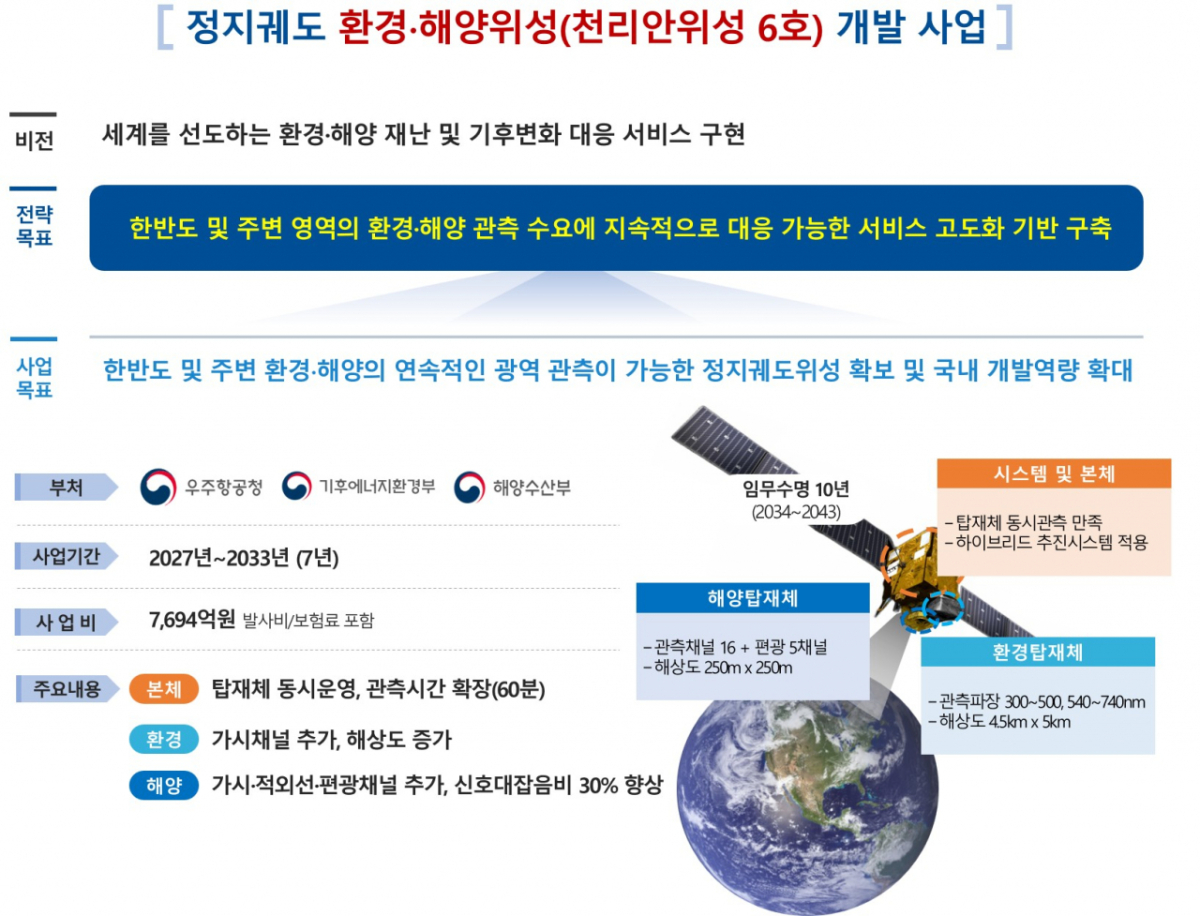
Development of 'Geo-KOMPSAT 6' (Geosynchronous Environment and Ocean Satellite), designed to accurately monitor atmospheric and oceanic changes on the Korean Peninsula, has passed the preliminary feasibility study and will move into its main phase next year. The scheduled launch date is 2033.
The Korea Aerospace Administration, Ministry of Climate, Energy and Environment, and Ministry of Oceans and Fisheries announced on the 25th that the Geosynchronous Environment and Ocean Satellite Development Project has passed the preliminary feasibility study for national research and development projects.
Geo-KOMPSAT 6 is a successor satellite that will take over the mission of 'Geo-KOMPSAT 2B,' the world's first geosynchronous environment and ocean satellite launched in 2020. The total project cost, including launch expenses, is approximately 769.4 billion won. Development is scheduled to begin in 2027, with a planned launch in 2033.
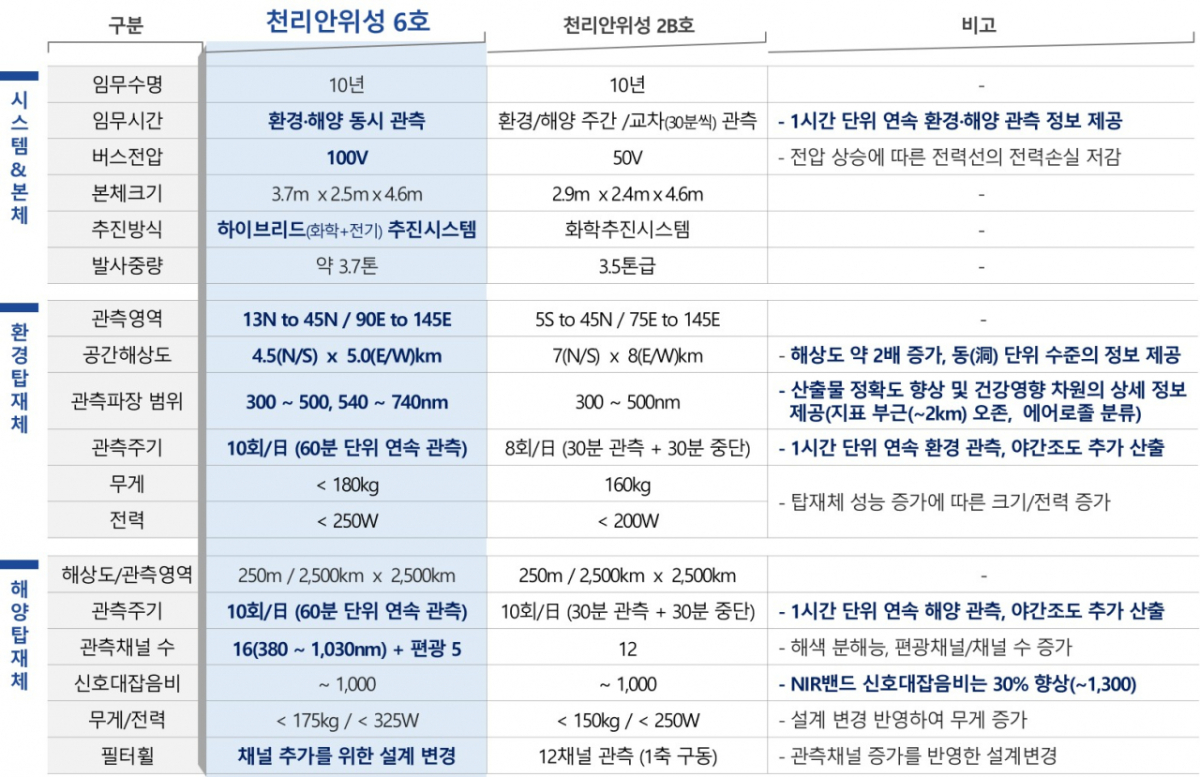
While Geo-KOMPSAT 2B conducted cross-observations of the Korean Peninsula's atmospheric environment and oceans every 30 minutes, Geo-KOMPSAT 6 will observe both simultaneously. The simultaneous observation window will also be extended to 60 minutes, enabling the provision of continuous observational data every hour.
The environmental payload, which will monitor air pollutants such as ozone, aerosols, and nitrogen dioxide, plans to enhance performance to accurately classify substances up to 2 kilometers above the ground. The ocean payload, designed for precise analysis of harmful algae drifting in Korean waters, will also focus on improving accuracy by reducing error rates compared to previous payloads. Geo-KOMPSAT 6 has a mission lifespan of 10 years and weighs approximately 3.7 tons.
Most importantly, the development of Geo-KOMPSAT 6 aims to localize the technology for developing geosynchronous satellite payloads. Geosynchronous orbit is located about 36,000 kilometers above Earth, where a satellite's orbital period exactly matches Earth's rotation, making it appear stationary at the same position when viewed from the ground.
The Korea Aerospace Administration, Ministry of Climate, Energy and Environment, and Ministry of Oceans and Fisheries plan to establish detailed plans for future project implementation, secure funding, and select research and development institutional investors.
Jung Ji-won, Director of the Atmospheric Environment Research Division at the Ministry of Climate, Energy and Environment, stated, "We will build upon the world-class experience in developing and operating environmental satellites accumulated through Geo-KOMPSAT 2B to advance it further with the more sophisticated Geo-KOMPSAT 6."
Jang Myo-in, Director General of the National Oceanographic Research Institute at the Ministry of Oceans and Fisheries, said, "Extensive long-term ocean observation data spanning over 30 years from Geo-KOMPSAT 1 through 6 will be utilized as key resources for determining marine and fisheries policies and responding to climate change."
Kim Jin-hee, Director of the Satellite Division at the Korea Aerospace Administration, remarked, "Geo-KOMPSAT 6 is a national core space asset that continuously monitors the atmospheric and ocean environments closely linked to citizens' lives. We will shift to a private-sector-led satellite development system to expand domestic development of key technologies."

 in TECH

