

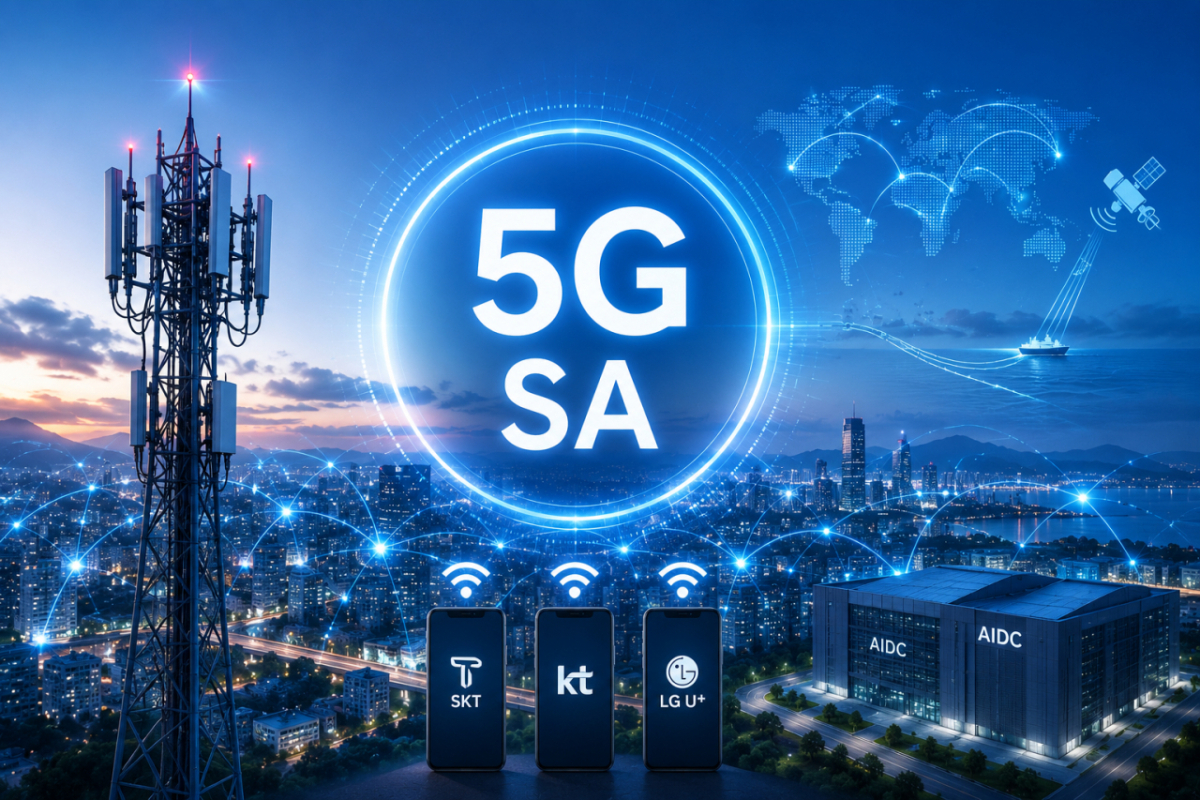
SK Telecom, KT, and LG Uplus are accelerating network construction with a goal of launching nationwide 5G SA (standalone mode) services by December. In response to the spread of AI (artificial intelligence), the government plans to introduce regulatory and tax support measures this year to encourage investment in next-generation communication networks beyond 5G SA, including AI-RAN (AI-based wireless access network), 6G, submarine cables, satellites, and AIDC (AI data centers).
The Ministry of Science and ICT announced on the 27th that it held a launch meeting for the 'Public-Private Consultative Body for Promoting Communication Network Investment in the AI Era' with the three mobile operators in Seoul. This follows a follow-up measure to last month's meeting between Deputy Prime Minister and Minister of Science and ICT, Park Beong-hoon, and the CEOs of the three telecom companies. The consultative body will include heads of network divisions from the three telecom operators, along with representatives from the Korea Information Society Development Institute (KISDI), the Korea Information Technology Evaluation Institute (IITP), and the Electronics and Telecommunications Research Institute (ETRI).
The government's push to promote investment comes amid a decline in equipment investment within the telecommunications industry. Equipment investment (CAPEX) by the three telecom operators fell from 9.6 trillion won in 2019, at the early stage of 5G commercialization, to 8.2 trillion won in 2021 and 7.6 trillion won in 2023, reaching 6.02 trillion won last year—a decrease of approximately 37% over six years. Meanwhile, as data processing volumes have increased due to the spread of generative AI and AI agents, the need for advanced communication networks has grown.
The consultative body will discuss investment plans across both wired and wireless infrastructure, including 5G SA, AI-RAN, 6G, submarine cables, satellites, AIDC, and optical communications. Existing legacy networks such as 3G will be gradually transitioned with user protection as a prerequisite. The government plans to compile measures for regulatory rationalization and budget and tax support—including initial pilot projects—and announce a comprehensive 'Next-Generation Communication Network Investment and Regulatory Improvement Plan' by the end of this year.
The three telecom operators are verifying 5G core network expansion and terminal compatibility with the goal of launching nationwide 5G SA services by December. KT has been commercializing and expanding its SA service since July 2021, while SK Telecom and LG Uplus are conducting nationwide tests. Unlike the existing 5G NSA (non-standalone mode), which uses LTE networks alongside 5G, SA enables the implementation of 5G-specific features such as ultra-low latency and network slicing by utilizing only the 5G network.
Telecom companies are also exploring new services leveraging SA. KT is applying network slicing to World Cup fan zones, fireworks festivals, and dedicated business networks for enterprises and institutional investors. SK Telecom is preparing customized services targeting specific regions and users. LG Uplus is advancing the integration of physical AI in areas such as live event broadcasting and delivery/patrol operations.
The government is also moving to revise regulations. It is coordinating with device manufacturers and OS providers to expand the range of terminals compatible with SA usage. Additionally, it will refine network neutrality guidelines focusing on priority transmission and special services, releasing a revised version in the fourth quarter. The existing communication quality evaluation system, which was centered on download speeds, will be restructured to reflect factors such as SA connection and maintenance, latency, and network slicing quality.
Choi Woo-hyuk, Director of the Information Protection Network Policy Office at the Ministry of Science and ICT, stated, "The foundation of national competitiveness in the AI era lies in intelligent wired and wireless communication networks that support it." He added, "We will remove regulatory and tax obstacles that hinder communication network investment and create a virtuous cycle for next-generation communication network investment."

 in TECH
