

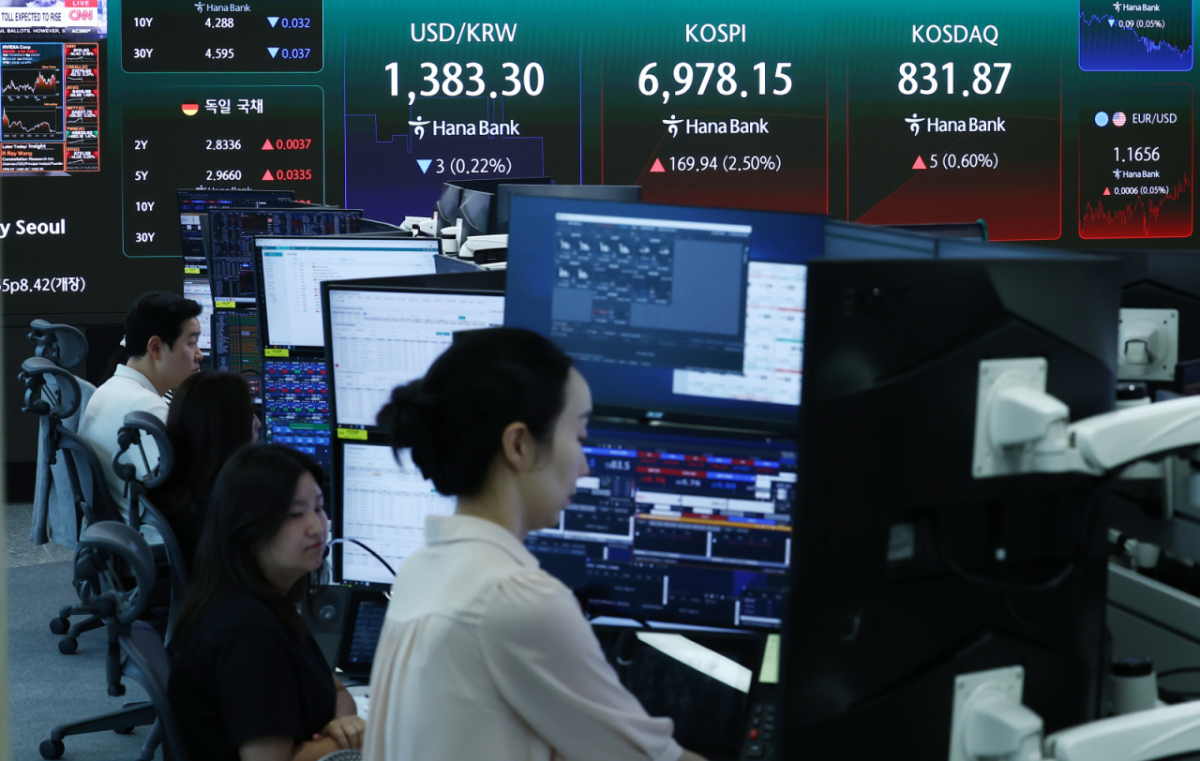
As the Bank of Korea Monetary Policy Board raised interest rates for the second consecutive time (base rate 3%), the 'Nvidia earnings effect' weakened, narrowing the gains of Samsung Electronics and SK Hynix. The KOSPI, which shifted from a strong 2% rally to a flat trend immediately after the Bank of Korea's interest rate hike, successfully rebounded by over 1% thanks to buying pressure from foreign investors and institutional investors.
At 11:12 a.m. on the 27th, the KOSPI stood at 6,931.24, up 123.03 points (1.81%) from the previous trading day.
The KOSPI opened the day at 6,996.12, up 187.19 points (2.76%), showing strong momentum before shifting to a flat trend in the 0th% range upon news of the Bank of Korea's base rate hike. Pushed down to the 6,840 level by 10:01 a.m., the KOSPI rebounded to a 1% gain thanks to buying from foreign investors and institutional investors.
Samsung Electronics and SK Hynix rose by 2% and 3%, respectively. However, their gains were narrower than in the early trading session. Kim Ju-yeon, a researcher at Mirae Asset Securities, stated, "The semiconductor sector started strong following Nvidia's better-than-expected earnings released after the U.S. market closed, but the upside was limited." He further analyzed, "This reflects a tug-of-war between the Nvidia effect and the Bank of Korea Monetary Policy Board's interest rate hike."
Nvidia's second-quarter revenue increased by 106% year-on-year to $96.22 billion (133.2 trillion won), setting a new sales record for the 13th consecutive quarter. The data center segment, which includes AI chip sales, grew by 117% to $89 billion, with an operating profit margin of 66.5%.
Han Ji-young, a researcher at Kiwoom Securities, noted, "Nvidia's conference call confirmed supply bottlenecks through 2028 and the sustained demand for AI (artificial intelligence), leading to a 4% rally in after-hours trading." She added, "Nvidia's earnings have improved visibility into demand for products like HBM (high-bandwidth memory) and strengthened pricing power, signaling an improving sentiment toward semiconductor investments."
Despite the Bank of Korea's interest rate hike, net buying by foreign investors and institutional investors drove the KOSPI higher. As of 11:31 a.m., foreign investors purchased stocks worth 168.9 billion won, while institutional investors bought 202.8 billion won in net purchases. In contrast, retail investors sold off holdings worth 1.04 trillion won.
Foreign investors net-sold Daewoo Construction, Hanwha Machinery & Services Holdings, and Hanwha Life on the KOSPI, while they net-bought Korean Air, Samsung Electronics, and Kumho Tire. Among the top sectors with net purchases by institutional investors were Samsung Electronics, Daewoo Construction, Dreamtek, and Hyundai Steel.
At the same time, the KOSDAQ rose 8.96 points (1.08%) to 835.83. The KOSDAQ market initially turned flat immediately after the Bank of Korea's interest rate hike but shifted to a strong trend thanks to net buying by foreign investors.
As of 11:31 a.m., foreign investors purchased stocks worth 11.2 billion won, while retail investors sold off 6.4 billion won and institutional investors sold off 3.6 billion won in net terms.
The so-called Nvidia effect also appeared in the KOSDAQ market. Semiconductor substrate stock Simtek surged by over 10%. EcoPro and EcoPro BM also rose by around 4%, showing strong momentum.

 in STOCK
