

# In February, shortly after Iran's Supreme Leader Ayatollah Ali Khamenei was reported killed in U.S. and Israeli airstrikes, a single photo circulated on social media (SNS). The image showed rescue teams recovering Khamenei's body amidst concrete rubble. Although it appeared to be an authentic on-site photograph, Iranian authorities had not released any images of the body at that time. UK fact-checking outlet Full Fact identified 'SynthID'—a watermark embedded by Google AI tools for creation or editing—in the image. There were also physically implausible elements, such as a person standing on concrete covering the body. The photo, which spread like an iconic war scene, was a fake created by AI.
During this Middle East conflict, 'fakes' emerged through methods such as newly generating bombing and victim scenes with AI or repurposing past footage to depict recent warfare. Screenshots from military games were also circulated as if they were real combat footage. A 2015 explosion video from Tianjin, China, was presented as a Tel Aviv strike scene; an Algerian football team's championship celebration video was transformed into footage of an Iranian airstrike; and gameplay footage from the game 'Arma 3' was spread as actual air defense combat.
War propaganda and manipulation have existed in the past. What has changed is the speed and cost of production. With generative AI, videos featuring explosions, fires, crowds, and military equipment can be created without specialized equipment. This capability has been combined with motives from state actors or political groups seeking propaganda value and view-based revenue. Platform structures that amplify sharing and comments for shocking content have further fueled this spread.
The harm of AI-generated fake news does not end with believing a single fabricated scene. Nonexistent attack outcomes are accepted as real battlefield developments, intensifying fear and hostility toward specific countries and groups. When fakes are repeated, even authentic photographs and media reports face suspicion: "Could this have been made by AI?" Fakes can undermine the evidentiary value of genuine content.
Platforms and AI systems cannot replace verification. Detectors may misclassify edited real photos as AI-generated or fail to recognize heavily manipulated images that significantly alter meaning. Chatbots can fabricate news reports citing non-existent sources. Resolving this issue through competition alone between technologies that create fakes and those that detect them is insufficient.
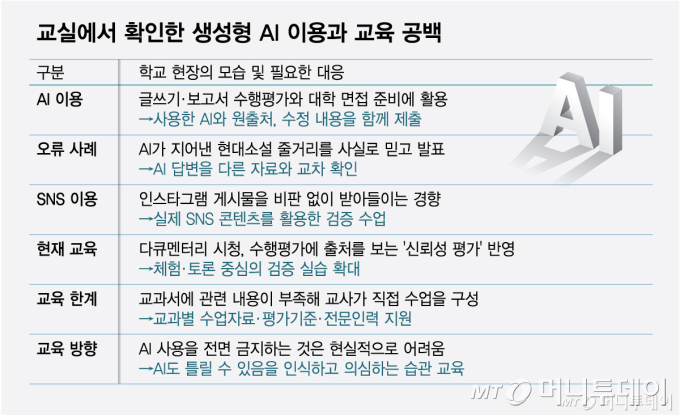
The same problem has been identified in schools. A teacher (A) at a high school in Gyeonggi Province stated that during a class on social issues, a student submitted what they claimed was disaster footage, but it turned out to be video filmed years earlier in another country. The student had believed it was recent based solely on view counts and comment reactions.
Teacher B, who has taught Korean language at a high school in Gangwon Province for 13 years, said: "Students show little interest in fake news itself but tend to accept Instagram posts uncritically." She added, "Teachers too may miss errors if the content is outside their expertise or not pre-verified."
The 'AI Basic Act' implemented this year requires watermarks on generative AI outputs and images, videos, or audio that appear real. However, watermarks can disappear if the screen is cropped or re-photographed. Technical measures are also needed for platforms to read and preserve creation/editing histories within posts.
Brakes must also be applied to dissemination and revenue structures. In high-impact events like wars or disasters, recommendations for content with unclear sources should be reduced, and warnings displayed before sharing. Accounts that hide the fact that their war-related content is AI-generated should face restrictions on revenue sharing, and repeat violators should have their reach limited.
Lee Seong-yeop, a professor of technology management at Korea University, stated: "While platforms unilaterally judging and blocking fake news raises concerns about infringing freedom of expression," he added, "for the sake of platform credibility, it is necessary to further refine and strengthen criteria for countering false information and filtering mechanisms."
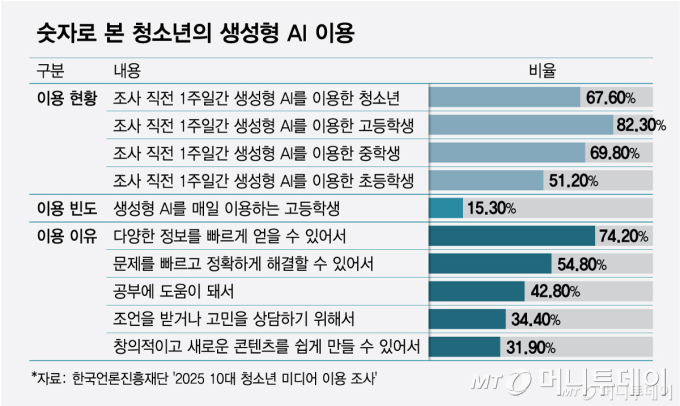
The final line of defense lies in user education. According to a survey by the Korea Press Foundation, 82.3% of high school students reported using generative AI within the week prior to the survey. However, AI education in schools relies more on individual teachers' interest and capabilities than on textbooks. Teacher B noted: "The existing curriculum does not adequately cover generative AI, so teachers must create their own lessons and performance assessments."
Professor Lee emphasized: "While there is general agreement that AI should be used correctly, it remains questionable whether sufficient standards, guidelines, and professional personnel exist to persuade students." He stressed the need to teach students to recognize that AI can make mistakes and to cross-check information with other sources and expert opinions.

 in TECH

