

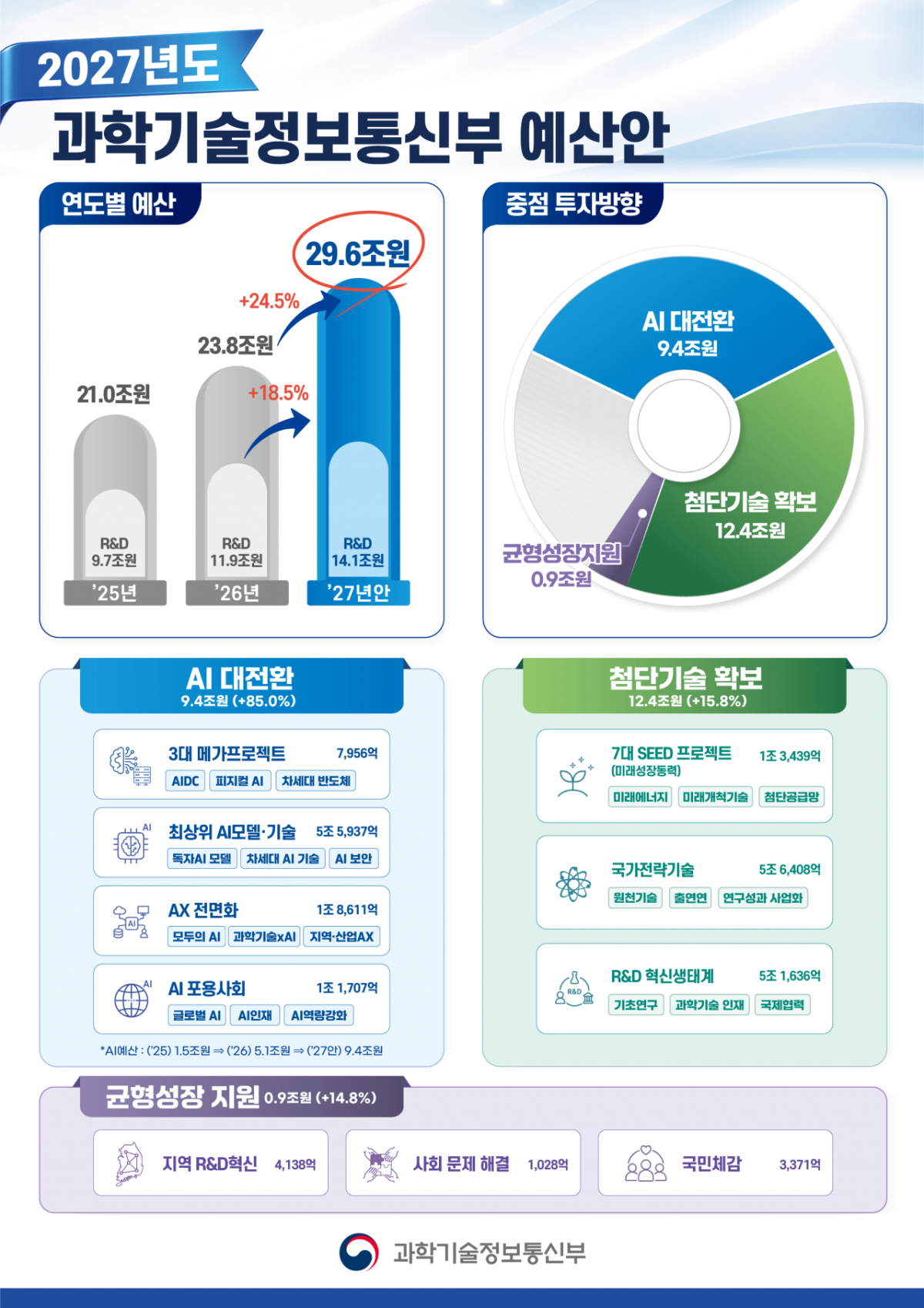
The Ministry of Science and ICT will allocate a budget reaching 30 trillion won in 2027. The core focus is to invest more than 70% of its budget into industrial Daejeon Hub and advanced technologies in response to the AI era.
On the first day, the Ministry of Science and ICT announced that it approved the '2027 Budget Proposal and 2026–2030 National Fiscal Operation Plan' during a State Council meeting chaired by President Lee Jae-myung at Cheong Wa Dae in the morning.
The total budget under the Ministry of Science and ICT for 2027 amounts to 29.6476 trillion won, representing an increase of 5.8272 trillion won (24.5%) compared to this year's supplementary budget. Of this, R&D (research and development) budget stands at 14.1 trillion won, accounting for approximately 36% of the government's total R&D spending.
Kook-hyuk Chae, First Vice Minister of Science and ICT, held a pre-briefing on the budget proposal at the Seoul Sejong University Government Office Building in Seoul the previous day. He stated, "The core philosophy of this budget is to drive a leap toward an 'irreplaceable Republic of Korea' through three mega projects—AI Data Center (AIDC), Physical AI (semiconductors), and independent AI models—and seven SEED projects including fusion energy, small modular reactors (SMR), and quantum technologies."
Among this budget proposal, 21.7981 trillion won is allocated to AI and advanced technology-related areas, representing 74% of the Ministry's total budget. Specifically, 9.4211 trillion won—57% of the government's total AI budget—is invested in the AI Daejeon Hub. Compared to the Ministry's 2026 budget of 5.938 trillion won, this reflects an 84.3% increase. The Ministry will allocate 795.6 billion won to the three mega projects (semiconductors, AIDC, and Physical AI) announced by the government in June this year, 5.5937 trillion won for securing top-tier AI models and technologies, 1.8611 trillion won for AI services and application areas, and 1.1707 trillion won for building an inclusive AI society.
An allocation of 3.85 trillion won has been designated to expand GPU (graphics processing unit) capacity for AI development, marking an 84.7% increase from the previous year. Additionally, 800 billion won will be invested in strengthening data competitiveness for frontier-level AI development. A new initiative includes a budget of 25 billion won to cultivate frontier talent in generative AI.
The Ministry plans to invest 250 billion won in the 'AI for All' project, which recently selected operators to support universal access to AI services for all citizens. It will also support regional AI transformation (AX) centered on four regions: Daegu-Gyeongbuk, Southwest, Jeonbuk, and Southeast. Plans include advancing the K-Shoot Project and developing science-technology-specific foundation models in fields such as biotechnology and mathematics. To address global challenges like climate change and food security, the budget also includes initiatives to build an inclusive society through cooperation with major international organizations, including establishing a 'Global AI Hub' domestically.
To secure national competitiveness beyond the AI era, 12.377 trillion won will be invested in securing 'NEXT' advanced technologies. This represents a 15.8% increase from this year's budget of 10.6925 trillion won. Of this amount, 1.3439 trillion won is allocated to seven SEED projects including SMR, fusion energy, and renewable energy technologies. Another 5.6408 trillion won will be directed toward developing and commercializing national strategic technologies, including support for research institutes securing foundational technologies. Additionally, 5.1636 trillion won has been set aside to strengthen the domestic R&D innovation ecosystem, gradually expanding research opportunities for Korean researchers and promoting programs to identify and nurture outstanding talent.
In response to the abolition of PBS (Project-Based System), a method where government-funded research institutes secure research funds by undertaking projects from the government or private sector, the Ministry plans to increase the proportion of funding allocated to personnel costs at these institutes by 10 percentage points. It will also allocate 16.7 billion won as performance-based bonuses for evaluating research institute institutional investors to foster a stable research environment.
Koo (Vice Minister) emphasized that "the 2027 Ministry of Science and ICT budget proposal is not merely an expenditure plan but a strategic investment plan aimed at creating new growth opportunities and driving a leap toward an irreplaceable Republic of Korea."

 in TECH
