

"As artificial intelligence (AI) has emerged, many jobs are disappearing and undergoing transformation. From a corporate perspective, how do you view the current hiring market?"
A student asked about research on AI-generated speech. In response, Jung Jae-heon, CEO of SK Telecom, replied, "There is no need to worry too much about jobs." He explained that while productivity has increased in many areas—allowing five people to do work previously done by ten—he also noted that countless new tasks are now being created that were once impossible due to labor shortages. "When you think about it, many new opportunities emerge," he added.
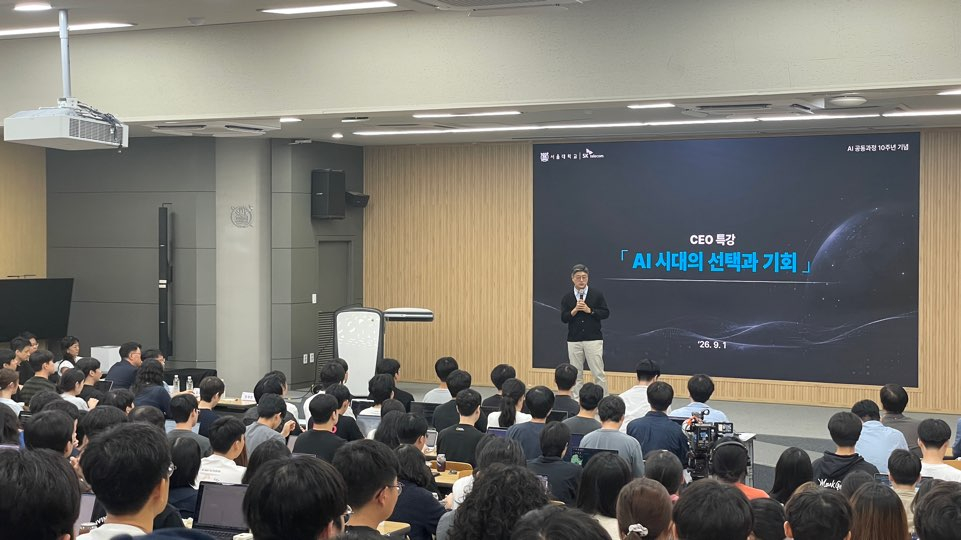
The CEO delivered his special lecture on the afternoon of the 1st at Room 118 of the College of Engineering at Seoul National University in Gwanak-gu, Seoul, under the theme "Choices and Opportunities in the Age of AI." This lecture marked the launch of the "SKT-Seoul National University Joint AI Program," a decade-long industry-academia collaboration course offered to graduate students in the Department of Electrical and Information Engineering for 15 weeks during the second semester this year. Although the lecture hall could accommodate 300 attendees, it became nearly impossible to find an empty seat just over ten minutes before the session began as students poured in.
The CEO began his lecture by introducing his background as a former judge who now serves as a corporate CEO. He posed the question, "Are we living in the same era?" and continued, "Some people still live 24 hours a day, while others experience 240 or even 2,400 hours. AI is changing the density of time," he stated.
He then explained how AI has reshaped industrial landscapes, accelerated the pace of change, and driven surging investments in recent years. Jung CEO emphasized that while the past two centuries since the Industrial Revolution were an era of tool evolution, AI does not merely serve as a tool but replaces human thinking power. "We should view this as the emergence of a new species," he stressed. He further warned that companies failing to adapt during such a period of transition could face crises.
Regarding SK Telecom's response strategy in the AI era, Jung CEO stated, "SK Telecom possesses the capabilities of a leading telecommunications company, and both telecommunications and AI share similar characteristics." He emphasized that both sectors require robust infrastructure development and the creation of models and capabilities to deliver services. He also highlighted the role of data centers (DCs) as producers of 'tokens,' which serve as currency in the AI era, and outlined SK Group's investment direction to secure these assets, alongside recent corporate activities such as developing its own AI foundation model and participating in "AI for All" initiatives.
On the competencies required of future talent, Jung CEO remarked, "In previous eras, if two individuals had capabilities of 10 and 100 respectively, that represented a tenfold difference. However, in an era where AI provides capabilities of up to 10,000, the gap between someone with 10,010 and 10,100 is merely 1%." He stressed that the ability to judge and act amid rapid change is essential, and emphasized that empathy skills—which AI cannot replicate—are critically important.
During the question-and-answer session following the lecture, inquiries about changes in the hiring market due to AI were raised first. Jung CEO stated, "Companies do not view AX (transition to AI) as equivalent to job losses." He added, "As we advance our AI businesses, we are actively recruiting large numbers of researchers and developers." As a former judge and legal professional, he noted, "While some firms claim they are no longer hiring new lawyers, the market itself is not stagnant. Even in the AI era, new legal services that were previously unavailable can be offered, and if consumers are willing to pay slightly more for better service, new jobs will emerge."
Another student who seized the opportunity asked, "SK Telecom recently invested in Anthropic (a U.S.-based generative AI development company) and achieved good results. I'm curious about the rationale behind this investment and where you might look next." The question drew laughter from the lecture hall. Jung CEO joked with the student, asking how long they had held their shares, before explaining, "SK Telecom has been pursuing AI business for five to six years, and during that process, we chose to invest in Anthropic. When selecting investment targets, we seek companies that generate synergies with SK Telecom. As we advance our AI initiatives, we invested in related firms, and it turned out to be a huge success."

 in TECH
