

Internal strife within the medical community is deepening over the passage by the National Assembly plenary session of the so-called "Emergency Room Non-Acceptance (Ping-Pong) Prevention Act," which mandates that central situation rooms and other bodies designate hospitals to transfer critically ill emergency patients. The atmosphere is tense, with internal accountability issues emerging from related academic societies.
According to the medical community on the 19th, Park Kyu-nam, president of the Korean Society of Emergency Medicine (professor at Catholic University College of Medicine), voluntarily resigned from his position as president on the 16th. This came just one day after the impeachment proposal for Jeon Byung-jo, Lee (President) (Jeon Nam-ui-dae (Prof.)), was rejected on the 15th. It appears he made the final decision to resign amid sustained internal backlash regarding the passage of the Emergency Medical Care Act amendment bill by the National Assembly plenary session.
Recently, the aftermath surrounding the Emergency Medical Care Act amendment bill has been spreading into internal conflict. In particular, it is known that the impeachment proposal against former Lee (President) was brought to the agenda amid claims that he conveyed the society's position of supporting the bill to the National Assembly, despite opposition from members working in emergency room settings.
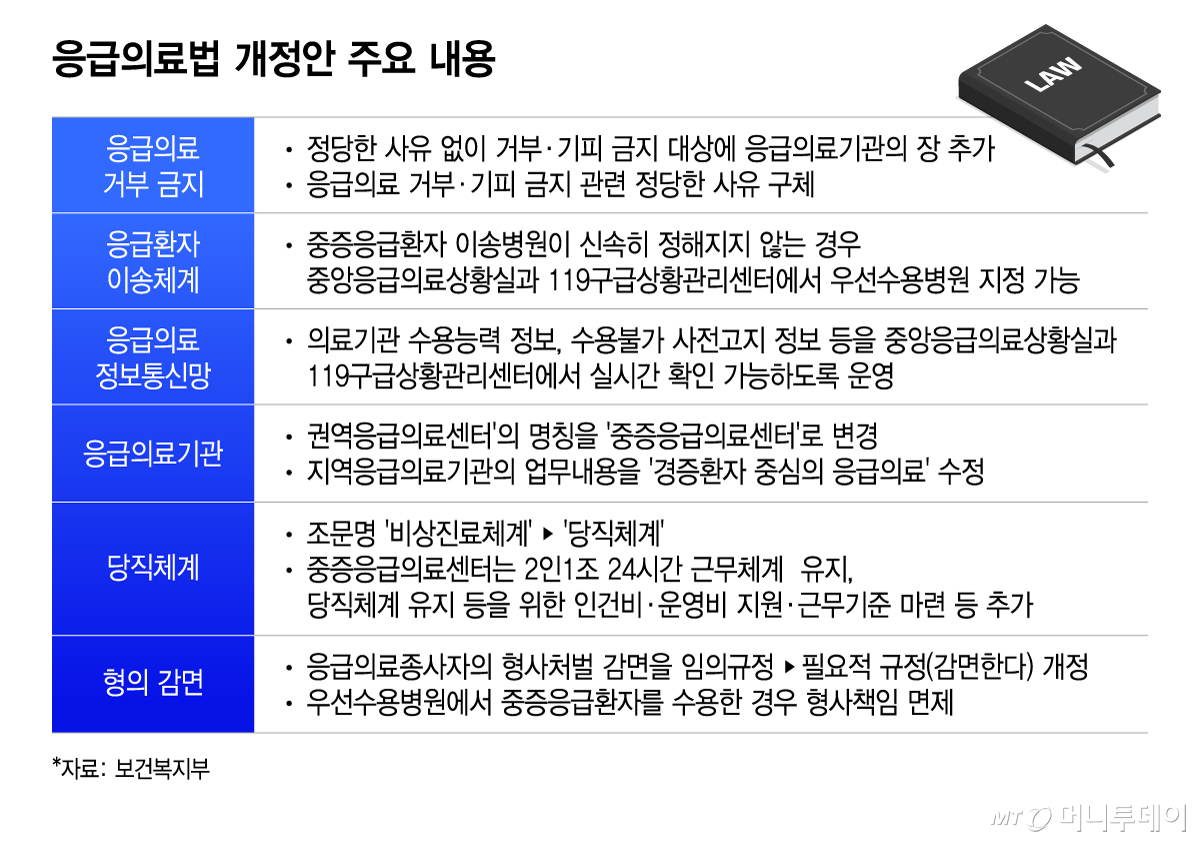
The Emergency Medical Care Act amendment bill, which served as the spark for this conflict, primarily stipulates that if a hospital for transferring critically ill emergency patients is not promptly determined, the Central Emergency Medical Situation Room and the 119th Rescue Situation Center may designate one. "Legitimate reasons" for refusing to accept a patient were also specified, including cases where △facilities, equipment, or personnel are insufficient to provide appropriate emergency treatment, and △the final treating personnel are performing final treatment for other patients.
The mitigation of criminal punishment for emergency medical workers was amended from a "discretionary" provision (may be exempted) to a "mandatory" provision (shall be exempted), and criminal liability is exempted when accepting critically ill emergency patients at priority acceptance hospitals. The clause requiring 119 rescue teams, etc., to verify a hospital's patient acceptance capacity was deleted.
On the medical front, there has been sustained backlash against the amendment bill for prioritizing only "acceptance obligations." It is argued that if the bill is implemented in a situation where the infrastructure and personnel of the background specialty departments responsible for final patient treatment are lacking, it will ultimately amount to mandating forced acceptance. According to a survey conducted by the Korean Society of Emergency Medicine targeting 301 emergency medicine specialists in the field, approximately 93% (279 respondents) answered that they "view the effectiveness of this bill negatively," and 96% (288 respondents) stated that it is "impossible to notify real-time information on situations where acceptance is difficult."
An emergency medicine specialist at a hospital in a non-metropolitan area said, "Reasons for being unable to accept a patient include 'when attending to other patients,' but it is hard to understand how this would be specifically verified," adding, "It is also impossible to immediately report reasons why acceptance is difficult without delay in a situation where every moment counts. Emergency room doctors cannot immediately grasp what the final treating personnel are doing at that very moment."
The National Residents' Union stated, "Improving the transfer and acceptance system is necessary, and we view it as meaningful that the mitigation of criminal liability for emergency medical workers has been changed to a mandatory provision," while pointing out that "(patient) acceptance feasibility criteria and procedures, and who will be responsible, remain unclear." The union urged more specific definitions of legitimate reasons for refusing emergency room acceptance and criteria for applying exemption from criminal liability for medical staff, as well as the establishment of protective measures for training hospitals.
Patient groups also express opinions that the amendment bill relies solely on forced acceptance and exemption from liability. Kim Seong-ju, president of the Korea Alliance of Critical Illness Patients, emphasized, "The revision of the Emergency Medical Care Act should not function as a 'law to send patients to any hospital,'" adding, "We must build a system where the state tracks and manages from patient acceptance through specialized care and final treatment, and strengthen regional background care systems so that re-transfers and long-term emergency room waits do not repeat."

 in THEBIO
