

"In Jeju, 1,000 adults disappear every year." "Could a police officer have murdered someone for falsely closing a missing person case?" "This is a crime committed by Chinese nationals."
These claims spread widely online after multiple missing persons were found dead in recent days in Jeju. Unfounded speculation was added to an actual incident where a police officer had wrongly closed a missing person case, painting the entire Jeju region as dangerous. Reactions such as "Is Jeju just a graveyard?" and "I'm scared to travel to Jeju" followed. The police stated that no criminal suspicion, including homicide, has been confirmed, and Jeju Island requested an end to the spread of unverified information and the deletion of posts containing false content.
The Special Committee on False Information Review newly established by the Korea Internet Self-Regulatory Organization (KISO) targets precisely such information that goes beyond harming individuals and triggers social anxiety and confusion. A committee official stated, "If such cases had been reported, we would likely have been able to assess them," assuming they were personal opinions. The implication was that had the content of the posts, their purpose, and their reach been examined, there was a possibility they could have been classified as false information.
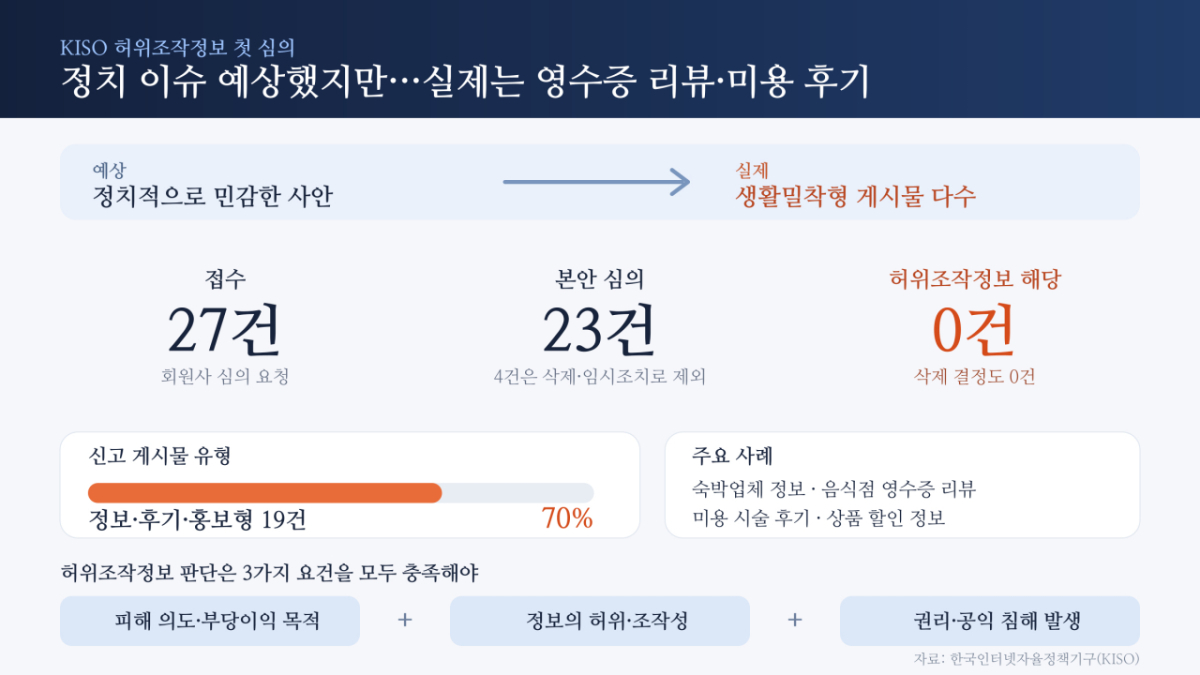
However, the 'Jeju Ghost Stories' never reached the committee. At the first review session, the agenda primarily consisted of restaurant receipt reviews, beauty treatment testimonials, and promotional posts from accommodation providers. The review body, launched to tackle fake news that shakes society, faced disputes—big and small—surrounding products and businesses during its inaugural meeting.
The KISO Special Committee on False Information Review held a press conference on the 2nd and publicly disclosed the status of reviews for the first time since the revised Act on Promotion of Information and Communications Network Utilization came into effect. When member companies such as Naver (NAVER) and Kakao encounter reports that are difficult to judge independently, they refer them to the committee, where experts from legal, media, journalism, and technology fields conduct reviews using consistent standards.
A total of 27 posts were received. Among them, 19 posts—classified as 'Information/Testimonial/Promotion Type,' including product/service information, user reviews, and promotional content—accounted for 70% of the total. Some posts used hotel lobby photos while introducing guesthouses, or promoted certain substances as beneficial to health. Restaurant receipt reviews, beauty treatment testimonials, and product discount information were also included in the review scope. Kim Min-ho, chairman of the special committee, said, "We initially expected most of the first agenda items to be politically sensitive matters," adding, "The actual reported cases were completely different from our expectations."
The committee conducted final reviews on 23 posts, excluding four that had been deleted during the review process or temporarily restricted for reasons such as defamation. All 23 posts were determined not to constitute false information under KISO guidelines. No posts were ordered to be deleted on grounds of being false information.
To be recognized as false information, there must be an intent to cause harm to others or gain undue benefits. The information itself must be false or manipulated, and this must result in damage to others' rights or the public interest. If even one of these three conditions is not met, the post does not qualify for deletion.
A committee official explained, "While a simple error constitutes misinformation, it does not meet the legislative purpose of false information laws." This means that even if a guesthouse promotional post mistakenly included hotel photos, it cannot be treated the same as false information that incites fear by portraying the entire Jeju region as exposed to crime.
Posts that infringe on an individual's reputation or privacy can already be deleted or access blocked through the existing temporary restriction system. The area where a new system is needed involves information that, while difficult for direct victims to address, could cause harm to society as a whole. Posts like the 'Jeju Ghost Stories,' which are based on false content and foster fear and hatred toward a region—potentially leading to economic damage in tourism—are representative examples.
The committee plans to prioritize reviews of reports where false information could lead to significant harm, such as those involving children, safety, and public health.

 in TECH
