

The Ministry of Science and ICT aims to uncover the 'mutation' genome specific to Koreans by 2031, investing around 500 billion won. Although this area accounts for 98% of the entire genome, it has remained in darkness due to lack of clarification. The goal is to explore this region using AI (artificial intelligence).
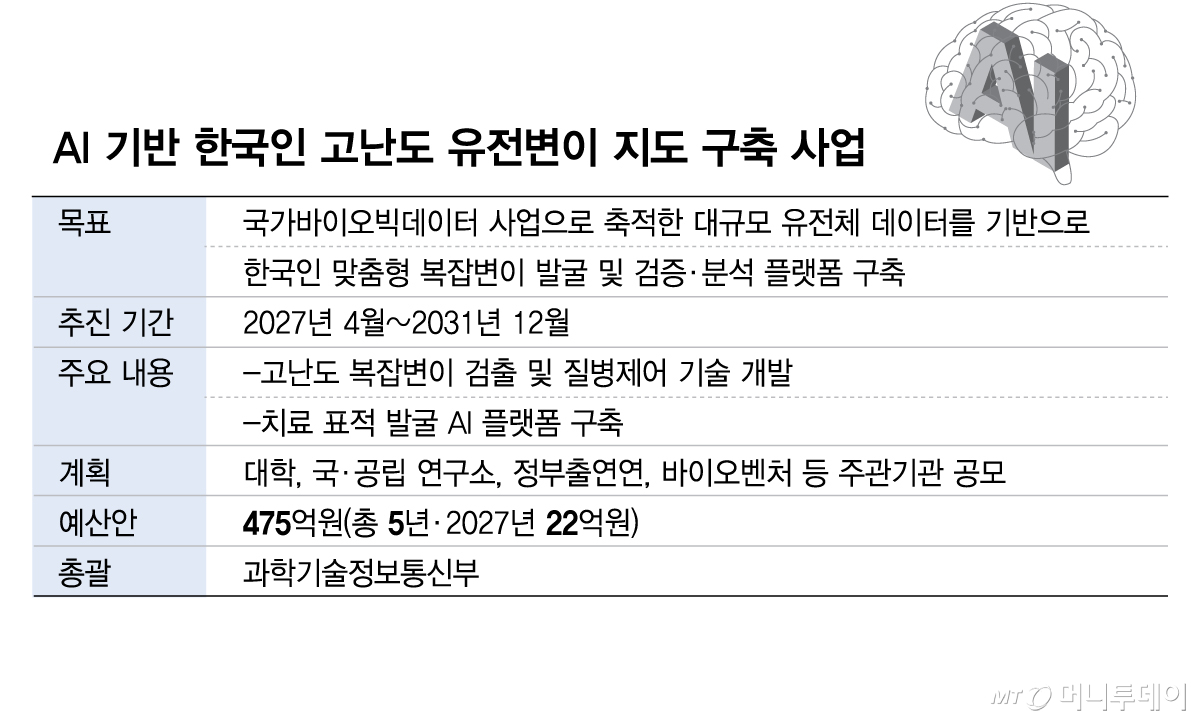
According to R&D project explanation materials submitted by the Ministry of Science and ICT to the office of Lee Jeong-heon, a member of the Democratic Party of Korea, on the 7th, the ministry will launch the 'Construction of a High-Difficulty Korean Genetic Variation Map Based on AI and Development of Pathogenic Control Technology' next year. The core objective is to detect 'non-coding' genomes within Korean bio data.
A genome is the complete set of all genetic information contained within a living organism. Until now, attention has focused primarily on the 'coding' region, which directly produces proteins. This is because proteins are key factors in generating bodily energy and regulating various hormones. However, this coding region accounts for only 2% of the entire genome. The remaining 98% consists of parts that have yet to be deciphered, known as 'non-coding' genomes.
Non-coding genomes do not directly participate in protein production but influence the level and timing of protein expression. The problem is that their sheer volume makes it extremely difficult for researchers to analyze them one by one, leaving this area largely unexplored. Deciphering an individual's entire genome reveals millions of non-coding regions. Mutation patterns are also complex: dozens of bases may be deleted, the order of bases may change, or certain repetitive bases may abnormally increase.
Nevertheless, the scientific community is focusing on non-coding genomes to uncover fundamental clues for genetic diseases such as dementia and diabetes. It is known that a significant number of mutations related to genetic diseases are located in non-coding regions.
The Ministry of Science and ICT plans to identify non-coding region mutations within the Korean genome and establish specialized platforms by 2031. Actively deploying AI models, such as the 'National AI Bio Foundation Model,' will be key to improving verification speed and accuracy. Additionally, data collected through the National Integrated Bio Big Data Construction Project will be utilized. This is a large-scale project aimed at gathering genomes, proteins, metabolites, and lifestyle information (lifelog) from one million Koreans. According to the 2027 budget proposal, the Ministry of Science and ICT plans to invest approximately 475 billion won over five years starting with 22 billion won next year.
A ministry official stated, "Although we are collecting large-scale data through the National Bio Big Data project, research on non-coding regions—which account for the remaining 98%—remains a national gap due to our focus on coding mutations. We plan to solicit research leaders from domestic universities, government-funded research institutions, and bio companies when launching the project next year."

 in TECH

