

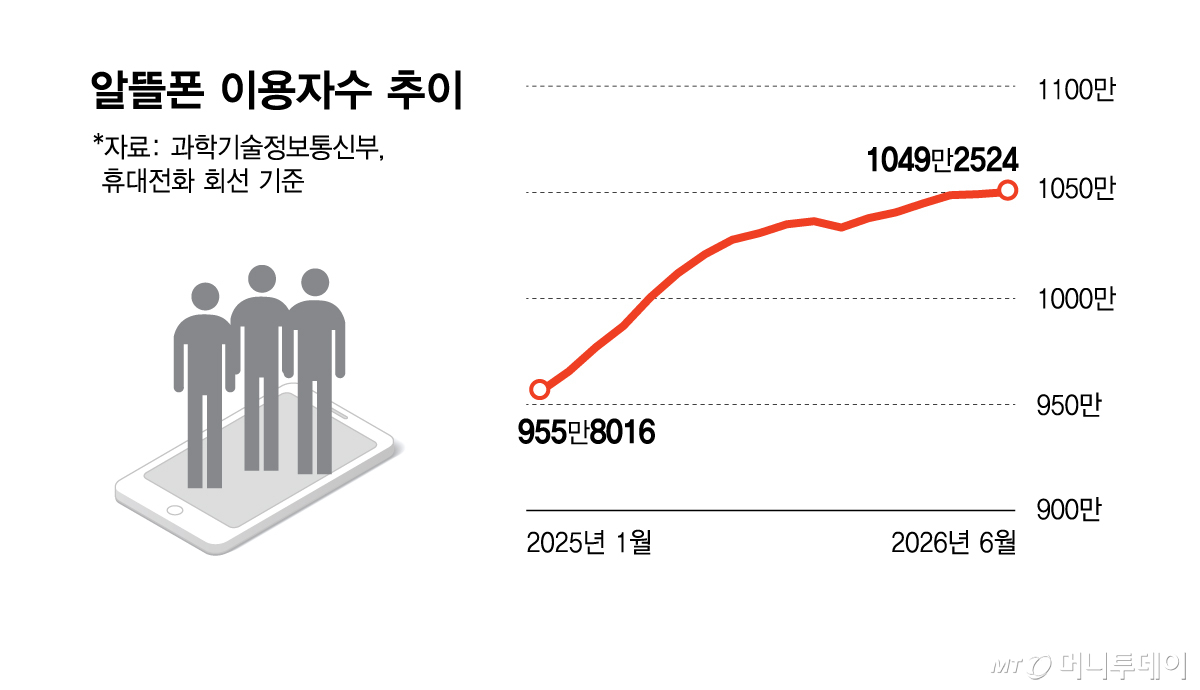
Among 10 million mobile subscribers to MVNOs (Mobile Virtual Network Operators), it was found that nearly half are with subsidiaries of the three major mobile carriers. Although both the number of subscribers and operators have steadily increased, analysis suggests that due to differences in capital power, brand strength, customer base, and distribution and partnership capabilities, the market structure remains centered on the three major carriers.
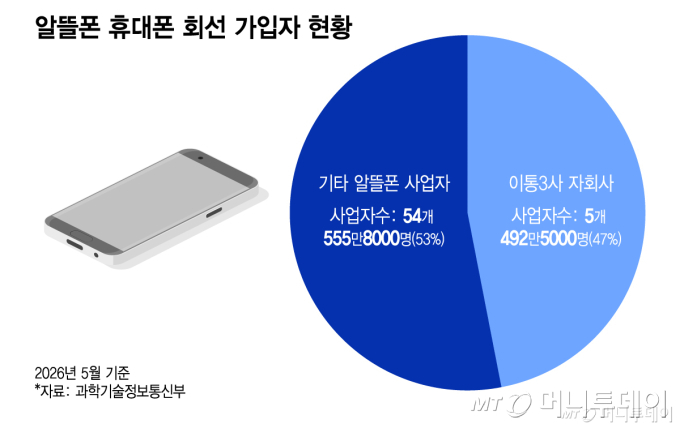
According to the Ministry of Science and ICT on the 8th, as of June, MVNO mobile subscribers totaled approximately 10.492 million. Among the total 59 operators, five MVNO subsidiaries of SK Telecom, KT, and LG Uplus accounted for about 4.922 million subscribers, or 47% of the total. Despite representing only 8.5% of all operators, these three major carrier subsidiaries secured nearly one out of every two subscribers.
The MVNO business initially lowered entry barriers through a registration system to promote competition at its launch. While effective in expanding the early market, concerns are raised that as the number of operators grew to 59, promoting actual competition has become difficult.
Professor Mo Jeong-hoon of Yonsei University's Department of Industrial Engineering cited differences in capital power as the background for concentration among subsidiaries of the three major carriers. Professor Mo stated, "Subsidiaries of the three major mobile carriers have significantly greater capital power compared to small and medium-sized MVNO operators." He added, "Because these subsidiaries can offer benefits such as discounts and after-sales support through customer service centers that small-scale operators find difficult to provide, consumers naturally choose the side offering more benefits."
Existing customer bases, distribution networks, and partnership capabilities also create competitiveness gaps among MVNO operators. Subsidiaries of large corporations can leverage customers or memberships and content secured from their existing businesses by linking them with MVNO services and expanding consumer touchpoints through diverse distribution channels. In contrast, small-scale medium and smaller operators face disadvantages due to low brand recognition and relative difficulty in creating partnership products with credit card companies and financial institutions.
An industry official stated, "The lower the price, the more consumers look for a trustworthy company or brand." They added, "Partnerships also require mutual benefits between operators and must align in scale to be realized, which presents limitations for small and medium-sized operators."
The government has also stepped up efforts to strengthen quality management of MVNO operators. The minimum capital requirement for MVNOs was raised from 0.3 billion won to 1 billion won, and information security obligations for existing operators were strengthened. These measures aim to filter out financially unstable operators and enhance user protection. However, since these measures focus primarily on improving operator stability and service reliability, it remains difficult to narrow the competitiveness gap between subsidiaries of the three major carriers and small and medium-sized operators.
An industry official pointed out, "Ultimately, what matters is how many operators possess brand strength, customer bases, distribution networks, and partnership negotiation power to compete in reality." They added, "In a structure where operators rely on mobile carrier networks and are heavily influenced by wholesale rates, there are limits to growing their scale and achieving sustained growth."

 in TECH

