

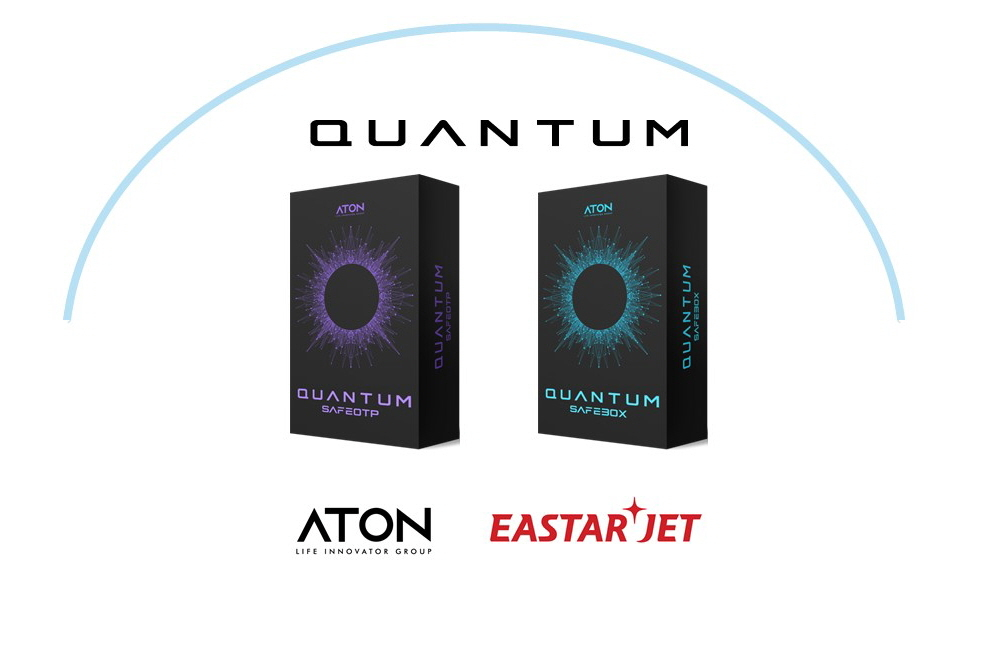
Aton has made its first entry into the aviation industry with its post-quantum cryptography (PQC) solutions. Following new references in the financial sector, virtual assets, and cultural content fractional investment platforms, it has now secured a new reference outside the financial sector.
On the 10th, Aton announced that it signed a supply contract for 'Quantum SafeOTP,' a PQC-based mobile OTP solution for access authentication of internal work systems at Eastar Jet. This marks the first time Aton is supplying PQC solutions to an airline.
Internal system security is broadly divided into two areas: data encryption and identity verification through authentication. Until now, Aton has supplied PQC-based encryption technology in the data transmission segment of internal work systems. Through this contract, it will expand its solution application scope beyond data transmission to include user access authentication.
Quantum SafeOTP protects both the authentication key used for generating one-time passwords and the storage area where that information is kept. When the server transmits the authentication key to a terminal, it applies 'ML-KEM,' a PQC algorithm adopted as a standard by the U.S. National Institute of Standards and Technology (NIST), to guard against potential data theft during communication.
Authentication information stored on terminals is protected via 'Quantum SafeBOX,' a secure storage medium employing white-box cryptography technology. The system is designed to make it difficult for external parties to extract authentication information even if the terminal is lost or stolen.
The solution also expands its usage environment. It supports applications for both Android and iOS, as well as a web browser-based method that requires no additional program installation. Employees can use the same authentication system regardless of whether they access the work system via mobile device or PC.
Access authentication serves as the first gateway in internal security systems. Even if data is strongly encrypted, a breach in user authentication can render subsequent defense measures ineffective. With the spread of remote work and cloud usage, pathways to access internal networks have diversified, increasing the importance of security at the authentication stage.
Information exchanged during the authentication process could also become a target for 'HNDL (Harvest Now, Decrypt Later)' attacks, where data is currently intercepted in encrypted form and later decrypted using quantum computers. Aton plans to proactively address such future security threats by applying PQC technology.
An Eastar Jet official stated, "Given the nature of the aviation industry, safely protecting customer data and establishing an advanced internal security system are top priorities. To keep pace with the expansion of smart work and AI environments, we have adopted a PQC-based OTP solution to proactively prevent security threats in the quantum computing era."
Aton CEO Woo Gil-soo said, "Once an authentication system is established, it operates for several years; therefore, the systems designed today must remain viable into the quantum computer era. Since internal employee authentication is a necessary framework for all companies regardless of industry, we will expand PQC transition cases across various industries."

 in TECH
