

[For more diverse information on startups, you can view it at Unicorn Factory's big data platform 'Data Lab'.]

Running shoe consumers do not consider only functions such as cushioning and rebound. Functions are a given; to open their wallets, shoes must also feature flashy, beautiful, and trendy designs.
As fashion cycles have shortened, the challenges brands face have changed accordingly. It has become more important than ever to quickly create designs that the market wants and connect them immediately to production through manufacturing partners.
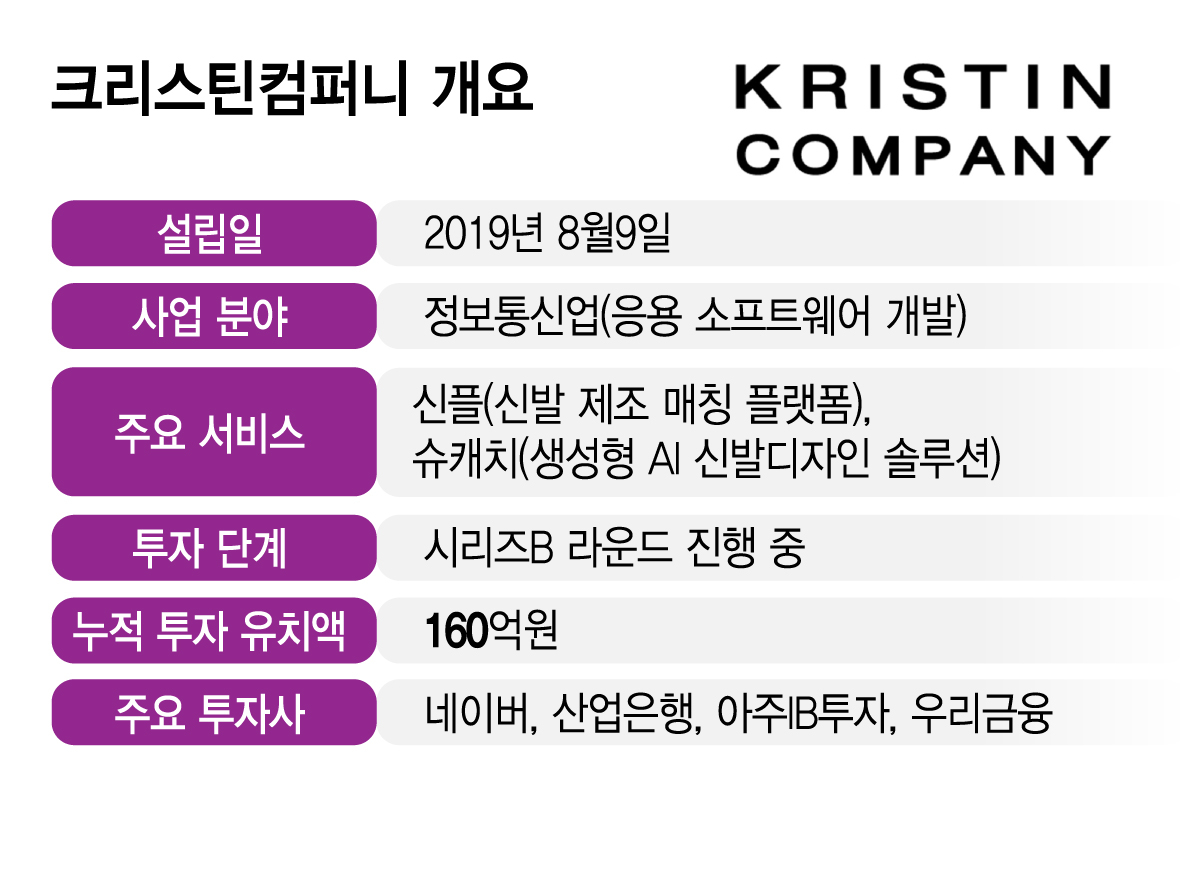
Kristin Company is a 'vertical AI' company that precisely targets this point. By integrating AI into the traditional manufacturing industry of footwear, it has digitized the entire process from design planning to factory matching and production.
The core lies in planning shoes desired by brands more quickly, finding suitable manufacturers, and connecting them to actual production. Lee Min-bong, CEO of Kristin, said, "As a startup from Busan, Ulsan, and Gyeongnam, we wanted to prove that competitive AI businesses can be established even in regional areas."
"Targeting 10 billion won in revenue this year"... SINPLE and ShoeCatch as top performers
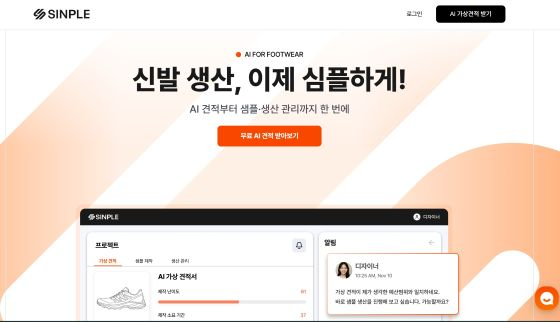
Kristin recorded 2.83 billion won in sales last year and aims for 10 billion won this year. Lee Min-bong (CEO) stated, "As of the end of August this year, we have already achieved approximately 6 billion won." The two main drivers of revenue are the B2B manufacturing matching platform 'SINPLE' and the generative AI design solution 'ShoeCatch' for consumers and designers. Of the cumulative sales of 6 billion won this year, SINPLE accounts for about 5 billion won, while B2C business including ShoeCatch accounts for about 1 billion won.
Launched as a paid service in October last year, SINPLE is a platform that connects factories needed for shoe manufacturing and charges fees. Since making one pair of shoes requires passing through approximately 10 factories for materials, components, processing, etc., connecting them appropriately at the right time is key.
The fee is on average about 20% of the order amount. Currently, there are about 430 cooperating factories connected and contracted with SINPLE in Korea and 50 overseas. There are 33 paid customers, among whom 24 have completed actual deliveries.
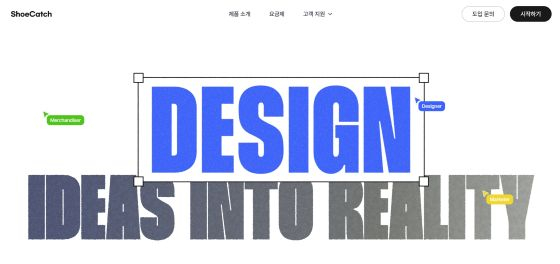
ShoeCatch, commercialized last July, is a service that creates shoe design proposals using generative AI. By simply entering a text prompt, it not only generates designs but also determines whether they can be actually produced. Lee (CEO) said, "It automates the sketching that designers used to do by hand, saving time," and added, "Brand designers need only focus on their final concern of how to incorporate our brand's sensibility."
"200,000 sheets directly labeled, reaching global maximum levels"
Kristin uses a method that is based on general-purpose generative AI but trains it with its own accumulated shoe data to create AI specialized for the footwear industry. It also has functions to convert designs created by AI into blueprints needed for actual production and analyze how similar they are to previously released shoes to determine design duplication. Work orders can also be automatically generated and sent to factories. Lee (CEO) said, "We have been developing and training our own foundation model with KAIST since three years ago, and we also hold GPUs internally."
As such, the company's competitiveness lies in its data. Lee (CEO) explained, "Unlike clothing, shoes are complex structures made by attaching multiple layers, and each part has a different name," adding, "Only after naming each part and labeling them individually can the data be used for AI training." The training data built by Kristin through direct labeling over several years is approximately 200,000 sheets. Lee (CEO) said, "This is almost at the maximum level even in the global market."
The closed nature of the industry itself is also a barrier to entry. Lee (CEO) stated, "The footwear industry has strong legacies and cartels, so it takes years for external companies to enter and persuade factories to establish cooperative relationships." He explained that even he, whose parents worked in the shoe industry, took a long time to build collaborative relationships with factories. He said, "This is not an industry that opens its doors easily just because someone brings money."
Robots make shoes... AI revives Korean manufacturing competitiveness
Design automation is also leading to new demand. A representative example is collaboration with local governments. Just as Tokyo, Japan, created running shoes incorporating regional characteristics targeting the global running population, it is now possible in Korea to plan shoes that tell local stories.
Lee said, "Busan City is creating a Gwangalli~Haeundae jogging course, and we are considering using ShoeCatch to plan shoes reflecting Busan's colors together with influencers," adding, "It is currently in the planning stage."
The company is also preparing for shoe business utilizing character intellectual property (IP). It is negotiating with global IP companies to incorporate game and animation characters into sneakers, along with collaborations with influencers and celebrities.
Shoe manufacturing involves many 3D processes that young generations avoid, such as gluing, and there are also many processes disappearing due to a lack of successors. The company plans to combine robots and AI in this area.
The goal is not simply to create robots that repeat one task but to build systems where AI can judge situations and produce various types of shoes. Lee said, "We are preparing for pilot testing in the footwear field by forming a consortium with our shareholder Naver."
Fundraising is underway in the Series B round. Lee said, "This time, our goal is to attract major overseas investors rather than domestic ones to create a meaningful round." They are directly participating in investor relations (IR) by matching through existing shareholders' overseas networks. In particular, the fact that Woori Financial Group and Korea Development Bank are shareholders provides a basis of trust for overseas investors. Lee said, "Overseas investors place great importance on having major financial institutions like Woori as key shareholders."
When asked about realistic goals within three years, Lee replied, "To have more than half of the products ranked in the top 30 for shoes on platforms favored by young generations such as Musinsa and Aerie produced through SINPLE." He added, "We aim to create a world where cool shoes can only be made through SINPLE."
[MoneyToday startup media platform 'Unicorn Factory']

 in TECH


