

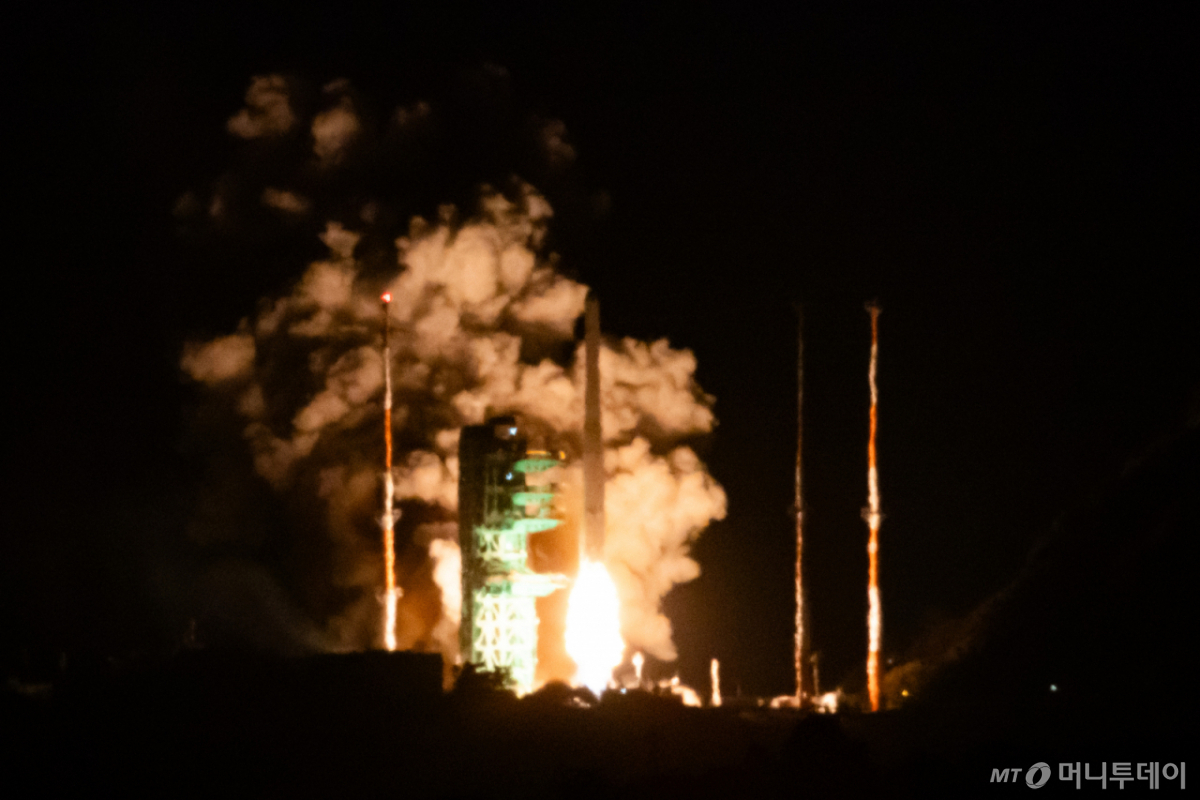
With the fifth launch of Nuri, Korea's space launch vehicle, just days away, all 15 satellites to be carried have arrived at the Naro Space Center in Goheung, Gwangju, South Jeolla Province, and are mounted on the main body of Nuri. This marks the largest number of payloads ever carried by Nuri.
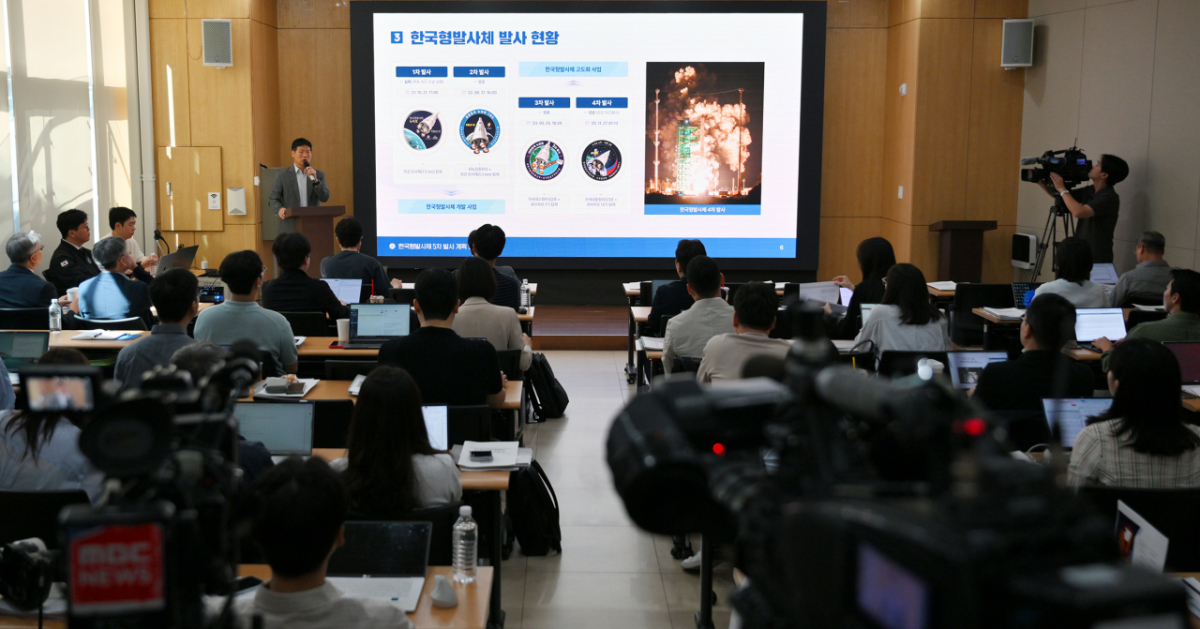
On the 15th, the Space Administration and the Korea Aerospace Research Institute (KARI) held a press conference near Gwanghwamun in Seoul to unveil the plans and key specifications for the fifth launch of Nuri.
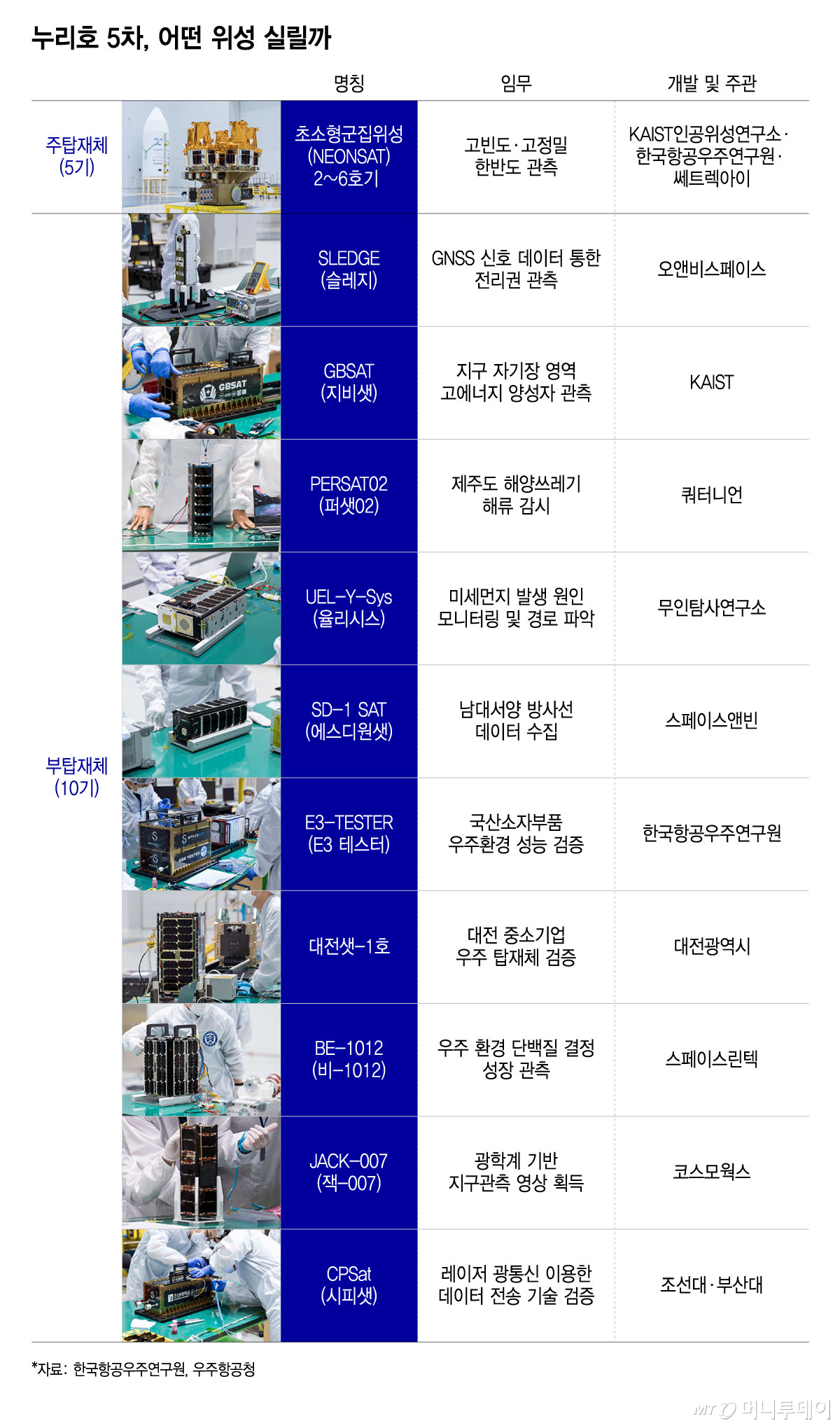
The target orbit for the fifth Nuri launch is a sun-synchronous orbit at an altitude of 570 kilometers with an inclination of 97.67 degrees. Along with five primary payloads, the 'Miniature Constellation Satellites No. 2 through No. 6,' ten cube satellites developed by domestic companies, universities, and research institutions will be carried as secondary payloads. A total of 15 satellites represent the highest number ever launched into space by Nuri.
The Miniature Constellation Satellites No. 2 through No. 6, developed by the Satellite Research Institute at KAIST (Korea Advanced Institute of Science and Technology), are satellites designed to conduct high-density, precise observations of the Korean Peninsula and surrounding waters from low Earth orbit. Following the launch of a prototype in 2024 and a verification satellite in 2025, this marks the first group of satellites launched in the Yangsan configuration. The plan is to complete the entire constellation of ten satellites by 2027, enabling the Korean Peninsula region to be photographed more than three times daily. The operational lifespan of the satellites, including the initial operation period, is three years.
The ten cube satellites carried as secondary payloads each have different purposes and functions. Cube satellites are small satellites with a basic unit (1U) defined as a cube measuring 10 centimeters in width, length, and height. 'Daejeon Sat-1,' developed by Daejeon City, will verify payload technologies developed by local SMEs (small and medium-sized enterprises) in orbit. It is significant because it will test its own developed 'Vibration Reduction Type 16U Satellite Ejection Tube.'
'UEL-Y-Sys' (Ullysis), developed by the Unmanned Exploration Research Institute, is a fine dust monitoring satellite. It measures ground-level fine dust using three types of instruments for comparison and analysis. It is expected to be utilized in future lunar exploration missions. O&V Space will launch 'SLEDGE,' an Earth atmosphere observation satellite. Its distinctive feature is the use of GNSS-RO (radio occultation) techniques that receive uniform microwaves at all times, enabling ionospheric observations without blind spots.
Space & Bin's 'SD-1 SAT' is a satellite that collects radiation data from the South Atlantic Ocean. It carries a space radiation detector protected by radiation shielding materials to verify material performance and collect various space radiation data. KAIST's 'GBSAT' is also a satellite designed to observe the space radiation environment. GBSAT measures the density of high-energy protons aligned with Earth's magnetic field.
There are also satellites demonstrating optical communication technology in space. Chosun University's 'CPSat' will experiment with a technology that transmits data using laser light instead of the 'RF' (radio frequency) traditionally used for satellite communications.
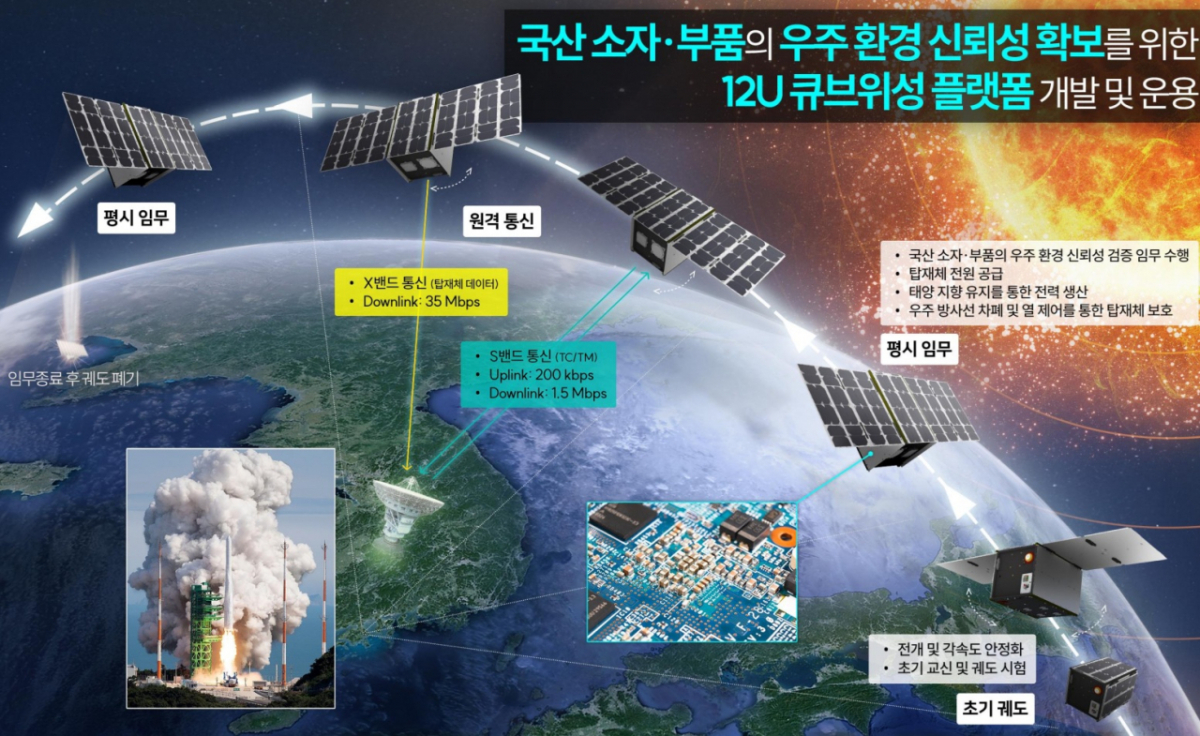
Space LinTech, Quaternion, and Cosmoworks will carry their own satellites on Nuri 5, following the fourth launch. Space LinTech is launching a new model called 'BEE-1012.' It is equipped with mobilerint's NPU (Neural Processing Unit)-based 'Onboard AI.' The explanation states that AI can immediately determine whether protein crystals are formed in the space environment and their growth stages. Following last year's 'PERSAT,' Quaternion will launch 'PERSAT-02,' a satellite for monitoring marine debris and ocean currents around Jeju Island. Cosmoworks will send 'Jack 007,' an Earth observation miniature satellite carrying more verification modules and systems than its previous models, 'Jack 003' and 'Jack 004.'
KARI's 'E3 Tester' will carry six domestic semiconductor devices and components on this launch, following last year's mission. These include: △SK Hynix DRAM and UFS △Insera Solution high-speed precision adjustment mirrors △CosmoV electric thruster 1A-class hollow cathodes △InterGravity orbital transport vehicle avionics testbeds △KAIST attitude determination and system modules, and △Momentum Space reaction wheels.
Meanwhile, the Nuri 5 launch vehicle is undergoing final assembly at the Naro Space Center ahead of its launch. All payloads have arrived at the Naro Space Center and were mounted on the upper stage of Nuri on the 14th. The total assembly of the launch vehicle is scheduled to be completed by the end of this month. The Space Administration will conduct a final inspection of the launch vehicle until the 5th of next month, and if no issues are found, it will transport Nuri to the launch pad the following day. The scheduled launch date is October 7. The launch time will be determined by the Launch Management Committee on the day of launch, taking into account weather conditions and the risk of collision with space objects.
Oh Tae-seok Woo Ju-cheong (Commissioner) stated, "The Space Administration and related institutional investors will make every effort to prepare for the launch until the last moment for a successful mission."

 in TECH


