

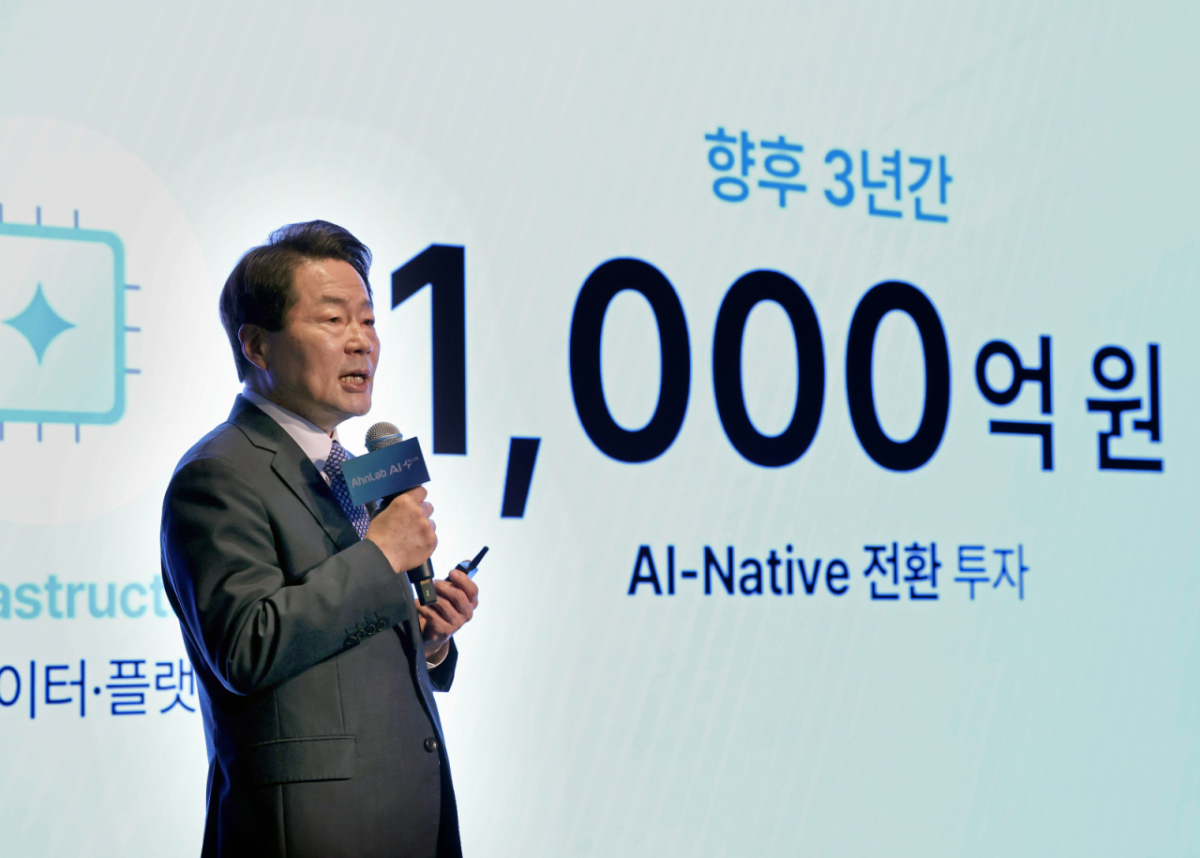
"We plan to invest an additional 100 billion won in the AI field over the next three years. We will achieve 1 trillion won in revenue and a 30% share of global sales by 2035."
Kang Seok-kyun An Raep (CEO) held a press conference on the 16th at Westin Seoul Parnas in Seoul Gangnam-gu and made these remarks. AhnLab invests about 30% of its annual revenue in research and development; the announced 100 billion won is additional investment for the AI field while maintaining the existing investment ratio.
Launch of 'AhnLab AI Plus'... Bridging the 'speed gap' between AI and humans
Today, AhnLab unveiled a new brand called 'AhnLab AI Plus.' It is a security system that connects data collection, judgment, and operation centered on AI. It consists of five elements: △'AI Decision Intelligence' for setting priorities and making decisions; △'AI Native Operation' automating the entire operational process; △'Exposure·Access Management' preventing attacks by minimizing risk exposure; △'Unified Security' linking various security functions; and △'Security Data Fabric' analyzing data both internally and externally.
This is to bridge the 'speed gap' that occurs when attacks accelerate due to AI while defense relies on humans. Kang (CEO) stated, "AI cyberattacks have already reached a level where human judgment and response are difficult in terms of speed, scale, and productivity," and explained, "AI cyberattacks are not so much about possessing new technologies but rather about increased speed and scale."
Today, detailed tasks were also presented: △a business structure centered on SaaS (Software as a Service), △AI-native security, and △security value and AhnLab's growth. First, the company will transition to an SaaS structure that allows for continuous updates, renewals, and expansion. This approach applies products as needed and expands flexibly, differing from on-premise (built-in) systems that introduce large-scale systems all at once.
Kim Chang-hee, AhnLab Je Pum-gi-hoek (Head), said, "This is a strategy to provide services previously possible only for companies with specialized organizations and institutional investors, going beyond simply moving products to the cloud," and added, "For enterprises with sufficient professional personnel, an environment will be created where repetitive tasks are reduced, allowing humans to focus on important decisions."
Global expansion was also considered. Kang (CEO) explained, "As the domestic SaaS share has been low, support for SaaS has been delayed," noting that "AhnLab has launched SaaS-based products three years ago in preparation for overseas expansion and is currently operating on a dual track with both on-premise and SaaS solutions."
Transformation to 'AI-Native Security'... Global expansion focuses on 'hub centers'
AI-native security is a new system that redesigns products, services, and security centered on AI. It is a concept developed from the existing 'AI-powered' approach of applying AI to individual products, expanding AI application across the entire business system beyond individual products.
AhnLab plans to build an 'Agentic AI-based architecture.' When AI analyzes risk signals coming from individual products and reconstructs them into single incidents while presenting priorities, security personnel can focus on important risks and judgments regarding response measures.
In this process, the principle of 'controlled autonomy' is applied. AI's judgment, actions, and data access processes are recorded and reviewed, and major measures require user approval. Lee Seung-kyung, AhnLab Ji Neung-gae-bal (Head), explained, "AI collects, selects, and investigates numerous security signals to find 'meaningful threats,'" adding, "It is not simply a method of providing many detection results."
For global expansion, AhnLab will use its local subsidiaries in China and Japan, as well as 'Lakin,' a joint venture (JV) established with Saudi Arabia, as hubs. Kang (CEO) stated, "Last year, AhnLab's overseas revenue share was about 8.5%, and this year it is expected to exceed 10%," noting that "As demands for securing sovereignty over AI data arise in each region, we plan to establish 'Cyber Defense Centers' in hub regions to provide support."

 in TECH

