

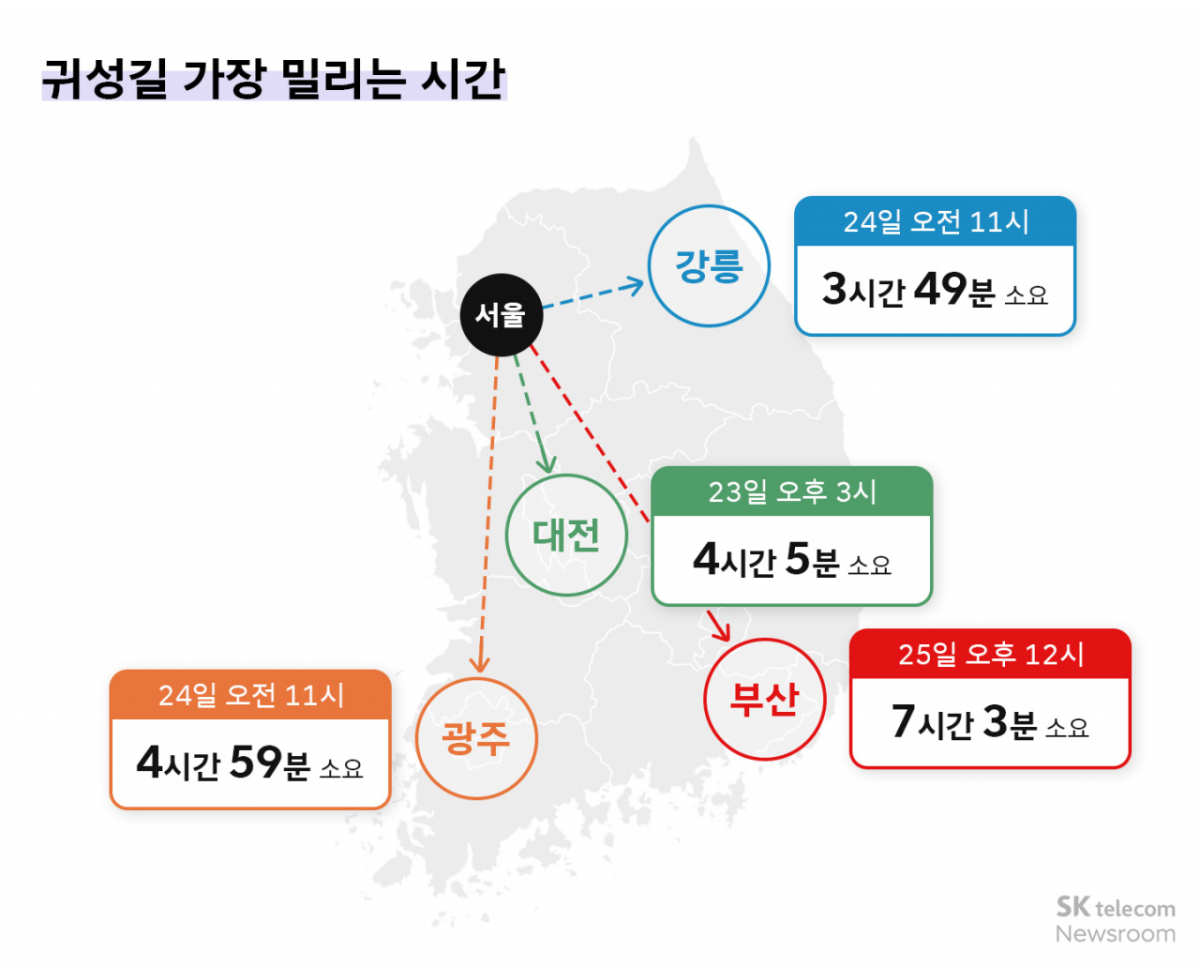
This year's Chuseok outbound travel congestion is expected to be spread over three days, while the return journey will concentrate on Chuseok day itself, the 25th.
Tmap Mobility and SK Telecom announced on the 17th the estimated travel times by major route segments based on an analysis of Tmap movement data during past Chuseok holiday periods.
Congestion timing for the outbound journey varies by segment. For the Seoul~Daejeon route, departing at 3 p.m. on the day before the holiday, the 23rd, is expected to take 4 hours and 5 minutes.
On the 24th, the Seoul~Gwangju and Seoul~Gangneung routes are forecast to be the most congested. Based on an 11 a.m. departure, estimated travel times are 4 hours and 59 minutes for Seoul~Gwangju and 3 hours and 49 minutes for Seoul~Gangneung.
For the Seoul~Busan route, departing at noon on Chuseok day itself, the 25th, is expected to take 7 hours and 3 minutes, making it the longest travel time of this year's outbound journey. This is approximately two hours longer than usual.
To avoid outbound congestion, it is advantageous to depart between late night on the 23rd and early morning on the 24th. Traffic flow on major routes is also expected to return to normal levels after 7 p.m. on the 24th and after 5 p.m. on the 25th.
For the return journey, congestion is expected to increase starting at 8 a.m. on the 25th, peaking around noon. Based on a noon departure on the 25th, travel times are estimated at 8 hours for Busan~Seoul, 6 hours and 23 minutes for Gwangju~Seoul, and 4 hours and 20 minutes for Daejeon~Seoul. For Gangneung~Seoul, departing at 1 p.m. is expected to take 3 hours and 54 minutes.
In particular, the Busan~Seoul route is analyzed as taking approximately two hours and 30 minutes longer than usual, making it the longest travel time among major return routes. Reverse return vehicles traveling from Seoul to local areas are also expected to peak at noon on the 25th.
On the 26th, travel times for major return routes are forecast to decrease by one to two hours compared to the previous day's peak congestion period. On the last day of the holiday, the 27th, most routes except some sections of Busan~Seoul are expected to return to normal levels.
Tmap Mobility provides information on rest area facilities, drowsy driving rest stops, and electric vehicle charging status during the holiday period. Upon entering a rest area, facility locations and recommended driving routes are displayed on the Tmap screen, and real-time availability of fast and slow chargers can also be confirmed.
Information such as highway toll exemptions, newly opened roads, bus-only lane operating sections, and temporary shoulder road allowances will also be reflected in route guidance.

 in TECH
