

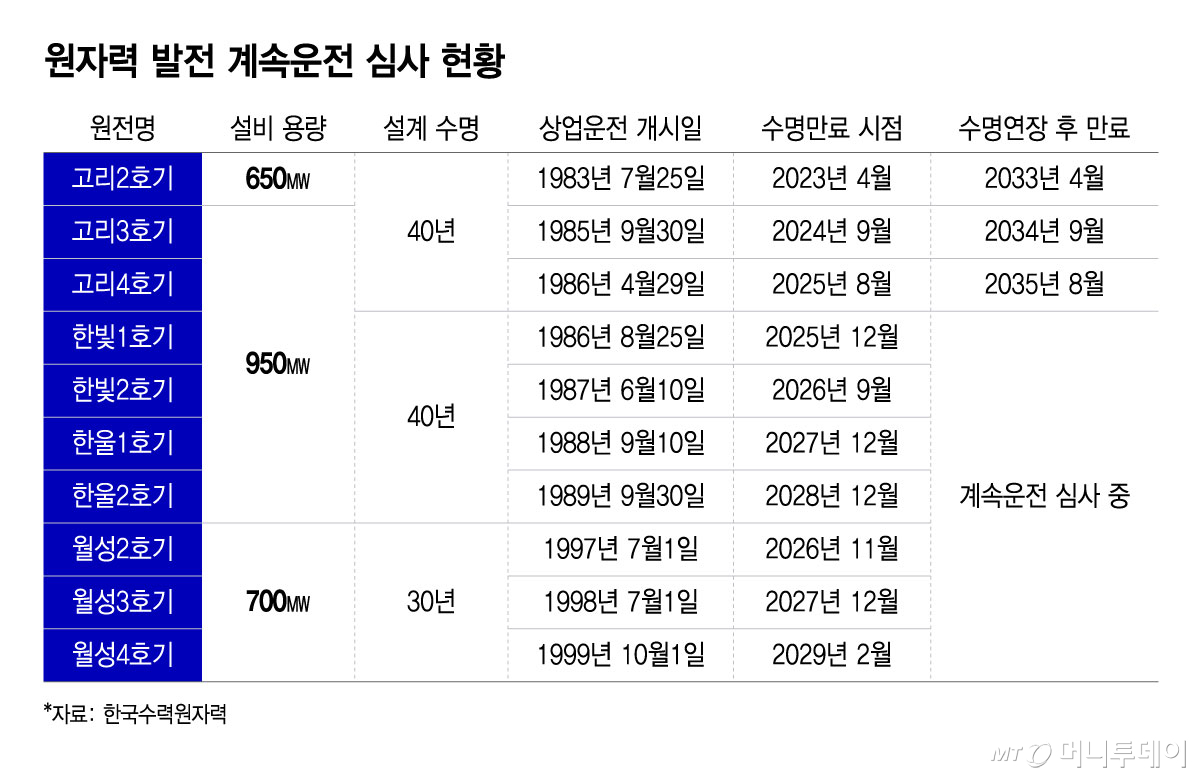
With the Nuclear Safety and Security Commission (hereinafter NSSC) approving the extended operation of Units 3 and 4 at the Gori Nuclear Power Plant in Gimhae, Busan, up to an additional 1,900 megawatts (MW) of power will be secured starting in the first half of 2027. This amount of electricity is sufficient to operate six semiconductor fabs and 19 data centers, each with a capacity of 100 MW. The AI (artificial intelligence) and semiconductor industries, which must respond to surging power demand, welcomed the news.
According to nuclear power and industry sources on the 2nd, the prevailing interpretation is that the NSSC, which had previously taken a cautious stance on extended operations, decided to grant its second extended operation permit with an eye toward power demand in the AI era and the government's "three mega-projects."
To build AI competitiveness in the global market, high-performance model development alone is not enough; AI data centers (AIDC) are also needed, and semiconductor equipment must be expanded to construct them. Ultimately, securing a stable power supply source is the first challenge that must be addressed.
In fact, Goldman Sachs, a major global investment bank, reported that U.S. data center power demand will increase by 38% this year and in 2027, respectively, and expressed concern about power issues stemming from △the expansion of substations and transmission lines, △delays in grid connection permitting procedures, and △construction delays for new gas and nuclear power plants. Jason Topfer, head of the global digital infrastructure investment banking division at Goldman Sachs, recently emphasized in a report titled "Securing Power in the AI Era" that "while big tech companies can purchase GPUs (graphics processing units) with massive funds, it is ultimately electricity that determines whether those servers can be powered on."
The industry maintains that the seven nuclear units currently awaiting extended operation review should continue operating without interruption and proceed to extended operation. Previously, Units 2, 3, and 4 at Gori, which received extended operation permits after their design lifespans expired, all experienced temporary power supply interruptions due to delays in extended operation reviews and maintenance deadlines required for restarts, ultimately failing to fully utilize the 10th-year extended operation period that was permitted.
[Production support: Ministry of Culture, Sports and Tourism, Public-Centered Communication Activation Project]

 in TECH
