

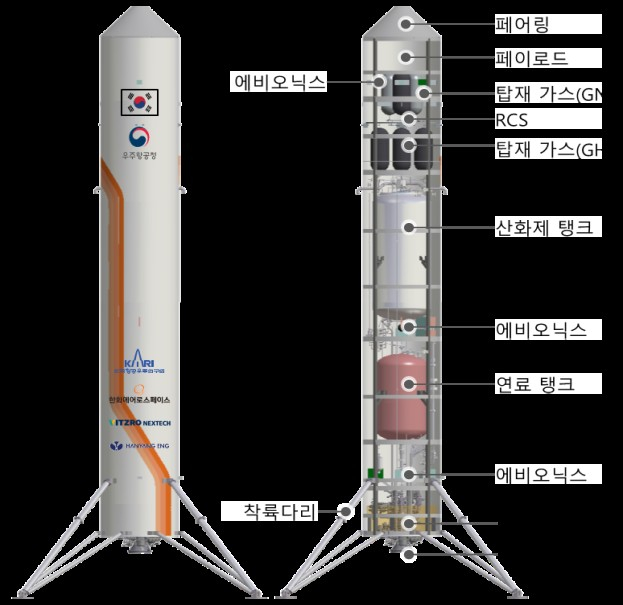
As the next-generation launch vehicle, which will succeed the “Korean-made launch vehicle” Nuri, is being developed as a reusable “reusable launch vehicle,” the Korea Aerospace Research Institute plans to launch its first reusable flight model in 2028.
The Korea Aerospace Research Institute announced on the 29th that it has begun assembling the first unit of the reusable technology demonstrator flight model at the Hanwha Aerospace Suncheon assembly plant. A reusable launch vehicle is a technology that recovers propellants launched into space and brings them back to the ground for use in subsequent launches. It can reduce launch vehicle manufacturing costs, making it more economical than existing single-use launch vehicles. SpaceX’s “Falcon 9” from the U.S. aerospace company is a representative example of a reusable launch vehicle.
The reusable technology demonstrator is an experimental flight vehicle used to verify related technologies before the actual development of a reusable launch vehicle. The “RV-X” launched by Japan in July was also a reusable technology demonstrator. At the time, Japan succeeded in a vertical takeoff and landing test, joining the ranks of countries developing reusable launch vehicles.
Last year, Korea changed the goals of its next-generation launch vehicle project under the leadership of the Aerospace Research Institute. As a result, the next-generation launch vehicle, originally planned as a single-use launch vehicle, will now be developed as a methane-based reusable launch vehicle.
The reusable technology demonstrator that the Aerospace Research Institute has begun assembling is 12.2 meters tall and weighs 6.4 tons (t). It is equipped with an 8-ton-class engine, which is smaller than the 80th-ton-class engine being developed for the reusable next-generation launch vehicle. The goal is to conduct a low-altitude vertical takeoff and landing flight test at the Naro Space Center in 2028 after completing final assembly and various ground tests.
Participation from private companies is also notable. Hanwha Aerospace is responsible for the system, Bitsro Nextech for the engine, and Hanyang Engineering for the ground equipment.
The Aerospace Research Institute plans to complete combustion tests for two engine flight models and assembly and functional tests for the first unit of the demonstrator flight model by 2027. In 2028, after conducting a ground combustion test on the first unit, it will carry out two flight tests to verify vertical takeoff and landing performance and the technologies required for reusability.
Lee Sang-cheol (Director) stated, “We will advance engine verification, demonstrator development, and flight tests in stages together with private companies to establish the technical foundation necessary for developing reusable launch vehicles.”

 in TECH
