

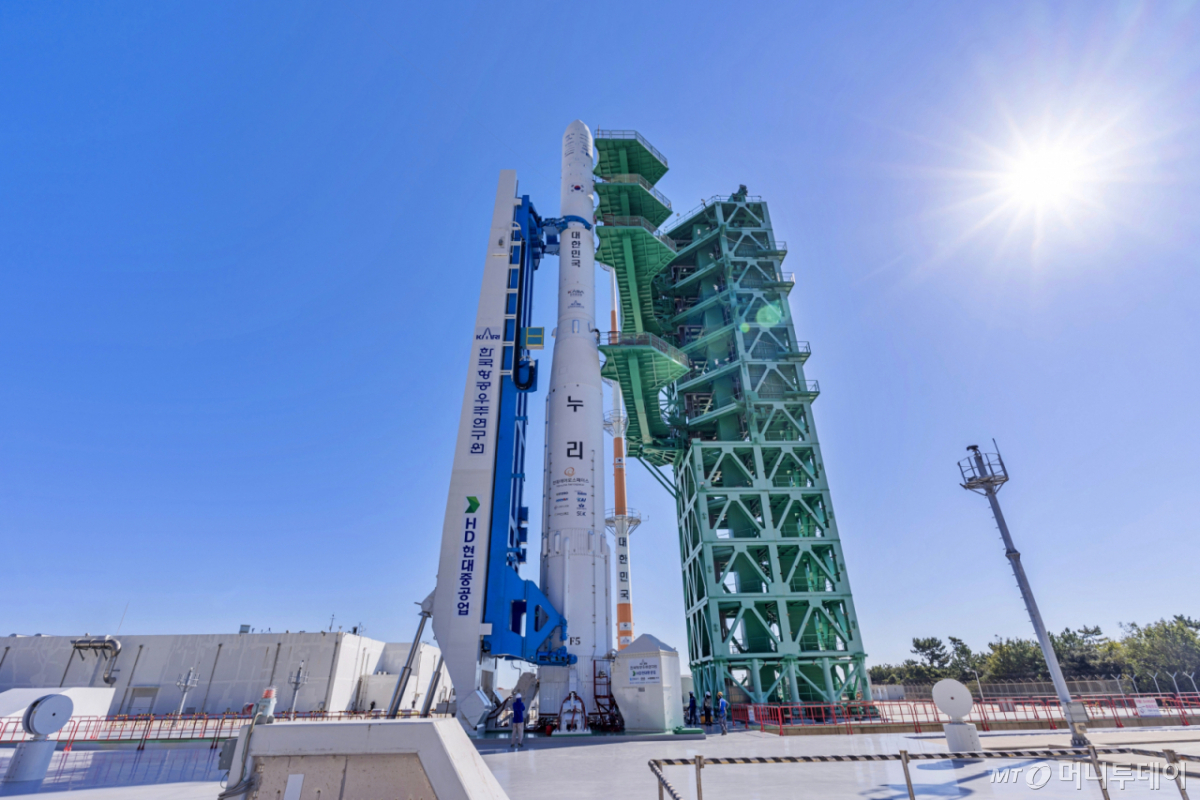
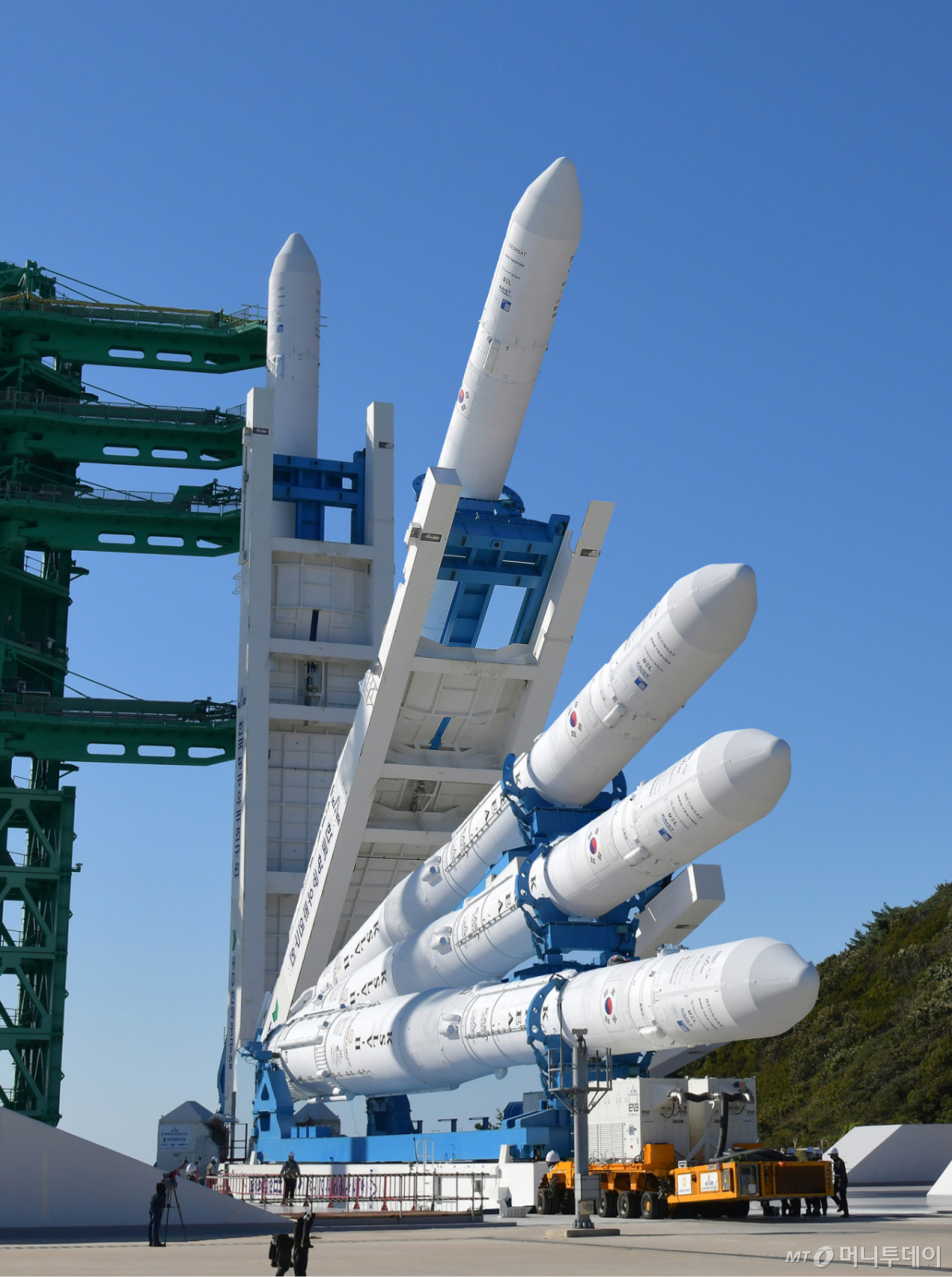
The Korean-made Nuri 5 rocket, scheduled for launch this afternoon, has been transported to the launch pad at Launch Site No. 2 of the Naro Space Center in Goheung, South Jeolla Province, and has completed its vertical erection.
The Korea Aerospace Research Institute (KARI) announced that it completed the process of erecting and securing the Nuri rocket on the launch pad at 10:35 a.m. on the 6th.
From this afternoon, preparations for the launch will proceed, including connecting umbilical lines to supply power and propellants (fuel and oxidizer) to the Nuri rocket, as well as conducting leak-tightness inspections.
A total of 15 payloads, the highest number in history, have been loaded onto Nuri 5. These include five microsatellite constellations (units 2 through 6) and 10 CubeSats developed and manufactured by domestic industry, academia, and research institutions. The primary payload, the Microsatellite Constellation units 2 through 6, are satellites designed to conduct high-density, precise observation of the Korean Peninsula and surrounding waters from low Earth orbit. This is the first satellite group to be launched in the Yangsan configuration, following the launch of a prototype in 2024 and a verification unit in 2025.
Also loaded are: △Domestic Component Verification Satellite (KARI) △DaejeonSat-1 (Metropolitan City of Daejeon) △BEE-1012 (SpaceLintek) △Sejong 5 (Hancom Inspace) △UEL-Y-Sys (Unmanned Exploration Research Institute) △SLEDGE (O&B Space) △PERSAT-02 (Quaternion) △COMMAND v1 (Perigee Aerospace) △CPSat (Chosun University, Pusan National University) and △GBSAT (KAIST).
Encouraging messages from the public gathered through the "Dream Capsule Project" will also be sent into space. The Korea Space Agency collected cheering messages to be carried on Nuri 5 via its website until the end of August.
Nuri 5 is expected to launch between 12:23 p.m. and 1:23 p.m. on the 7th. The Launch Management Committee, which will convene in the morning on the 7th, will comprehensively review technical readiness status, the launch window (time of possible launch), weather conditions, and the possibility of collision with space objects to determine the final launch time for Nuri.

 in TECH

