

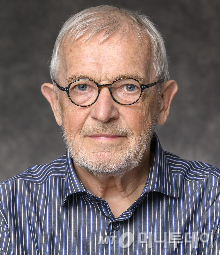
The 2026 Nobel Prize in Physics went to particle physicist Francis Halzen for uncovering the secrets of "neutrinos," high-energy particles that carry information about the origin of the universe. He is the sole recipient of this year's prize.
On the 6th (local time), the Nobel Committee of the Royal Swedish Academy of Sciences selected Professor Francis Halzen of the University of Wisconsin-Madison, United States, as the laureate for the 2026 Nobel Prize in Physics.
The Royal Swedish Academy of Sciences stated that the selection was made "for his decisive contribution to the IceCube Neutrino Observatory and for the discovery of astrophysical high-energy neutrinos."
Neutrinos are generated when high-energy cosmic rays collide with atoms, and they are the most fundamental particles that make up all matter. With a mass close to zero, they move at speeds approaching that of light. Hundreds of billions of neutrinos fall to Earth every second, but because their interactions are extremely rare, they are difficult to detect.
Professor Halzen succeeded in capturing neutrinos by using ice located 2 kilometers underground in Antarctica as a giant "water tank." This was the "IceCube Project" in 2013. He observed the light produced when neutrinos collide with water molecules within the ice. It is the first study to detect ultra-high-energy neutrinos that reached Earth from distant space.
Based on this discovery, in 2017, he collaborated with ground-based and space-based gamma-ray telescopes to identify the source of neutrino emission: "blazars," galactic nuclei containing supermassive black holes.
Yang Un-gi, a professor of physics at Seoul National University Cheon Mun-hak-bu (Prof.) (Director of the Institute for Nuclear Particle Astrophysics), described this selection as "a monumental figure in the field of astrophysics" and explained that he is "the first researcher to detect neutrinos, which are the origin of the universe and had not previously reached Earth, using Antarctic ice."
The recipient of this year's Nobel Prize in Physics will receive a prize money of approximately 1.6 billion won. If there are three laureates, the prize money is divided equally into thirds. The award ceremony will be held in Stockholm, Sweden, in December.

 in TECH
