

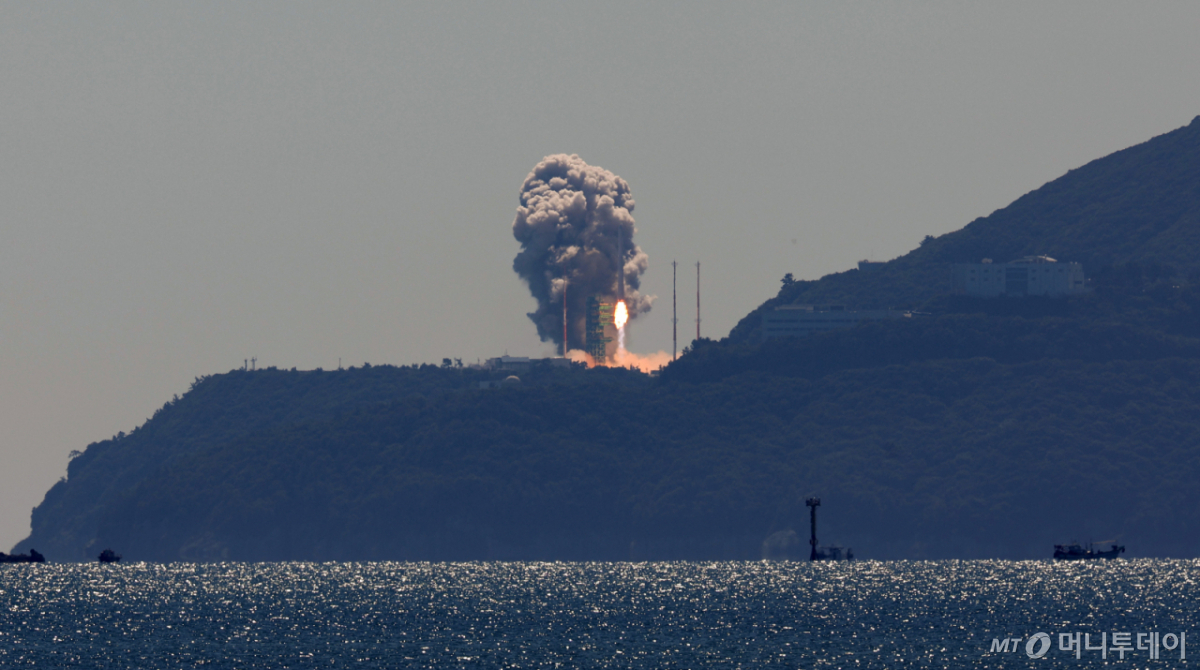
The 'Korean-made launch vehicle' Nurihwa No. 5 was launched from the Naro Space Center in Goheung, South Jeolla Gwangju, on the 7th.
Nurihwa took off as scheduled at 12:25 p.m. that day. After liftoff, it flew south along a launch azimuth of 170° to ensure safe flight during the thrust phases of the first and second stages.
Approximately 2 minutes and 3 seconds after launch, the first stage of the rocket separated. About 3 minutes later, following the separation of the fairing, the second stage also separated about 4 minutes after launch. The predicted splashdown points for the △first stage, △fairing, and △second stage are in international waters located approximately △396 km, △1,587 km, and △2,667 km from the launch site, respectively.
Subsequently, upon reaching an altitude of approximately 575 km, it began the first satellite deployment. This was the main payload, the Microsatellite Cluster Satellite No. 2. It occurred about 13 minutes after the launch time. Following this, they were successfully separated one by one at intervals of 35 to 40 seconds. Since satellites are deployed at intervals of a few seconds, a separation sequence involving rotating the rocket body by 30 degrees and 50 degrees in space was applied to prevent collisions between satellites.
The deployment of secondary payloads was also carried out. Nurihwa No. 5 carried 10 CubeSats developed by domestic industry, academia, and research institutions. The CubeSats were released two at a time at 10-second intervals. As a result, Nurihwa successfully deployed all the satellites it carried around 12:42 p.m., approximately 17 minutes after launch.
Around 12:44 p.m., Nurihwa's autopilot was terminated. This means that the third stage of the rocket has completed all maneuver controls in the pre-planned flight sequence. Along with this, Nurihwa No. 5 officially ended its mission. The remaining third stage will continue flying and drift through space.

 in TECH
