

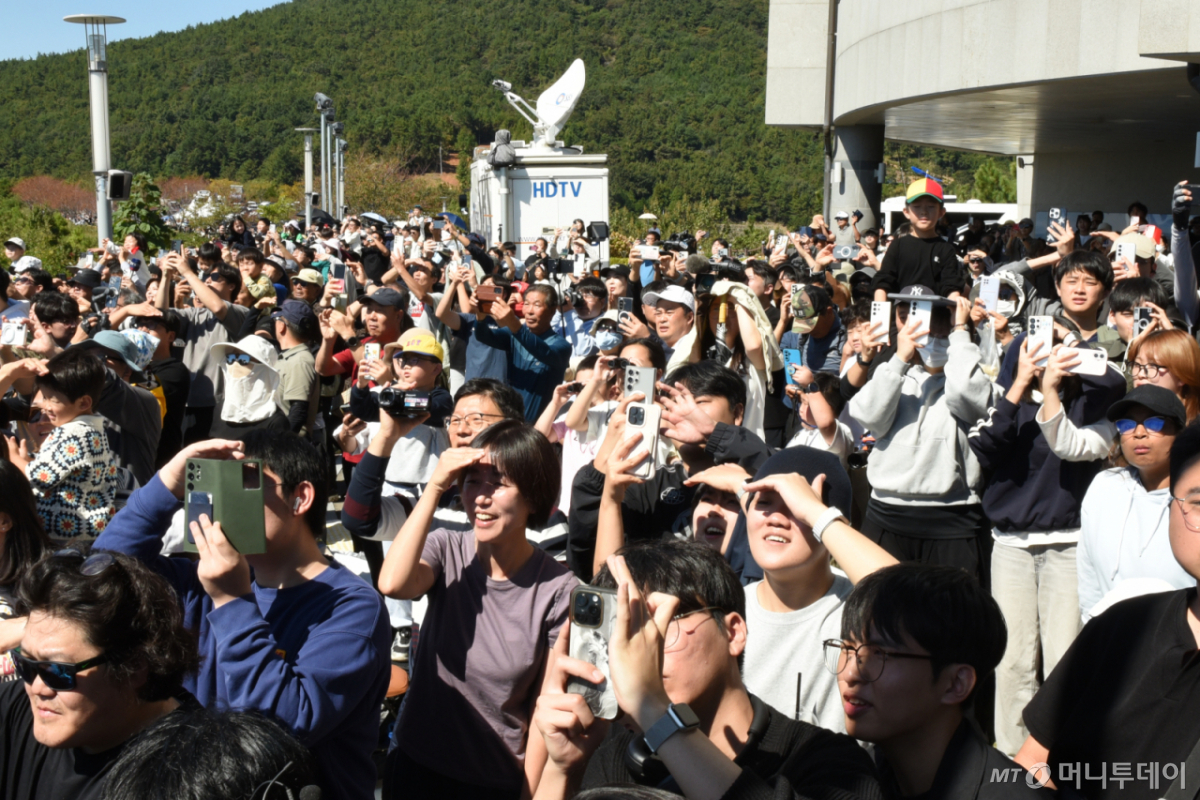
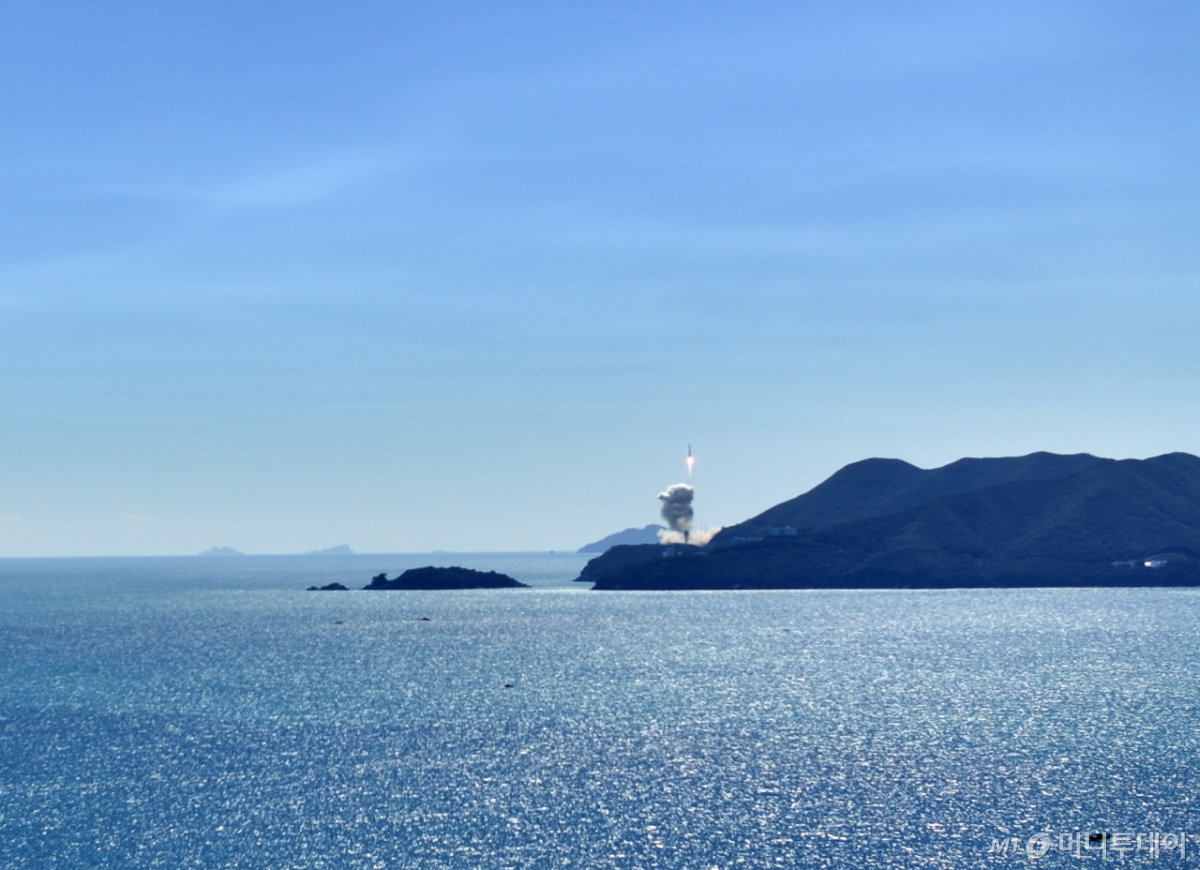
The "Korean-made rocket" Nuri No. 5 was launched at 12:25 p.m. on the 7th from the Naro Space Center in Goheung, Gwangju, South Jeolla Province. This is the first time a launch has been carried out precisely according to the scheduled time without any pre-launch plan changes or delays. The Nuri 5th mission successfully placed all five primary payload micro-satellite constellations into their target orbits and nine of the ten secondary payloads.
Nuri No. 5 lifted off as scheduled at 12:25 p.m. on the day. Oh Tae-seok (Commissioner) stated immediately after the end of the Nuri 5th flight that it was "the first case in Nuri's history where a launch occurred at the scheduled time."
In reality, the 1st launch in 2021 was delayed by one hour due to system checks from its original 4 p.m. slot. It also failed to place the satellite simulator into orbit after launch. The 2nd launch in 2022 was postponed from June 15 to June 21 due to a sensor malfunction. The 3rd launch in 2023 was also delayed by one day. The 4th launch in 2025 was delayed by 18 minutes after an anomaly was detected in the sensor signal just minutes before launch.
After taking off on time, Nuri flew south following a 170-degree launch azimuth during the first and second stage thrust phases. Approximately 2 minutes and 1 second after launch, the first stage of the rocket was separated; fairing separation occurred approximately 3 minutes and 51 seconds later, and the second stage separation was successful approximately 4 minutes and 22 seconds later. The separated first stage, fairing, and second stage are estimated to have fallen into international waters at distances of approximately 396 km, approximately 1,587 km, and approximately 2,667 km from the launch site, respectively.
Nuri No. 5, satellite delivery "complete"
Upon reaching the target altitude of approximately 575 km, Nuri began its first mission. The continuous ejection of five micro-satellite constellations was a criterion for determining the success of the Nuri 5th launch and was considered the highest difficulty level of this mission. The micro-satellite constellation is an observation satellite for the Korean Peninsula, with each unit weighing less than 100 kg. Nuri was tasked with placing the five satellites into orbit one by one at intervals of approximately 35 to 40 seconds. The key was ensuring that the satellites did not collide with each other during ejection. Nuri succeeded in the high-difficulty technology "separation sequence," which involves rotating the upper stage directly by 30 degrees and 50 degrees respectively to place the satellites into orbit sequentially. At the moment the ejection of the five primary payload satellites was confirmed, cheers and applause erupted from the Mission Control Center overseeing the Nuri launch.
Of the ten secondary payloads, nine were ejected. Nuri No. 5 carried 10 CubeSats developed by domestic industry, academia, and research sectors, including △Domestic Device/Component Verification Satellite (KARI) △DaejeonSat-1 (Daejeon Metropolitan City) △BEE-1012 (SpaceLintec) △Sejong No. 5 (Hancom Inspace) △UEL-Y-Sys (Unmanned Exploration Research Institute) △SLEDGE (O&B Space) △PERSAT-02 (Quaternion) △COMMANDv1 (Perigee Aerospace) △CPSat (Chosun University, Pusan National University) △GBSAT (KAIST). Among these, the ejection of Quaternion's "Persat-02" failed because its ejection tube did not open. The exact cause is under analysis. The remaining nine CubeSats were released two at a time at 10-second intervals.
The Nuri 5th launch officially ended at 12:45 p.m.
Meanwhile, in this launch, Hanwha Aerospace, the system integration company for Nuri, participated in all processes from launch preparation to ignition. Of the 22nd consoles in the Launch Control Center, 20 were manned by Hanwha Aerospace employees, with 18 people directly operating them. Hanwha Aerospace was also responsible for the launch countdown and progress management.

 in TECH

