

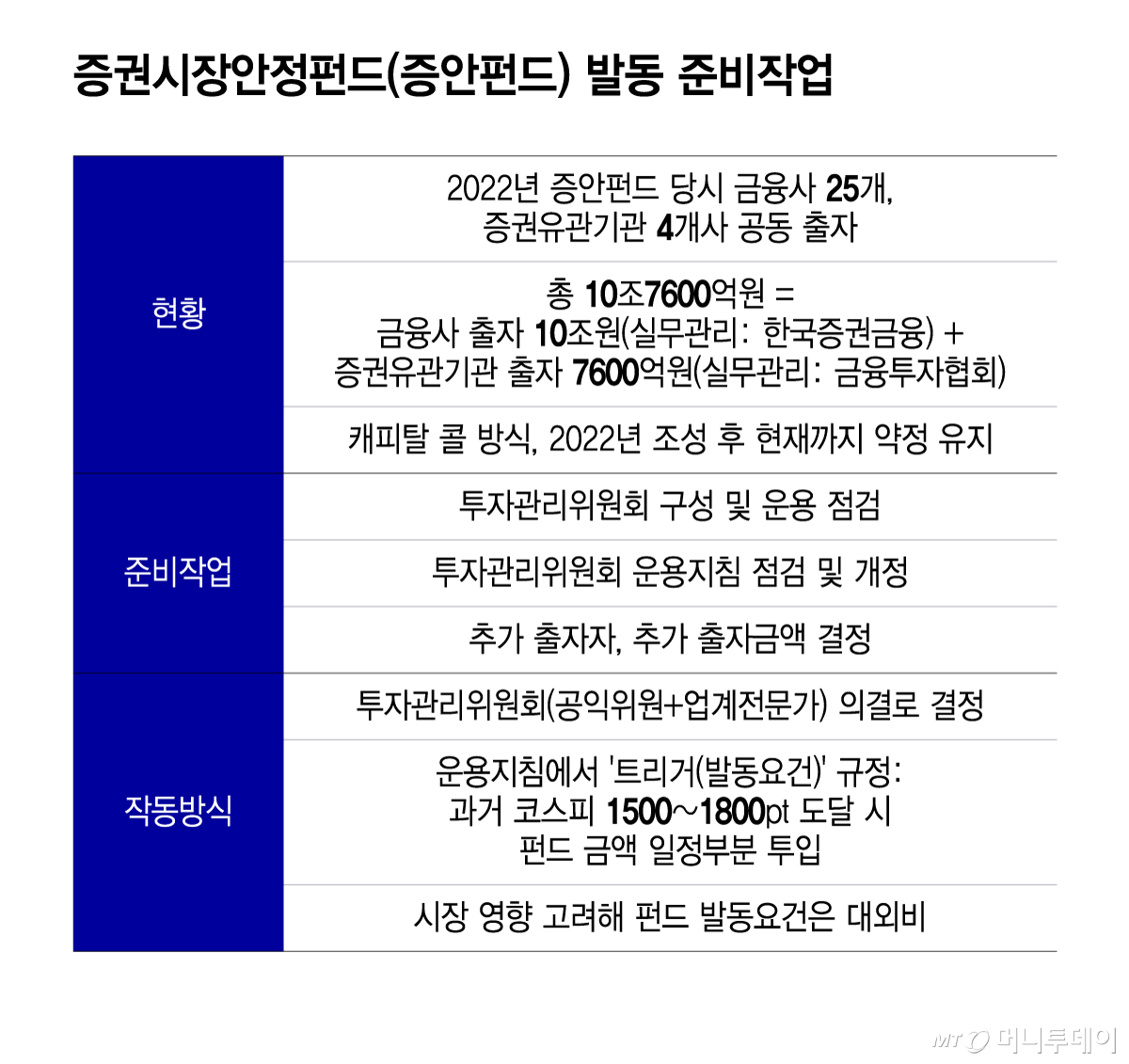
Financial authorities are accelerating preparations to activate the Securities Market Stabilization Fund to stabilize the stock market. They are revising the deployment criteria, which were previously set at KOSPI levels of 1,500 to 1,800, and reviewing whether to raise additional funds. By loading up on "ammunition" that can be used at any time during a sharp decline, they aim to send a signal to the market that they will not tolerate a plunge.
According to financial authorities and the financial investment industry on the 23rd, the Financial Services Commission has led the launch of preparatory work, including establishing an activation system for the Stabilization Fund and enhancing its effectiveness.
The financial authorities and fund investors are reportedly set to discuss the composition of the Investment Management Committee, operational guidelines, and the fund's execution index (activation conditions). The Stabilization Fund is a market stabilization tool designed to prevent further stock price crashes during market panic situations by establishing a separate fund to purchase stocks.
The core issue is changing the "execution index," which determines when and how much capital will be deployed.
According to the financial investment industry, existing operational guidelines are based on KOSPI levels of 1,500 to 1,800. Now that KOSPI is fluctuating between 4,000 and 5,000, new operational guidelines must be established regarding the timing (execution index) and scale (execution amount) of fund deployment.
The 10 trillion won capital contribution agreement from financial institutions, with practical operations handled by Korea Securities Finance Corporation, will be decided through the Investment Management Committee.
The committee is composed of representatives of financial institutions that invested funds and external public interest commissioners. Given the time elapsed since its initial establishment, there is a high likelihood that the committee's composition and operational guidelines will be comprehensively reorganized.
The currently agreed Stabilization Fund capital stands at 10.76 trillion won, established in 2020 and re-agreed upon in 2022. This amount comprises the 10th trillion won committed by financial institutions such as KB Kookmin Bank, Shinhan Bank, Hana Bank, Woori Bank, IBK Industrial Bank of Korea, and Industrial Bank of Korea, plus 760 billion won raised by securities-related agencies.
The Stabilization Fund raises capital through a capital call method, where financial and securities firms agree to contribute under specific conditions.
Discussions on additional fund establishment are also expected. According to the Korea Exchange, foreign net selling reached 7.733 trillion won in a single day on June 29 this year, accounting for approximately 72% of the total Stabilization Fund commitment. If foreign selling pressure remains intense, deploying the entire Stabilization Fund would be insufficient to defend the index.
Financial authorities are not disclosing specific details such as operational guidelines or whether additional funds will be raised. This is because informing the market about when and how much capital will be deployed, or whether additional funds will be raised, could conversely increase volatility. The financial sector analyzes that "the authorities are intentionally maintaining strategic ambiguity."
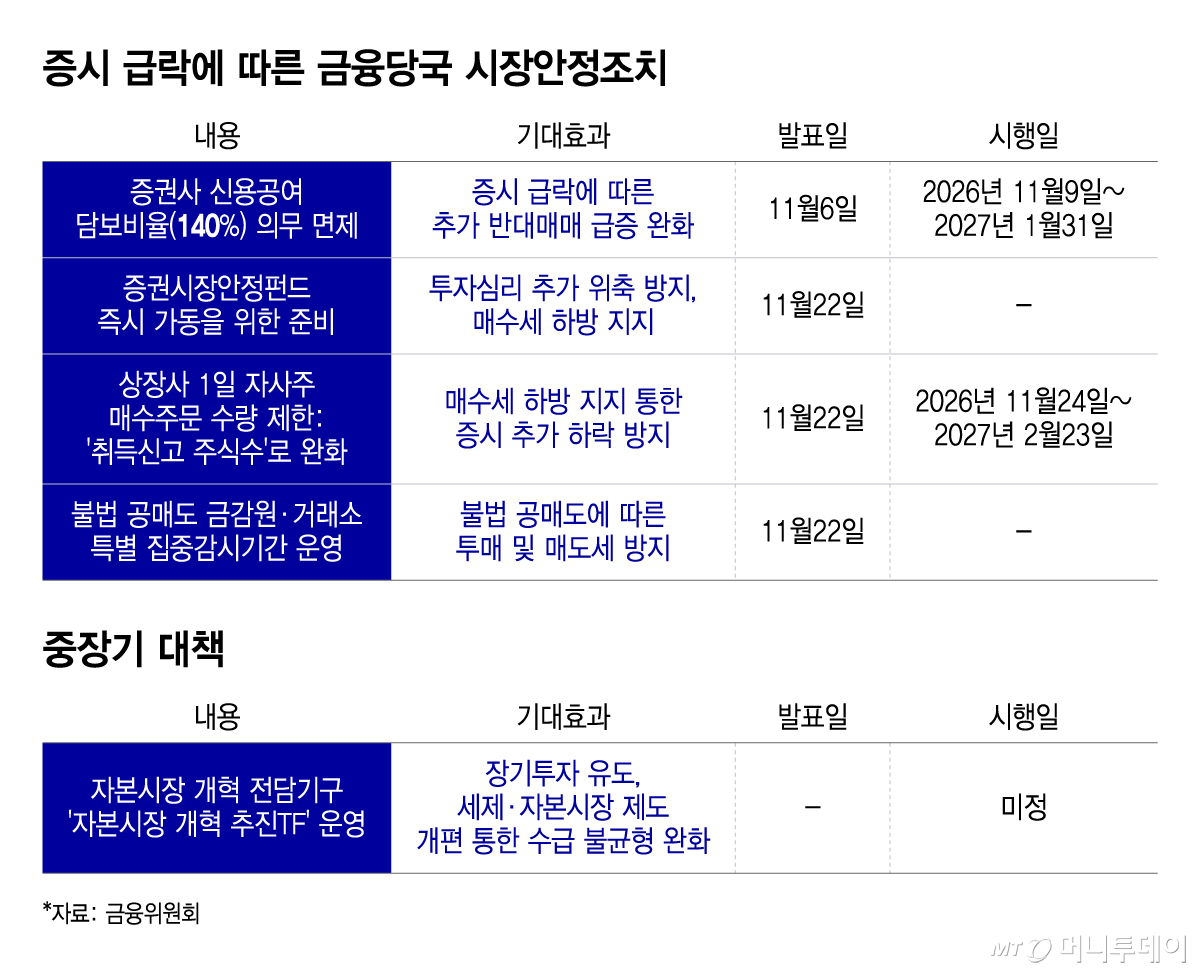
Financial authorities have also deployed all three components of the "Market Stabilization Measures Package" implemented during the 2022 stock market plunge. Following a regular meeting of the Financial Services Commission on that day, they relaxed the daily buy order quantity for listed companies' treasury shares to "the total number of shares in the acquisition report."
They are also operating a special intensive monitoring period for illegal short selling and have temporarily exempted securities firms from the obligation to maintain a 140% collateral ratio for credit lending since the 9th.
Various opinions are emerging in the market regarding the effectiveness of the Stabilization Fund. A financial sector official stated, "The Stabilization Fund is more significant as a tool for 'a battle of momentum against selling forces.' In reality, if funds are depleted within days after deployment, the problem could worsen."
The official added, "It is a double-edged sword: deploying it removes one emergency measure, while not deploying it makes it difficult to ensure the effectiveness of countermeasures." Han Ji-young, a researcher at Kiwoom Securities, analyzed, "While there is a possibility of improving supply and demand through actual capital deployment, the signal itself that the market will not tolerate a sharp decline can have an effect of calming supply and demand instability."

 in STOCK

