

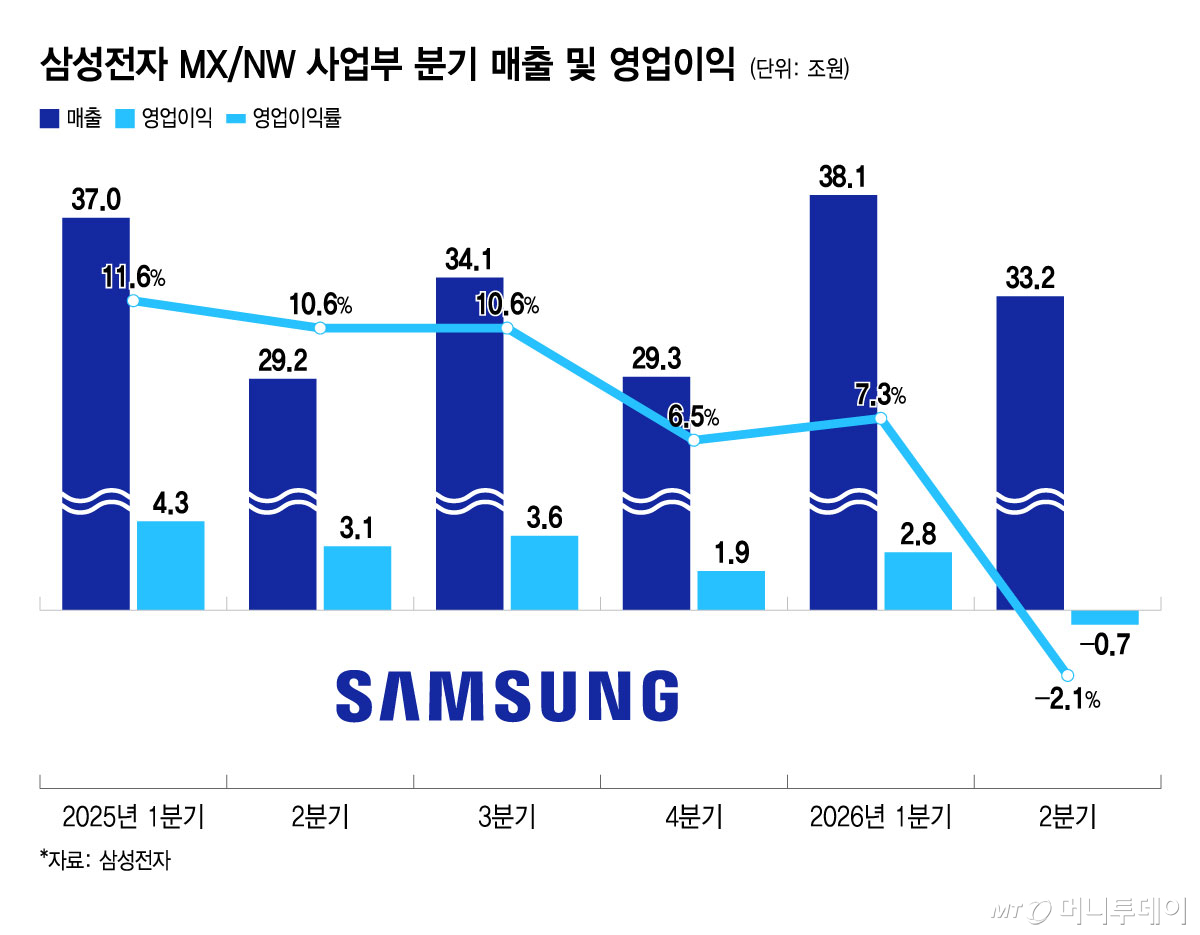
Samsung Electronics' Mobile eXperience (MX) division has pulled out the card of adjusting smartphone production volumes. This is interpreted as a desperate measure in response to the current structure of the smartphone market, where selling products does not yield significant profits. It is the result of surging semiconductor and memory prices in the AI era leading to a deterioration in the division's operating profit margin.
According to Samsung Electronics and Meritz Securities on the 7th, the operating loss of Samsung Electronics' Mobile eXperience division (including the Network division) turned into a deficit of 700 billion won in the second quarter of this year and is expected to expand to 1.9 trillion won in the third quarter. Additionally, Meritz Securities projected that, excluding the first quarter of 2027, which reflects seasonal factors such as graduation, new school terms, and new product launches and is expected to record operating profits in the range of 1 trillion won, losses will occur in all quarters from the second to the fourth quarter of 2027, ranging from 600 billion to 900 billion won.
The industry points to rising memory prices, which directly impact costs, as the background for the deterioration in Samsung Electronics' Mobile eXperience division's operating profit margin. It is explained that memory prices used in smartphones have surged more than double compared to last year, increasing cost burdens and ultimately leading to a decision to cut production volumes by up to 30%.
Although pre-orders for the Galaxy Z Fold 8 series launched by Samsung Electronics in July of this year recorded 1.44 million units domestically and 5 million units globally, and sales momentum continued with increased third-quarter production, it is interpreted that these efforts are insufficient to improve the Mobile eXperience division's operating profit.
There is also an interpretation that this was a judgment considering the seasonal characteristics of the fourth quarter, when product sales decrease due to the impact of demand waiting for new products expected in the first quarter of next year, and the fact that the burden of rising memory prices cannot be immediately reflected in product shipping prices given the nature of products where consumer price increases directly lead to decreased demand. The fact that smartphone replacement cycles are lengthening, exhibiting the characteristics of "durable goods" (items used for a long period after a single purchase, like automobiles), as product prices have exceeded 5 million won at their peak, was also cited as one of the causes for production cuts.
However, Samsung Electronics continues to move to reflect costs by raising launch prices for both existing and new products. Samsung Electronics recently raised the price of its premium tablet, the "Galaxy Tab S12 Ultra," by up to 25% compared to the previous model, depending on specifications. The successor to the basic model priced at 998,000 won at the time of the S11 launch was excluded from the new product lineup.
In addition to raising the shipping price of the Galaxy S26, currently a flagship smartphone model, by 11.6% starting this month, Samsung Electronics has also raised the shipping prices of some models of the Galaxy S25 Edge, Z Fold 7, Flip 7, and mid-to-low-priced products such as the Galaxy A, F, and M series since the beginning of this year. The "passport-style foldable phone" Galaxy Z Fold 8, announced as a flagship product for this year, also underwent cost-saving efforts, such as excluding the 200th-megapixel wide-angle camera included in the top-tier model, to lower the product shipping price to the 2nd million won range.
Kim Sun-woo, a researcher at Meritz Securities, assessed the background of Samsung Electronics' Mobile eXperience division's deficit by stating, "In the set (finished product) business, the proportion of component costs such as memory is rising sharply," and added, "Efforts to minimize losses are unavoidable amid the transformation into durable goods characterized by 'price increases leading to reduced sales volumes.'"

 in TECH
