

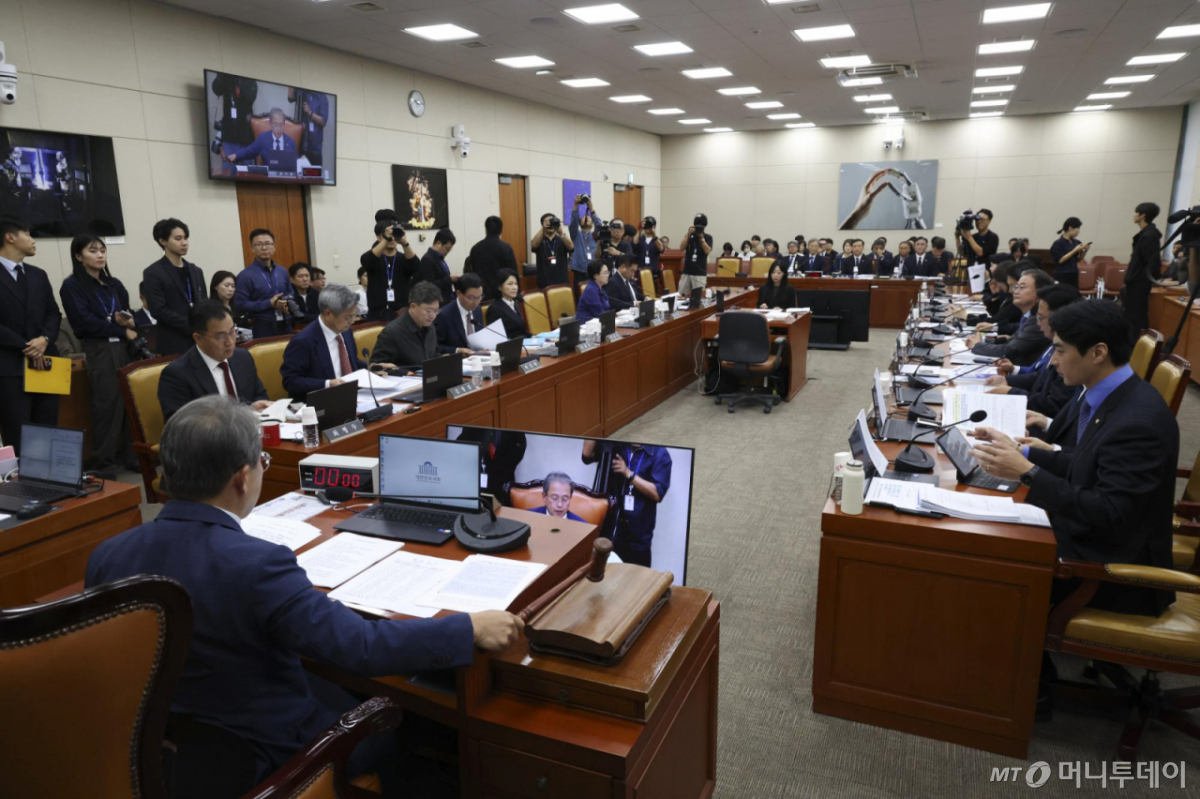
Lee Ju-hee, a Democratic Party of Korea lawmaker, stated regarding the blind spots in AI chatbots that allow conversations with artificial intelligence (AI), "We must introduce an obligation for operators to specifically verify users' ages and establish a system to intervene in dangerous conversations."
Song Ki-heon made this request during the national audit of the Ministry of Science and ICT held at the Seoul Yeouido National Assembly on the 12th, addressing Kim Jong-cheol, head of the Broadcasting and Media Communications Division.
Song said, "The AI chatbot that citizens use for the longest duration is a program called 'Zeta,' with a monthly usage time of as much as 110 million hours." He explained, "Statistics show this is more than double that of ChatGPT, and nearly nine out of ten users are in their teens or twenties."
He continued, "The problem arises when children ask dangerous questions to such AIs," revealing, "According to a survey by the Green Umbrella Foundation, 52 percent—more than half—of adolescents who asked about self-harm, suicide, violence, or sexually explicit content received specific answers from the AI." Song stated, "This type of conversation occurs in a process where a child and an AI are talking alone, in a situation that neither parents nor teachers can control at all," adding, "The issue is not only harmful answers but also excessive immersion."
Song said, "Countermeasures are needed to prevent excessive immersion of adolescents in AI," noting, "Overseas, regulations are being implemented by viewing the design of AI chatbots themselves as a risk." Kim explained overseas responses to AI chatbots, including △a complete ban for minors, △crisis intervention connecting users to counseling institutional investors when danger signals such as suicide or self-harm are detected, and △methods of notifying that the AI is not an expert like a doctor or counselor.
While Song said, "It seems we cannot immediately impose a complete ban on AI itself for adolescents," he added, "The issue of adolescents becoming seriously excessively immersed must definitely be prevented." Kim proposed legislative measures for AI response, including △regulations mandating operators to verify user ages, △provisions for parental consent and intervention, △restrictions on addictive design, and △establishing grounds for responding during dangerous conversations.
In response, Song said, "As the head of the competent institutional investor (for related duties), I am very sorry that legislation is progressing slowly," answering, "We will do our best to ensure that whether it is a revised Information and Communications Network Act or supplements to the AI Basic Act, various opinions are gathered and faithfully implemented."

 in TECH
