

Socar has received an invitation to join the government-led 'K-MaaS' (Korean Integrated Mobility as a Service) project. As the car-sharing market faces stagnation, the initiative is expected to help secure new users. However, concerns have also emerged that it could conflict with Socar's blueprint for building its own 'super app.' Socar is currently reviewing whether to participate.
According to Korea Expressway Corporation on the 21st, Socar and Korea Expressway Corporation held a working-level consultation regarding the expansion of K-MaaS transport operators on the 30th of last month. On that day, Korea Expressway Corporation proposed API (Application Programming Interface) integration to Socar, and Socar responded that it would review security and technical factors.
K-MaaS is a public-private cooperation project designed to support users in searching for, booking, and paying for fragmented transportation modes—such as rail, bus, air, PM (Personal Mobility), and maritime services—through a single app. Similar to existing map apps like Tmap, Naver Map, and KakaoMap, it provides 'navigation' functionality to destinations, but allows users to directly book trains, buses, and flights within the app. Korea Expressway Corporation aggregates APIs and data from various transport operators, while private platform operators run the service apps.
Korea Expressway Corporation proposed Socar's participation not only to secure new operators but also to diversify transportation modes. Currently participating entities include △Korea Railroad Corporation and SR (rail) △Tmoney and Eodeung-ui Jeongureum (intercity bus) △Norangpungnyeon (air) △Zbike and Beam (PM) △Studio Galilei (DRT) △ONDA (accommodation). No car-sharing company is currently involved. If Socar participates, it would be the first case in the industry.
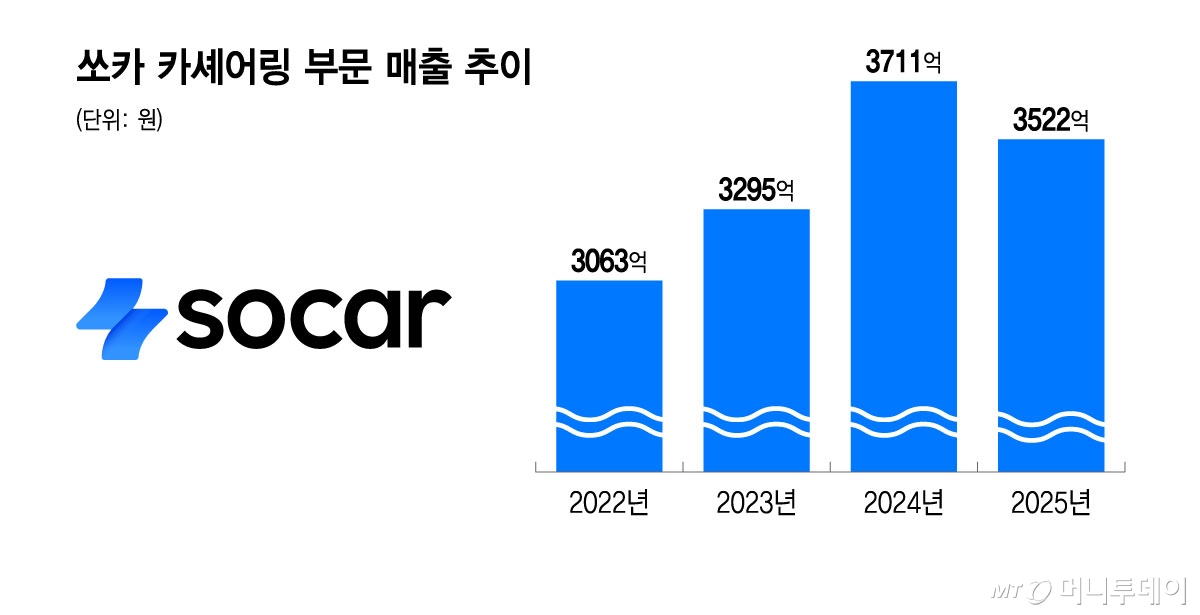
Joining K-MaaS could allow Socar to expand its user touchpoints. Although its market share already exceeds 80%, the company still needs to secure additional demand. According to Socar's business report, revenue from its car-sharing business was 306.3 billion won in 2022, rising to 329.5 billion won in 2023 and 371.1 billion won in 2024, representing year-on-year increases of 7.5% and 12.6%, respectively. However, last year's revenue decreased by 5.1% year-on-year to 352.2 billion won.
The effect of creating new users through linkage with other transportation modes has already been verified. After Socar launched the 'KTX Bundle Booking' feature, which allows simultaneous booking of KTX and car-sharing services via its app, data analysis over a two-year period (January 2023 to December 2024) revealed that one in five users of the KTX Bundle Booking feature was a new user using Socar for the first time.
However, Socar is taking a cautious stance. The company stated that it is difficult to prioritize K-MaaS due to the many projects currently underway internally. Analysis also suggests that joining K-MaaS could conflict with Socar's platform strategy. Socar has set building a 'full-stack mobility platform'—integrating various modes of transportation—as its medium- and long-term goal, targeting the domestic mobility market worth 350 trillion won. To this end, it acquired the shared bicycle platform 'Ecle' and the parking platform 'Modu-ui Juchajang' in 2021, and introduced KTX and flight ticket booking services.
A Socar official said, "We have just begun our review after conducting initial meetings," and refrained from further comment.

 in TECH
