

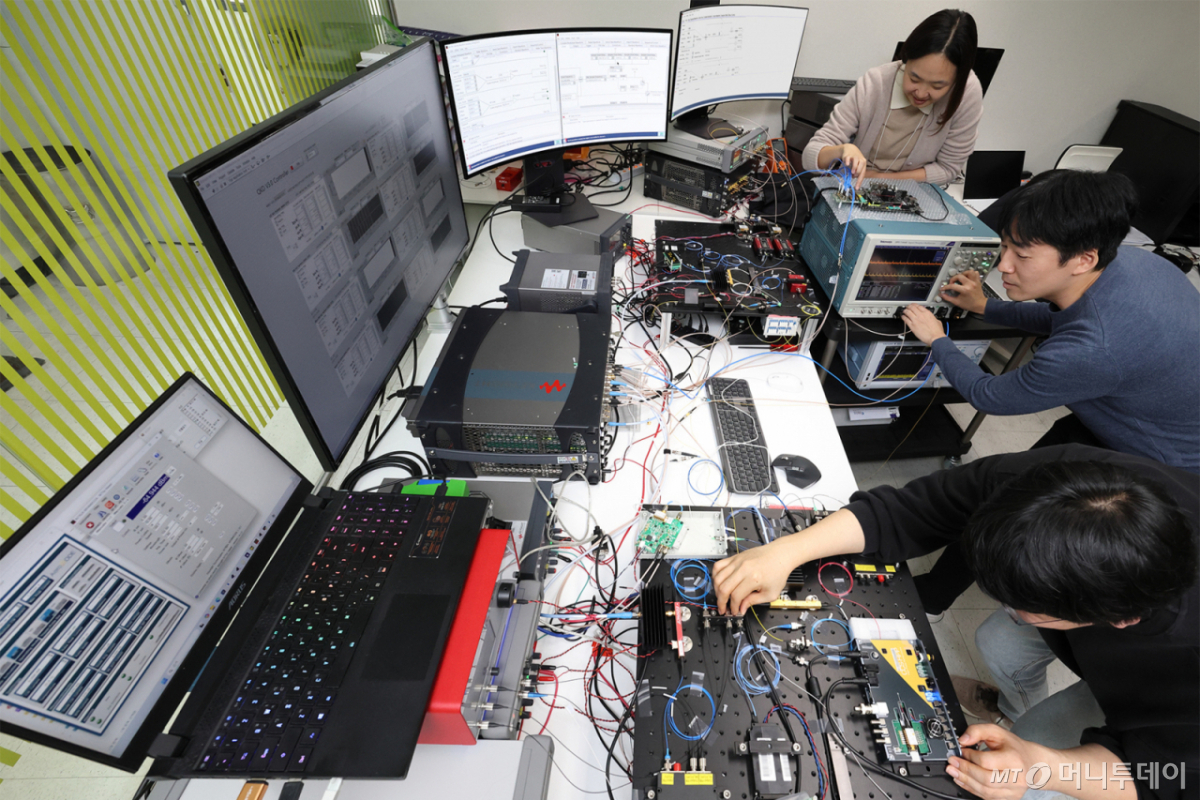
The government will expand the domestic quantum cryptography communication test network to Daegu, Gwangju and Busan, and the Gangwon region by 2028. In addition, it will demonstrate quantum cryptography communication networks overseas in Singapore, Poland, Bulgaria, and other countries.
The Ministry of Science and ICT announced that it will hold a kickoff report meeting for the open quantum testbed advancement and expansion project on the 21st at the Pangyo Corporate Support Hub of the Korea Institute for Advancement of Defense Intelligence Command (NIA).
The open quantum testbed is a demonstration space where the performance of quantum communication-related technologies and products developed by domestic companies and research institutional investors can be verified by building a quantum cryptography communication test network and measurement equipment. Quantum cryptography communication is a security technology that encrypts information using the quantum mechanical property that meaningful information is transmitted only when 'measured.'
The Ministry of Science and ICT and NIA have been building a quantum testbed in sections connecting Seoul, Pangyo, and Daejeon since 2024.
Through this project, the existing demonstration foundation will be expanded into △commercial hubs, △overseas hubs, and △future hubs. The KT-led consortium will handle the commercial and future hubs, while the SK Broadband-led consortium will manage the overseas hub. A total of 7.4 billion won will be invested, including a government grant of 3.75 billion won and a private contribution of 3.65 billion won.
At the commercial hubs, the existing test network will be expanded to Daegu this year, with phased expansion to Gwangju and Busan in 2027, and to the Gangwon region by 2028. Based on this, quantum cryptography communication will be applied to data transmission in the research, medical, and financial sectors. In addition, interoperability between domestic equipment from different manufacturers will be verified.
At the future hubs, a demonstration environment for next-generation quantum communication technologies, such as long-distance wireless quantum cryptography communication and quantum entanglement distribution among multiple sites, will be established.
At the overseas hubs, plans are underway to promote inter-national quantum security demonstrations in conjunction with quantum testbeds in Singapore, Poland, Bulgaria, and other countries. Quantum key distribution (QKD) will be applied to relatively short-distance domestic and local overseas sections, while post-quantum cryptography (PQC) will be used for long-distance international sections. QKD is a method of sharing keys between sender and receiver by loading encryption keys onto photons. PQC is a method of applying encryption algorithms directly within the software itself.
Through this, demonstrations of research data transmission and future air traffic data protection are planned.
Yoon Kyung-sook, Director of Basic and Fundamental Research Policy at the Ministry of Science and ICT, stated, "To accelerate the commercialization of quantum technology, it is important to broaden the demonstration foundation so that companies can verify their technologies and products in various environments," adding, "Through the expansion of domestic testbeds and overseas linkages, we will increase opportunities for corporate demonstrations and strengthen testing, verification, and technical support tailored to on-site demand."

 in TECH
