

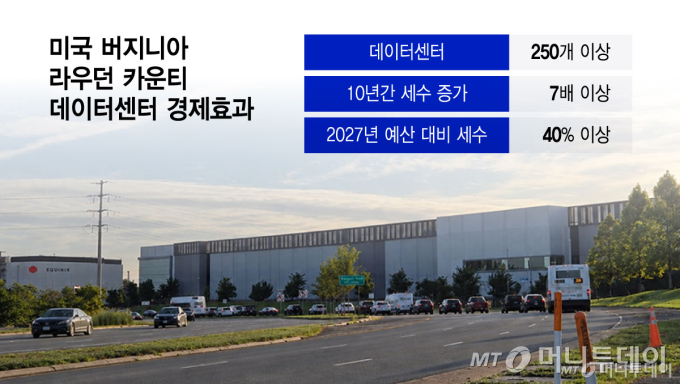
Loudoun County in Virginia, U.S., the world's largest AI (artificial intelligence) DC (data center) cluster, is home to more than 250 DCs. Through this, the taxes collected by Loudoun County reach $1.1 billion (approximately 1.46 trillion won). Considering that Sejong City's expenditure budget for this year is 197.08 billion won, resources sufficient to sustain a population of 400,000 people for one year come from the AI DC industry alone.
AI DC investment not only boosts demand in the semiconductor sector but also in related industries such as power, cooling equipment, and construction. In particular, as heat generation and power consumption of high-performance AI semiconductors increase, the importance of liquid cooling technology and power supply facilities has grown. Companies that secure the technologies and equipment needed for DC construction and operation open up new export markets.
Korea is considered a country well-suited to grow the AI industry, equipped with the HBM (high-bandwidth memory) production capabilities of Samsung Electronics and SK Hynix, manufacturing bases in automobiles, robotics, and shipbuilding, and high-quality power supply infrastructure.
The key lies in stable power supply and a long-term infrastructure investment strategy that considers future technological changes. Scott Wallace, Senior Vice President at global DC company Digital Realty, advised, "Facilities being built now must be able to support chip design 36 to 60 months later," adding, "In particular, it is important to make the local community understand." This means that major challenges remain in building infrastructure that considers future technological changes and linking this to the growth of related industries such as semiconductors, power, and cooling equipment, as well as expanding exports.
[Production Support: Ministry of Culture, Sports and Tourism Public-Centered Communication Activation Project]

 in TECH
