

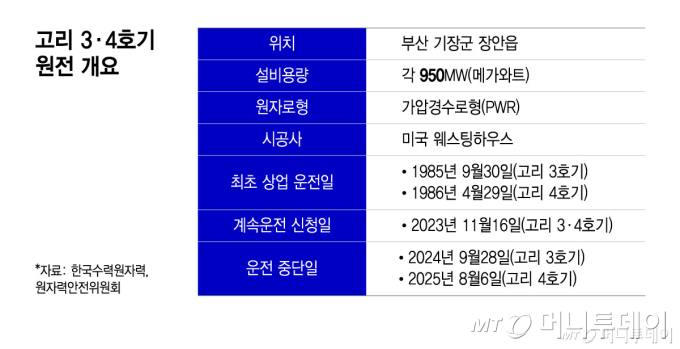
Gori Nuclear Power Plant Units 3 and 4, which had been idle for over a year, are set to resume operations as early as the first half of next year.
The Nuclear Safety and Security Commission (hereinafter referred to as the Nuclear Safety and Security Commission) approved the continued operation permit applications for Gori Units 3 and 4 on the 27th. With this approval, Gori Unit 3 will proceed with resumption procedures two years after halting operations due to the expiration of its design life on September 28, 2024, while Gori Unit 4 will do so one year and two months after it was suspended on August 6, 2025. Consequently, the operational lifespans of Gori Unit 3 and Gori Unit 4 have been extended to September 2034 and August 2035, respectively.
The approval for the resumption of Gori Units 3 and 4 is expected to ease domestic power supply constraints. As pressurized water reactors with an installed capacity of 950 MW (megawatts) each, they will supply a total of 1,900 MW of electricity upon resuming operations. This level comfortably covers the annual electricity consumption of all households in Seoul (approximately 1,700 MW) and is sufficient to operate several dozen artificial intelligence data centers (AIDCs), each with a capacity of 100 MW, simultaneously.
Amid new projections from the International Atomic Energy Agency (IAEA) suggesting that global nuclear power generation capacity could exceed 1,000 GW (gigawatts) by 2050 due to an explosion in energy demand, voices are increasingly calling for expedited continued operation reviews for other nuclear plants that have ceased operations. With the approval of continued operation for Gori Units 2, 3, and 4, a total of seven domestic nuclear plants are now awaiting continued operation reviews. Among these, as the accident management plan for Hanbit Nuclear Power Plant Units 1 and 2 in Yeonggwang County, South Jeolla Province, was approved this month, a decision on their continued operation is expected as early as the first half of next year.
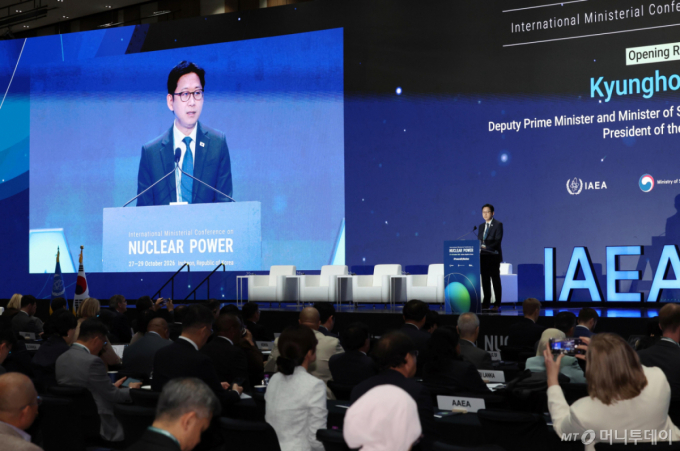
At the IAEA Conference of Nuclear Energy Ministers, which opened in Songdo, Incheon, on the same day, Vice Prime Minister and Minister of Science and ICT Bae Kyung-hoon stated, "We will work together to find answers on what needs to be prepared and how we should cooperate to safely and responsibly realize the potential (of nuclear energy expansion)." He added, "We must prepare for demonstration, licensing, and financing in tandem to ensure that development achievements in small modular reactors (SMRs) and advanced reactors translate into actual energy supply. Furthermore, from the stage of preparing new applications, we must establish safety, regulation, laws, and systems concurrently while building international trust."

 in TECH

