

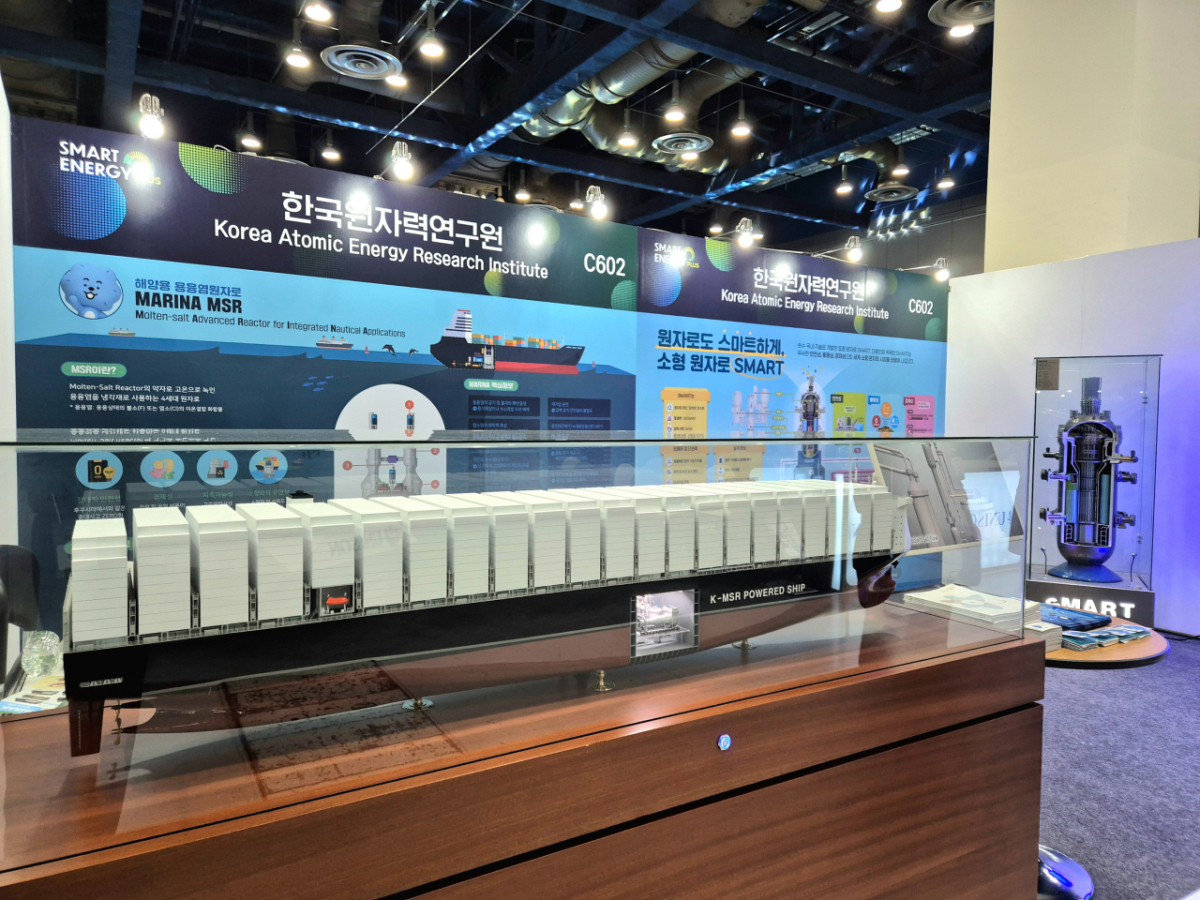
"You mean this is a ship powered by nuclear energy?"
At the 'Smart Energy Plus (SMART ENERGY PLUS·SEP) 2026' held on the 28th in Hall B of COEX in Seoul Samsung-dong, visitors focused their attention on the next-generation ship based on MSR (Molten Salt Reactor) technology unveiled by the Korea Atomic Energy Research Institute.
MSR is one type of SMR (Small Modular Reactor). It uses nuclear fuel material dissolved in molten salt mixed with fluorine, chlorine, and other elements as its fuel. As carbon emission restrictions for ships tighten, drawing attention from the shipbuilding industry to SMR vessels, development of MSR technology is also accelerating.
Unlike fossil fuels, SMR ships do not emit carbon dioxide during operation. Additionally, because complex propulsion systems are housed within a single reactor, they offer high spatial efficiency. This means significant savings in space that would otherwise be occupied by fuel tanks on conventional ships. Among various SMR designs, MSR is particularly gaining attention due to its high safety profile, low carbon emissions, and excellent energy efficiency.
Korea plans to begin construction of the first 'nuclear ship' based on MSR technology by 2035, led by the Korea Atomic Energy Research Institute. This is one of the 12th missions under the cross-ministerial R&D (Research and Development) project 'K-Moonshot Project' (hereinafter K-Moonshot).
The Korea Atomic Energy Research Institute has independently developed MSR nuclear fuel manufacturing technology over a long period. While developing 'pyroprocessing' technology for recycling spent nuclear fuel, the institute accumulated expertise in high-temperature molten salt technology used in the process, securing core foundational technologies including MSR nuclear fuel manufacturing and purification, as well as chemical and physical property evaluation of molten salts.
Research outcomes are leading to the development of MSR ships. The conceptual design for an 'MSR-equipped vehicle carrier' developed by the Korea Atomic Energy Research Institute together with HD Hyundai Heavy Industries, HDHD Hyundai Heavy Industries, Hyundai Glovis, and J-Marin Service obtained Approval in Principle (AiP) from Lloyd's Register (LR) last June. AiP is a symbolic procedure in which a classification society certifies that a new ship design method or technology complies with international regulations and safety standards. Obtaining AiP signifies that the first step toward applying MSR to actual ships has been cleared.
An official from the Korea Atomic Energy Research Institute stated, "If the SMR 'SMART,' which received the world's first standard design approval by the institute in 2012, is responsible for land-based applications, MSR will lead the way at sea," adding, "We will support efforts to ensure Korean nuclear technology secures competitiveness and enters the global market."

 in TECH
