

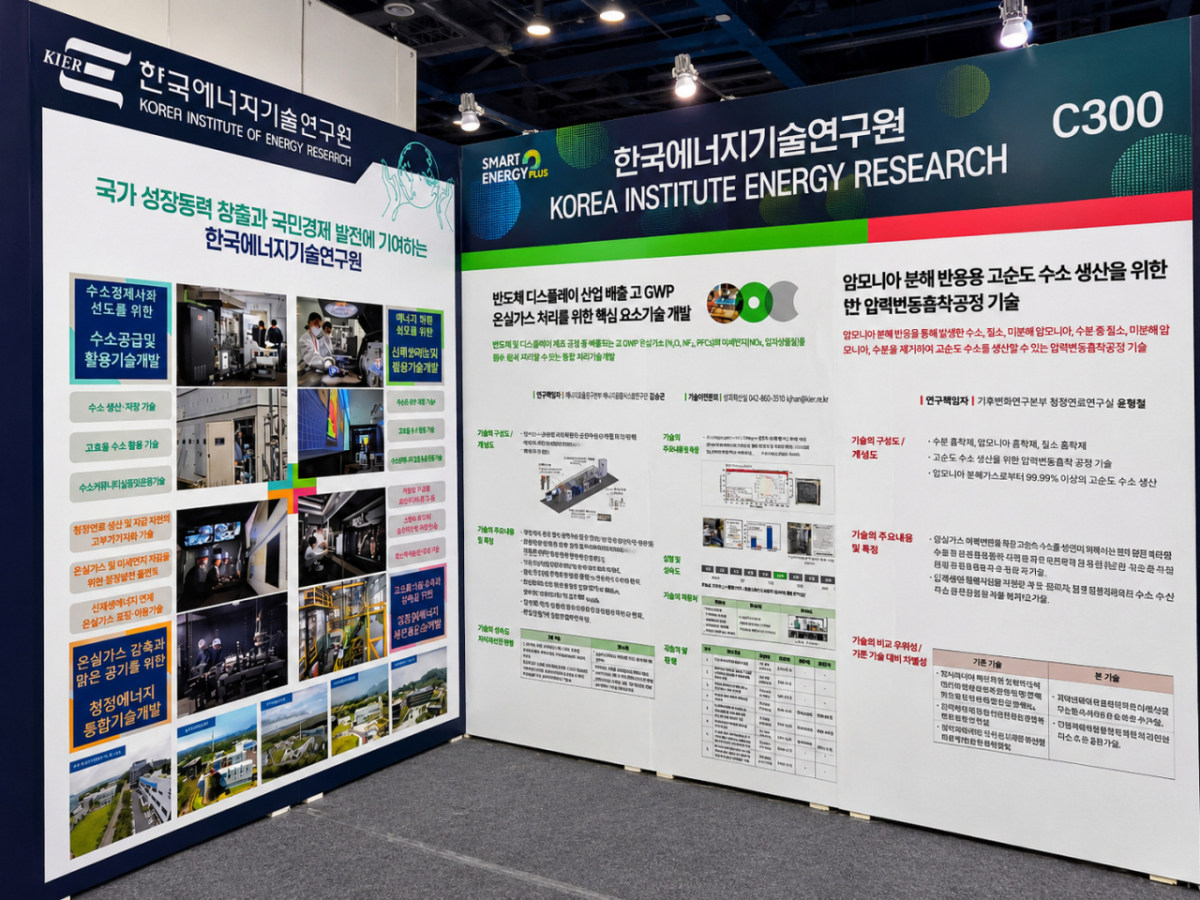
Technologies that treat over 99% of greenhouse gases emitted from semiconductor factories and produce hydrogen with a purity of 99.99% or higher from ammonia were gathered in one place. These are technologies developed by domestic researchers to reduce carbon emissions in industrial settings while improving hydrogen production efficiency and equipment safety.
At 'Smart Energy Plus (SMART ENERGY PLUS·SEP) 2026,' held on the 28th in Hall B of COEX, Samsung-dong, Seoul, carbon-neutral-related technologies developed by the Korea Institute of Energy Research (KIER) were introduced. The exhibition featured various research outcomes, ranging from semiconductor greenhouse gas treatment to hydrogen production and industrial electrostatic precipitators.
Drawing attention was the technology for treating greenhouse gases generated in semiconductor and display manufacturing processes. During semiconductor production, gases that affect global warming, such as nitrous oxide (N₂O), nitrogen trifluoride (NF₃), and perfluorocarbons (PFCs), are emitted. Some of these gases have a much greater warming impact than carbon dioxide, making emission reduction crucial.
The Korea Institute of Energy Research developed an integrated technology that simultaneously treats these greenhouse gases, nitrogen oxides (NOx), and particulate matter. According to experimental results presented by the research team, the technology achieved treatment performance of over 99% for N₂O and CF₄, a semiconductor process gas. The goal is to increase equipment efficiency and reduce treatment costs by handling multiple pollutants in a single system.
Hydrogen production technology was also introduced. It is a 'Pressure Swing Adsorption Process' technology that decomposes ammonia to produce high-purity hydrogen. This method separates hydrogen, nitrogen, unreacted ammonia, and moisture generated during the ammonia decomposition process to obtain hydrogen with a purity of 99.99% or higher.
Previously, separate purification devices were required for tasks such as ammonia removal and nitrogen removal. The Korea Institute of Energy Research focused on reducing equipment configuration and operating costs by designing a single adsorption process that simultaneously removes multiple impurities. The research team is currently conducting system performance evaluations and reliability tests for high-purity hydrogen production at a scale of 100 N㎥ per hour.
Technology to reduce fire risks in industrial settings was also exhibited. 'Low-energy wet electrostatic precipitation technology' captures oil particles and moisture contained in exhaust gases using electrical force.
Conventional electrostatic precipitators can pose a fire risk if flammable materials accumulate. The Korea Institute of Energy Research utilized the electrical wetting phenomenon to supply liquid to the collection section, designing the system to reduce fire risks while also lowering energy consumption.
Test results presented by the research team recorded collection efficiencies in the 90th% to 99% range, depending on particle size and operating conditions. In particular, the technology is drawing attention for its potential industrial application due to its ability to simultaneously reduce the fire risks and maintenance burdens of existing precipitators.

 in TECH
