

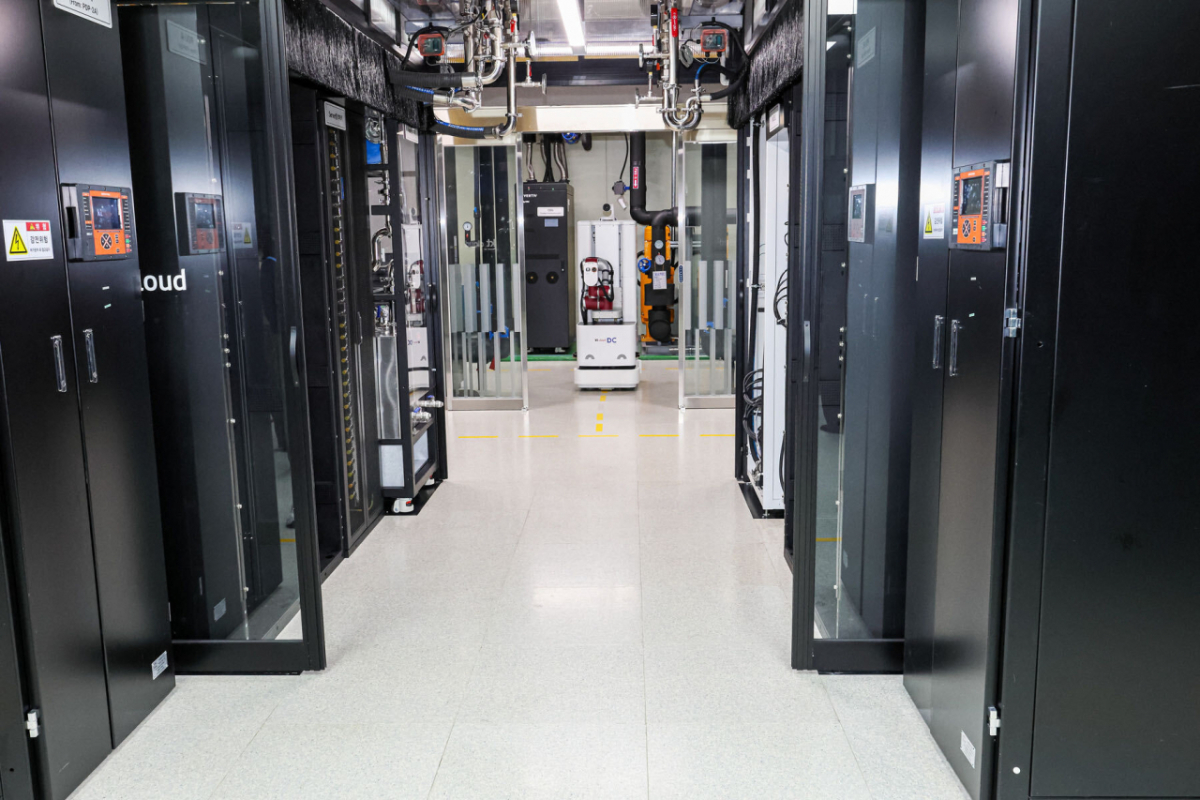
"It is easy to make equipment that simply generates heat or cools things down. Our load generator reproduces the characteristics of high-performance GPU (graphics processing unit) servers and cooling water, including ·flow rate·pressure·temperature, exactly as they would operate in actual conditions."
The price of NVIDIA's next-generation AI (artificial intelligence) chip 'Vera Rubin,' allocated in the government's 2027 budget, is 27.5 billion won per rack. Considering that the average apartment price in Seoul last month was slightly over 1.6 billion won, this amount is equivalent to the value of 17 apartments. Future data centers will have to operate such expensive equipment, so they must provide an appropriate environment for cooling and power supply.
At a press conference held on the 30th of last month at KT Cloud's Mokdong Data Center in Yangcheon-gu, Seoul, a KT Cloud official explained the solution using their own verification facility. The official introduced the advantages, stating, "Thanks to our in-house developed equipment called a 'load generator,' which can generate load on servers, we can verify whether servers like the B200, worth the price of one Seoul apartment, or Vera Rubin, worth the price of one building complex, are properly built before installation."
KT Cloud has established a verification space called the 'AI Innovation Center' within its Mokdong Data Center, where it can experiment with high-performance GPUs, liquid cooling, and AI networks. Using the load generator, KT Cloud created an environment with power and thermal loads of approximately 140 kW (kilowatts) per rack in this space. KT Cloud can confirm whether the power and cooling equipment operate at the desired level without actually installing servers.
KT Cloud introduced three advantages of its data centers: stability, economic efficiency, and scalability. It also has a 'Path Finder' that monitors the status of power equipment in real time and searches for the optimal recovery path when a failure occurs.
A dual safety net has been established where, if there is a problem with the power supplied from Yangcheon Substation, it is received from Mokdong Substation, and if both are cut off, its own generator is operated. A KT official stated, "The 12 diesel generators of 3,900 kW each in the generator room can produce a total capacity of 46,000 kW," adding, "In the event of a power outage, emergency generators automatically start within 30 seconds and supply power within one minute."
Economic efficiency is achieved through efficient heat management. KT Cloud is verifying 'D2C' (Direct-to Chip) liquid cooling technology for high-density data centers that are difficult to handle with conventional air cooling methods. This method involves directly contacting a cold plate on the surface of chips where heat generation is concentrated, such as GPUs, and flowing cooling water through it to remove heat. A KT official said, "Although the chip and cooling water do not come into direct contact, using a cold plate with high thermal conductivity can reduce cooling power consumption by 20% to 30%."
The most noticeable feature inside the data center was the 'air tunnel,' an empty space running from the fourth floor to the rooftop. It serves as a buffer zone to introduce outside cold air into the server room. Outside air entering through grille-shaped windows on the walls is connected to constant temperature and humidity controllers and used to cool the servers. A KT official explained, "Thanks to the air tunnel, we have improved energy efficiency by 30% and lowered the PUE (Power Usage Effectiveness) to 1.4," adding, "It operates from mid-November to mid-March, and when the temperature is above 15 degrees Celsius, outside air intake is blocked and it automatically switches to internal operation mode."
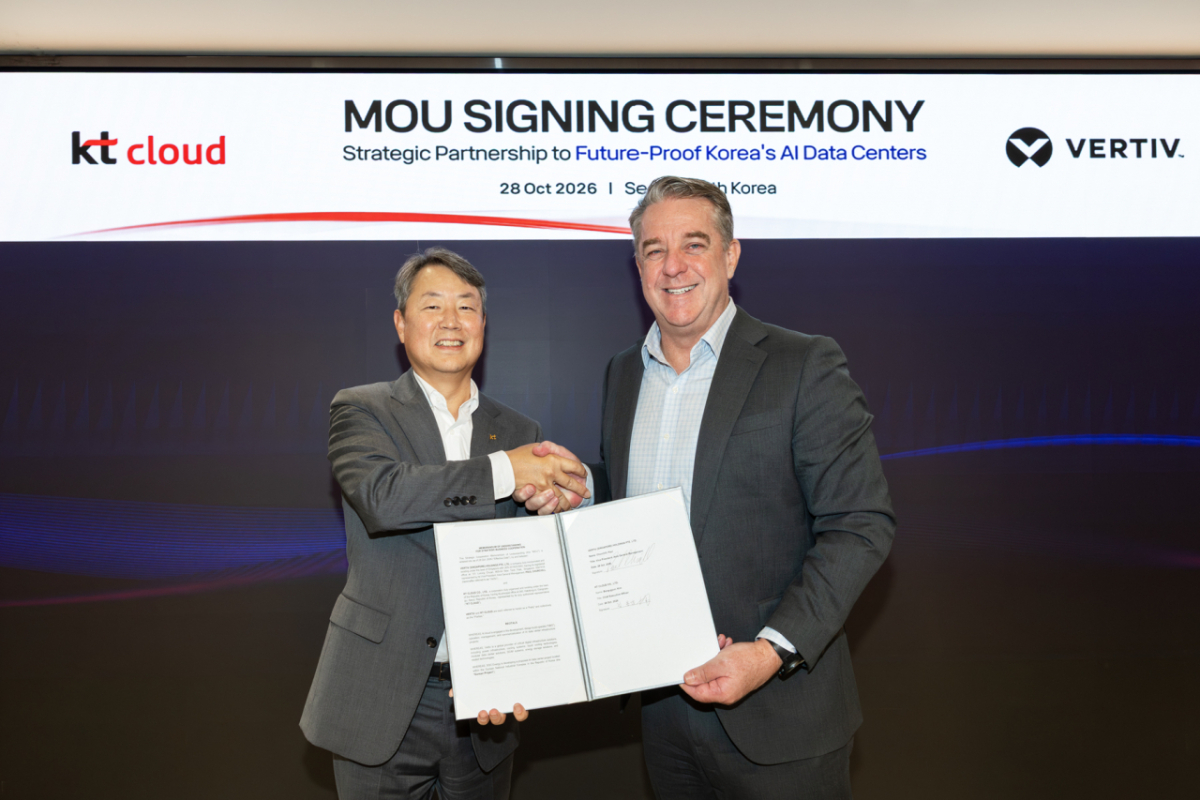
It also collaborates with specialized companies such as LS Electric and Vertiv. Going beyond simple equipment supply, it cooperates with experts in each field from the design stage. With LS Electric, it jointly researches the power infrastructure required for modular data centers and builds a collaborative system to stably supply major power equipment according to the data center construction schedule. With Vertiv, it is promoting design optimization that considers power, liquid cooling, and modular infrastructure together, and plans to apply modular infrastructure solutions to Gunsan AIDC as well.

 in TECH

