

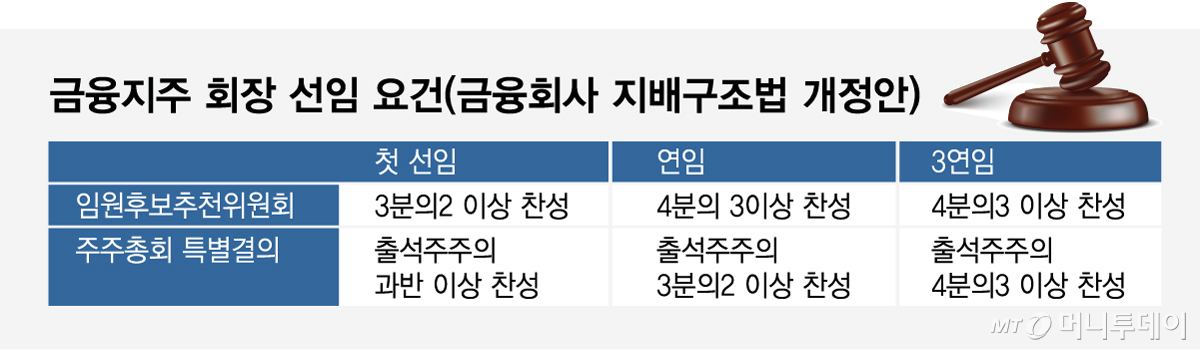
To become the chairman of a financial holding company, an individual must secure a certain level of approval from both the Nomination Committee and a special resolution at the shareholders' meeting, starting with their initial appointment. In particular, for second and third consecutive terms, the candidate must obtain at least three-quarters approval from the Nomination Committee. If just two out of seven outside directors oppose, reappointment is blocked.
However, the original proposal to outright ban a third consecutive term by law or require unanimous consent from the Nomination Committee was scrapped amid constitutional controversy.
According to political circles on the 2nd, the Financial Services Commission explained the "Plan for Advancing Financial Company Governance" at a policy council composed of Democratic Party of Korea lawmakers on the National Assembly's Political Affairs Committee. The plan centers on strengthening the requirements for Nomination Committee and special shareholder meeting resolutions based on the number of reappointments when selecting a financial holding company CEO (Chief Executive Officer).
For an initial appointment, the candidate must secure at least two-thirds approval from the members of the Nomination Committee. Subsequently, at the shareholders' meeting, they must obtain approval representing a majority of the voting rights of attending shareholders and at least one-quarter of all issued shares.
For a second term, at least three-quarters approval from the Nomination Committee and at least two-thirds approval from the voting rights of attending shareholders (representing at least one-third of all issued shares) at the shareholders' meeting are required. For a third consecutive term, the Nomination Committee requirement remains the same as for a second term, requiring at least three-quarters approval. Additionally, a separate special resolution at the shareholders' meeting must secure three-quarters approval (representing more than half of all issued shares).
This represents a significant strengthening compared to current voting requirements. Currently, reappointment and a third consecutive term are possible if the candidate secures approval from a majority of the board of directors and passes an ordinary resolution at the shareholders' meeting with a majority vote.
The threshold has been raised by requiring at least two-thirds approval from the Nomination Committee starting with the initial appointment. In particular, analysis suggests that requiring three-quarters consent from Nomination Committee members for reappointment will act as a high hurdle. For example, if the Nomination Committee is composed of seven outside directors, at least six votes in favor are needed to pass a reappointment proposal. If two members oppose, the reappointment fails. This applies equally to a third consecutive term.
Among financial holding companies, KB Financial Group, Woori Financial Group, and BNK Financial Group have Nomination Committees composed of seven members (all outside directors). Shinhan Financial Group and Hana Financial Group have five and nine members, respectively. With the exception of Hana Financial Group, all are structured such that reappointment is impossible if two or more members oppose.
In the case of special shareholder meeting resolutions, the threshold for a third consecutive term becomes even stricter. Most past financial holding company chairmen secured over 80% approval to achieve reappointment or a third consecutive term. To obtain three-quarters approval, at least 75% shareholder consent is required.
As the authority of the Nomination Committee is being strengthened, financial regulators have decided to include the committee chairman in the accountability structure for internal control responsibility. This means that if governance issues arise, the Nomination Committee chairman may also be subject to sanctions. Additionally, the Nomination Committee chairman must directly explain the reasons for recommending the chairman candidate at the shareholders' meeting. The minutes must record who recommended the candidate and why, and this information must be disclosed transparently.
The Democratic Party of Korea and the Financial Services Commission are expected to finalize the revised Financial Company Governance Act after additional party-government consultation procedures. Even before the law is amended, there is a possibility that financial regulators may announce the governance advancement plan as early as within this month.
Accordingly, the new chairman selection procedure may be applied starting with iM Financial Group, where the current chairman selection process is underway. iM Financial Group narrowed down its pool of next chairman candidates to six (long list) at the end of last month and plans to further narrow the candidates by the end of this month. The term of current Chairman Hwang Byung-woo expires at the end of March next year, amid speculation about his potential reappointment.
However, the draft proposal to outright ban a third consecutive term for financial holding company chairmen or require unanimous consent from the Nomination Committee has been effectively scrapped. Since President Lee Jae-myung directly criticized long-serving financial holding company chairmen as a "corrupt inner circle" in December last year, financial regulators have been seeking ways to prevent long-term reappointments of holding company chairmen. During this process, options such as legally blocking a third consecutive term or requiring unanimous Nomination Committee consent were discussed, but the ruling party also raised concerns about potential unconstitutionality, leading to a step back.

 in FINANCE
