

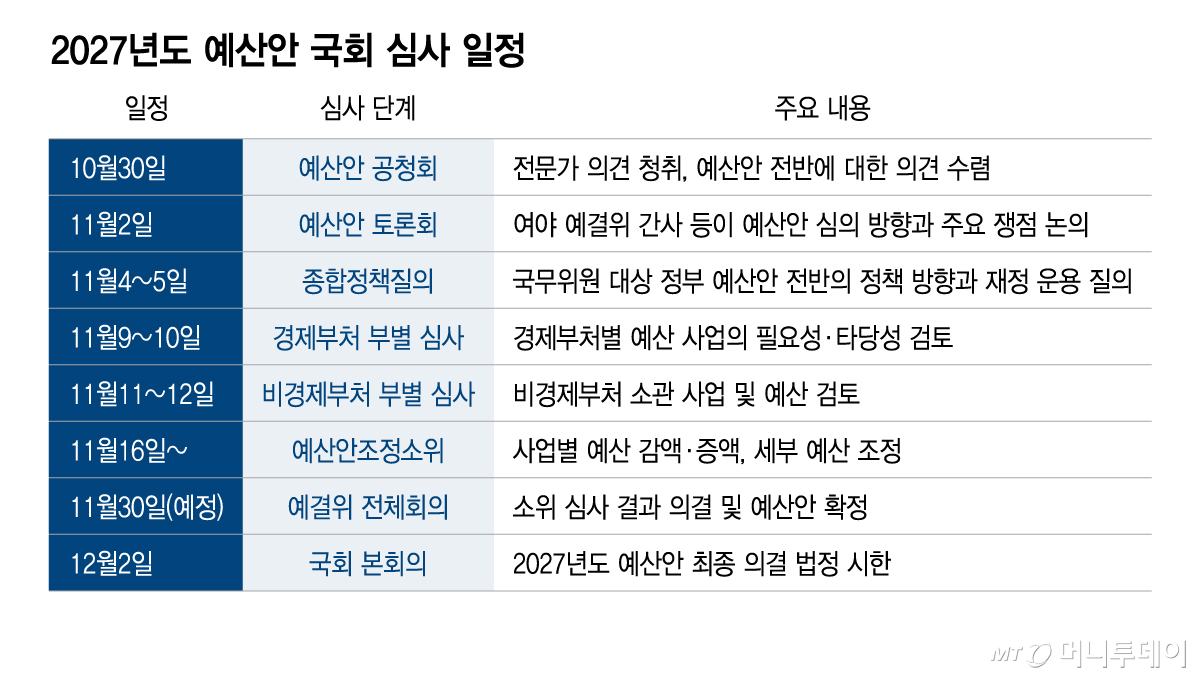
As the National Assembly's Special Committee on Budget and Accounts has fully launched its review of the 2027 budget bill, attention is growing over whether key artificial intelligence (AI) project budgets will clear the National Assembly hurdle. Both ruling and opposition parties agree on the need to cultivate the AI industry and make national-level investments, but they are showing differences in opinion on specific projects.
Regarding next year's budget bill, the National Assembly conducted comprehensive policy questions on the 4th and 5th of this month, and will proceed with ministry-by-ministry reviews of economic and non-economic ministries from the 9th to the 12th. Starting on the 16th, it will convene the Budget Adjustment Subcommittee to review detailed budgets. The statutory deadline for processing next year's budget bill is December 2.
With the People Power Party having set a policy to cut at least 3 trillion won from the overall government budget, attention is focused on the Future Response Fund, which includes AI budgets and others. The People Power Party has called the Future Response Fund "pocket money" for the upcoming general and presidential elections, foreshadowing an all-out offensive.
Among the AI project-related budgets within the Future Response Fund, there is a point of contention over the 4.7 trillion won budget for the 'Frontier AI Development Project.' In particular, opinions are divided on the 800 billion won-scale AI data support budget among them.
Discussions on the Frontier AI Development Project were fully launched after the 'Mythos Shock' in June. It was an incident that shocked the world when Anthropic's frontier-level AI, 'Mythos,' demonstrated outstanding performance in hacking by discovering vulnerabilities unknown for over 20 years and launching automated attacks. As global big tech companies successively released frontier-level AIs leveraging massive capital and computing infrastructure, the government determined that it would be difficult to close the gap with individual corporate investment and technology alone. Accordingly, the project was launched with the aim of securing top-tier global performance for an independent AI model through large-scale concentrated investment by both the government and companies.
The budget for the Frontier AI Development Project includes 3.85 trillion won for the purchase of 10,000 units of Vera Rubin, the latest GPU that the government plans to procure from NVIDIA next year, an 800 billion won AI data support budget (including 50 billion won for security-specialized data), and 25 billion won for talent development costs.
The data budget is designed in a structure where the government contributes 750 billion won to the Korea Development Bank, which then invests in domestic AI companies. In this regard, the opposition party points out that the use of funds is unclear because the budgets for the 'Independent AI Foundation Model' (Dokpamo) and Frontier AI development are being pursued separately, yet combined within the data budget.
Additionally, issues regarding the project's method include whether to establish a special purpose vehicle (SPV), and the relationship between independent AI model development and the Frontier AI project. It is noted that funds transferred from existing projects and newly increased amounts are not distinguished, and criteria for selecting investment target companies, the equity stake the government will secure, and conditions for recovering investment funds are also not included. They also demanded clear explanations on how performance measurement methods change as the support form shifts from initial contributions to capital injections.
Experts advise that since the core of the AI budget review lies in gaining consensus on the necessity of investment, specific budget plans must be disclosed and the necessity conveyed persuasively.
Professor Yoo Byung-jun of the Department of Business Administration at Seoul National University stated, "Data is also infrastructure for the AI era, so it has the characteristic that it must be secured in advance, like building a dam." He added, "We must persuade well on the necessity and reach an agreement on future infrastructure-type budgets, and should also consider budgets prepared for market failures rather than popularity-seeking budgets."
[Production Support: Ministry of Culture, Sports and Tourism Public-Centered Communication Activation Project]

 in TECH
