

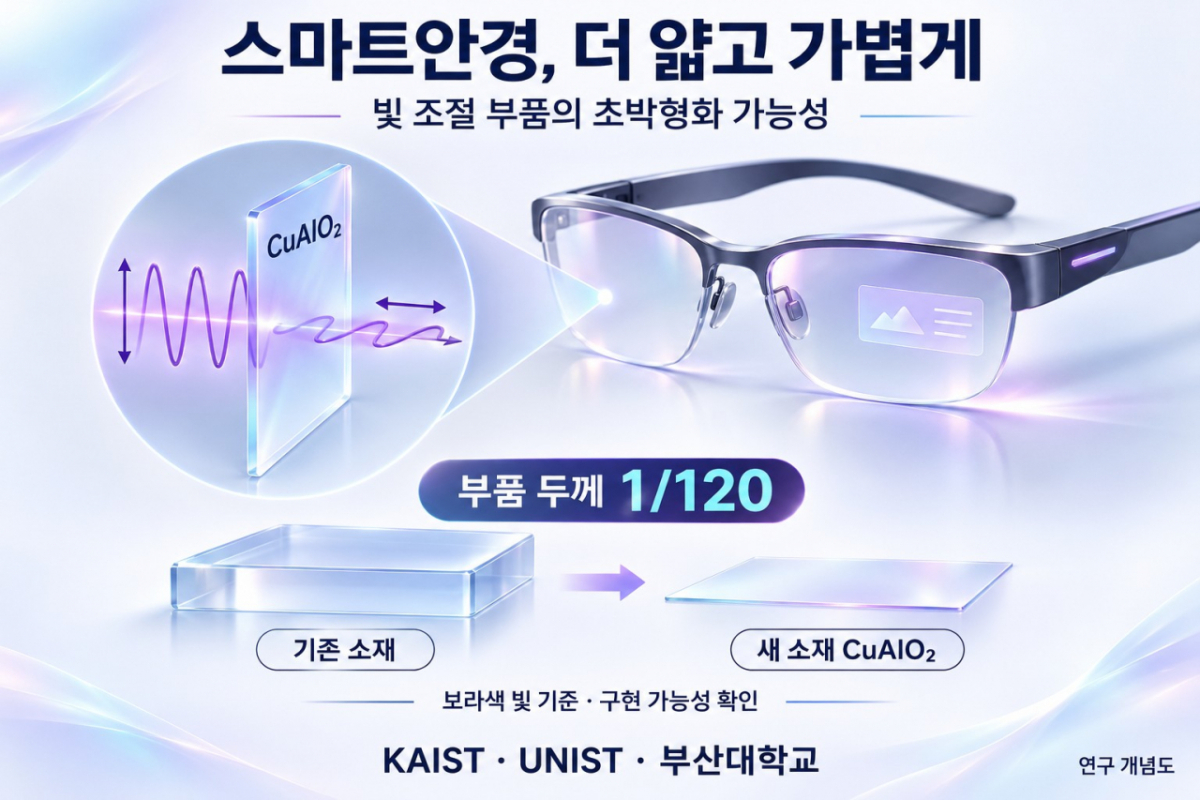
Domestic researchers have discovered a new material capable of reducing the thickness of existing polarizing materials used in lenses for smart glasses and other devices to one-120th.
The Korea Advanced Institute of Science and Technology (KAIST) announced on the 24th that a research team led by Professor Son Chang-hee from the Department of Physics, in collaboration with researchers from the Ulsan National Institute of Science and Technology (UNIST) and Pusan National University, discovered and elucidated the cause of characteristics in the oxide semiconductor "copper aluminum oxide" (CuAlO₂) that allow it to transmit light well while strongly controlling "polarization," which is the direction of light vibration. The research results were published on the 13th of last month in the international academic journal "Nature Communications."
The copper aluminum oxide analyzed by the research team transmits visible light well but exhibits a birefringence (the property where the refractive index varies depending on the direction of light vibration) approximately 120 times greater than that of quartz, an existing material, in violet light. It was analyzed that this can be utilized to realize the function of existing materials with a thickness of approximately 173 nanometers.
The research team also stated that they confirmed why this material reacts significantly differently depending on the direction of light vibration, as well as its characteristic of propagating light in a different manner than general materials in the ultraviolet region.
KAIST explained, "The significance of this achievement lies in finding a material that combines good light transmission with high birefringence, laying the foundation for designing optical devices thinner than the wavelength of light." It added, "In the future, if high-quality thin film fabrication technology is secured, it will contribute to reducing the thickness and weight of augmented reality (AR) devices, as well as miniaturizing optical communication equipment and precision optical instruments."
Professor Son Chang-hee said, "We have confirmed the possibility of creating components that transmit light well while controlling the direction of light vibration at a thickness approximately one-120th of existing ones." He added, "This can contribute to making smart glasses and optical communication equipment smaller and lighter." He further noted, "We are conducting research to make the material thin and uniform so it can be utilized in actual components, as well as to reduce light loss."
In this study, Dr. Kang Baek-jun from KAIST and Researcher Shin Jun-hee from UNIST served as co-first authors, while Professor Son Chang-hee (KAIST), Professor Jin Ho-seop (UNIST), and Professor Ok Jong-mok (Pusan National University) participated as co-corresponding authors.

 in TECH
