

As global demand for artificial intelligence (AI) surges, exacerbating a shortage in the supply of data centers (DCs), which serve as foundational infrastructure, analysts have predicted that growth opportunities will emerge in Korea.
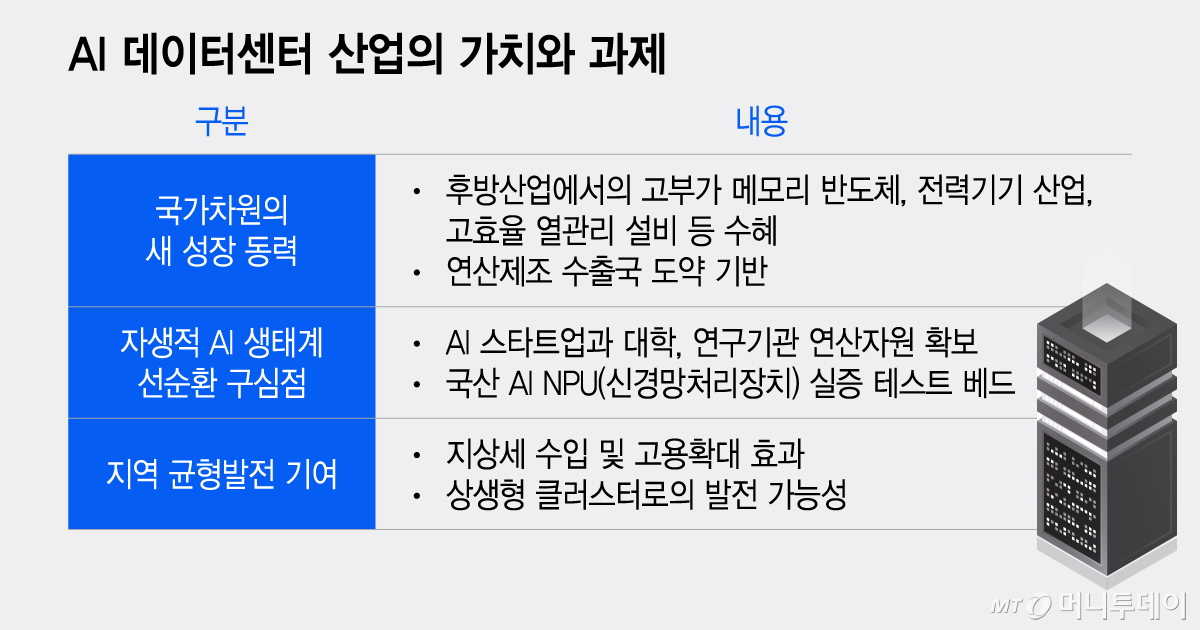
This means that work will be generated not only in high-value-added memory semiconductors but also across upstream and downstream industries such as power equipment, cooling systems, and plants, and that a self-sustaining AI ecosystem can be formed centered on AI DCs. In particular, regions where AI DCs are established are expected to benefit from regional balanced development effects, including increased tax revenue and job creation.
On the 25th, Song Young-woong, a researcher at SK Telecom's AI Policy Research Institute, explained that AI data centers are creating new opportunities, detailing the recent surge in AI computing demand, infrastructure supply shortages, and the growth potential of domestic industries.
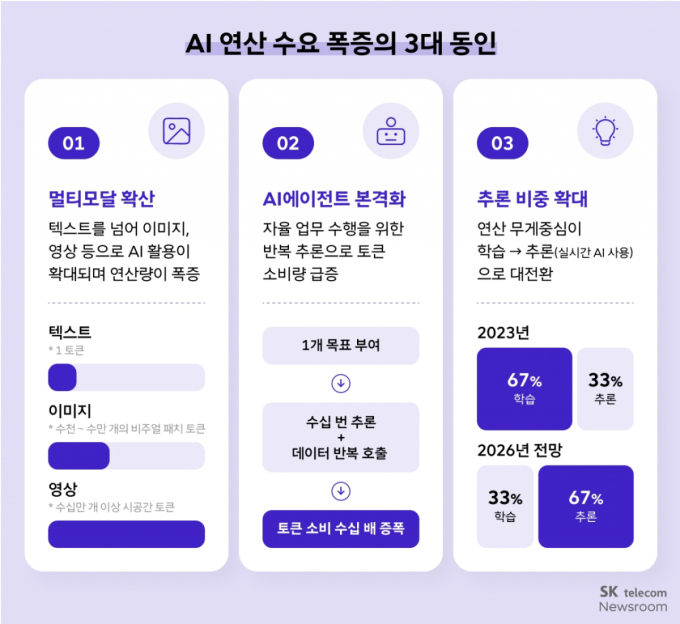
Citing the "Tokens Per Day" index, which indicates global AI usage, Song stated, "As of November this year, global token consumption is estimated to have exceeded 450 trillion tokens per day on average." He cited as causes for the surge in token demand: content production needs extending beyond text to video, images, and music; the full-scale deployment of AI agents; and a shift in the center of gravity of computing from training to inference.
Song stated, "This surge in AI demand will require massive expansion of physical infrastructure, specifically AI DCs, in the medium to long term." McKinsey projected that global data center capacity demand will reach between 219 GW and a maximum of 298 GW by 2030.
The problem is that the supply shortage of AI DCs is difficult to resolve in the short term. Song explained, "Setting aside GPU availability or funding procurement, significant time is required for transmission grid and power intake, construction of large-scale cooling and communication facilities, and environmental and local government permits." He added, "Supply available in the short term is insufficient compared to the surging demand."
As the AI DC supply shortage deepens, global tech giants have no choice but to expand beyond the United States, leading to the conclusion that this presents an opportunity for Korea. Song emphasized, "Korea possesses robust capabilities and know-how necessary for building AI DCs, including memory semiconductors, DC construction, ultra-high-voltage power equipment, and high-speed communication networks." He stressed, "Expanding AI DCs is directly linked to the future competitiveness of the entire nation, going beyond the new business performance of individual companies."
Regarding the national-level value of the AI DC business, Song stated, "AI DCs can be utilized as a new growth engine." He noted, "In upstream industries, not only high-value-added memory semiconductors but also power equipment industries such as ultra-high-voltage transformers, switchgear, and energy storage systems (ESS) have emerged as key beneficiary sectors." He also emphasized the potential benefits for industries involved in cooling and plant construction.
Song added, "AI DCs serve as a focal point for the virtuous cycle of a self-sustaining AI ecosystem that connects semiconductor hardware, foundation models, and industry-specific AI services into a single value chain." He further noted, "Regional balanced development can be expected through effects such as increased local tax revenue for local governments and expanded employment."
The government also views AI DCs as an opportunity to enhance regional industrial competitiveness. According to the plan of a senior government official, regions where AI DCs are built will receive exceptional benefits, such as supporting branch offices of technology companies that assist in AI transformation and lowering computing infrastructure prices, with the aim of creating jobs for young people and supporting the AI transformation (AX) of all industries within the region.

 in TECH

