

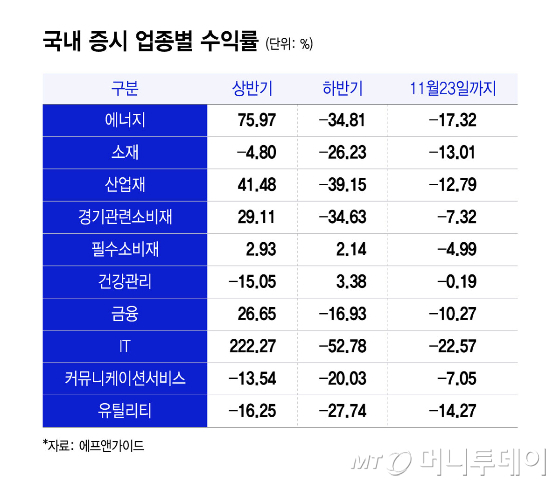
As the downturn in South Korea's stock market drags on, all sectors have posted negative returns so far this month. Even consumer staples and health care, which had previously performed relatively well, have turned weaker, suggesting that defensive stocks are also losing their resilience.
According to financial information provider FnGuide on Wednesday, not a single sector among the 10th domestic stock market sectors recorded a positive return from the start of this month through the 23rd.
The IT (information technology) sector, which includes semiconductor stocks, fell by 22.57%, posting the worst performance, while energy (-17.32%), utilities (-14.27%), materials (-13.01%), and capital goods (-12.79%) also showed double-digit declines.
What stands out most is that even essential consumer goods and healthcare sectors, which had shown some defensive strength during the sharp market drop in the second half of the year, have recorded negative returns. Since the start of this month, the essential consumer goods sector has fallen by 4.99%, and the healthcare sector by 0.19%.
These two sectors are the only ones that have maintained positive returns even as the domestic stock market has been significantly volatile in the second half of the year. During the period from July through the 23rd, when the KOSPI index plunged by approximately 44%, only essential consumer goods and healthcare sectors rose by 4.90% and 2.22%, respectively.
Even in October, when KOSPI volatility remained high, only the essential consumer goods and healthcare sectors rose by 4.45% and 3.16%, respectively. These two sectors are considered representative defensive sectors. This is because demand for items such as food products, household goods, and pharmaceuticals remains at a certain level regardless of economic conditions. They have been noted as relatively stable investment alternatives whenever stock market uncertainty increases.
However, as the bear market has persisted since the second half of the year, these sectors also appear unable to escape the overall weak trend in the stock market. In July, despite the sharp drop in KOSPI, four sectors—essential consumer goods and healthcare, as well as financials and communication services—recorded positive returns. Last month, the number of rising sectors decreased to two, and since the start of this month, there have been none at all.
Utilities, which had been considered a defensive sector along with essential consumer goods, have posted negative monthly returns for five consecutive months from the second half of the year through this month. The cumulative decline rate is 27.74%.
Analysts say that the biggest burden on the domestic stock market is the failure to emerge new leading stocks to offset the sluggishness of existing leading sectors. The IT sector, which rose by 222.27% in the first half of the year and led the strength in the domestic stock market, has fallen by 52.78% in the second half, posting the lowest performance among all sectors.
Capital goods, energy, and consumer discretionary sectors, which recorded double-digit gains in the first half of the year, have all fallen by more than 30% since the start of the second half.
The securities industry views that investors' options have further narrowed as even defensive stocks, which had performed relatively well, have turned to a downward trend. With the method of reducing losses by utilizing return differences between sectors disappearing, it has become a market environment where it is difficult to generate returns merely by switching investment sectors.
A securities firm official said, "Even if existing leading stocks are sluggish, buying pressure shifting to other sectors can support the market downside, but recently, as defensive stocks also show weakness, investment alternatives are decreasing," adding, "If a new leading sector does not emerge, investors' tendency to hold cash will strengthen, potentially worsening supply and demand conditions in the stock market."

 in STOCK
